| Audience | Marketers configuring tiles in a journey |
| Prerequisites | A journey in draft or edit mode (see Create a journey) |
Journey tiles control what happens after a member enters: when they wait, which path they follow, what gets sent, and which values or offers are assigned.
Overview
Add tiles to the journey canvas in the order members should encounter them:
- Control timing with Time delay and Hold until.
- Create branches with Segment and A/B Split.
- Send messages or data with Send email, Send SMS, Send push, and Send to destination.
- Assign values or offers with Set variable and Assign coupon.
For entry, exit criteria, scheduling, and activation, see Create a journey.
Control timing
Time delay
The Time delay tile holds each member until its delay condition is met. Choose one of four modes:
- Duration — Wait for a fixed period, such as two hours or three days.
- Specific date — Wait until a calendar date and time.
- Date from a profile property — Wait until a date stored on the member's profile, with an optional offset, such as two days before
subscription_renewal_date. - Next matching time — Wait until the next occurrence of a recurring time, such as Monday at 9 AM.
After the delay condition is met, the member advances on the next journey run. For example, with a six-hour schedule, a one-day delay can result in a wait of 24 to 30 hours. See How the schedule affects timing.
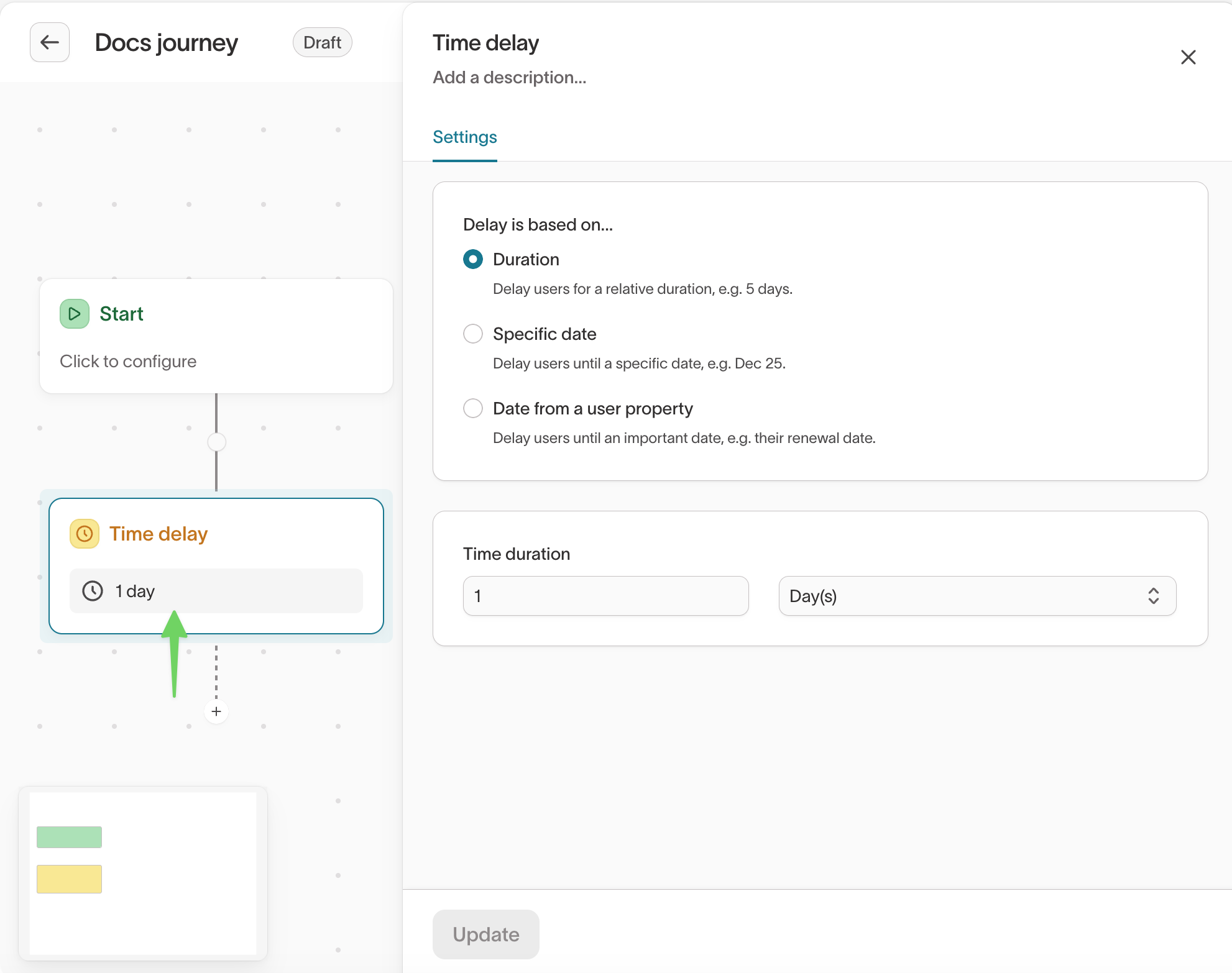
A duration shorter than the evaluation interval doesn't cause the journey to run sooner. On an hourly schedule, both a 15-minute delay and a 59-minute delay advance on the next hourly run.
Hold until
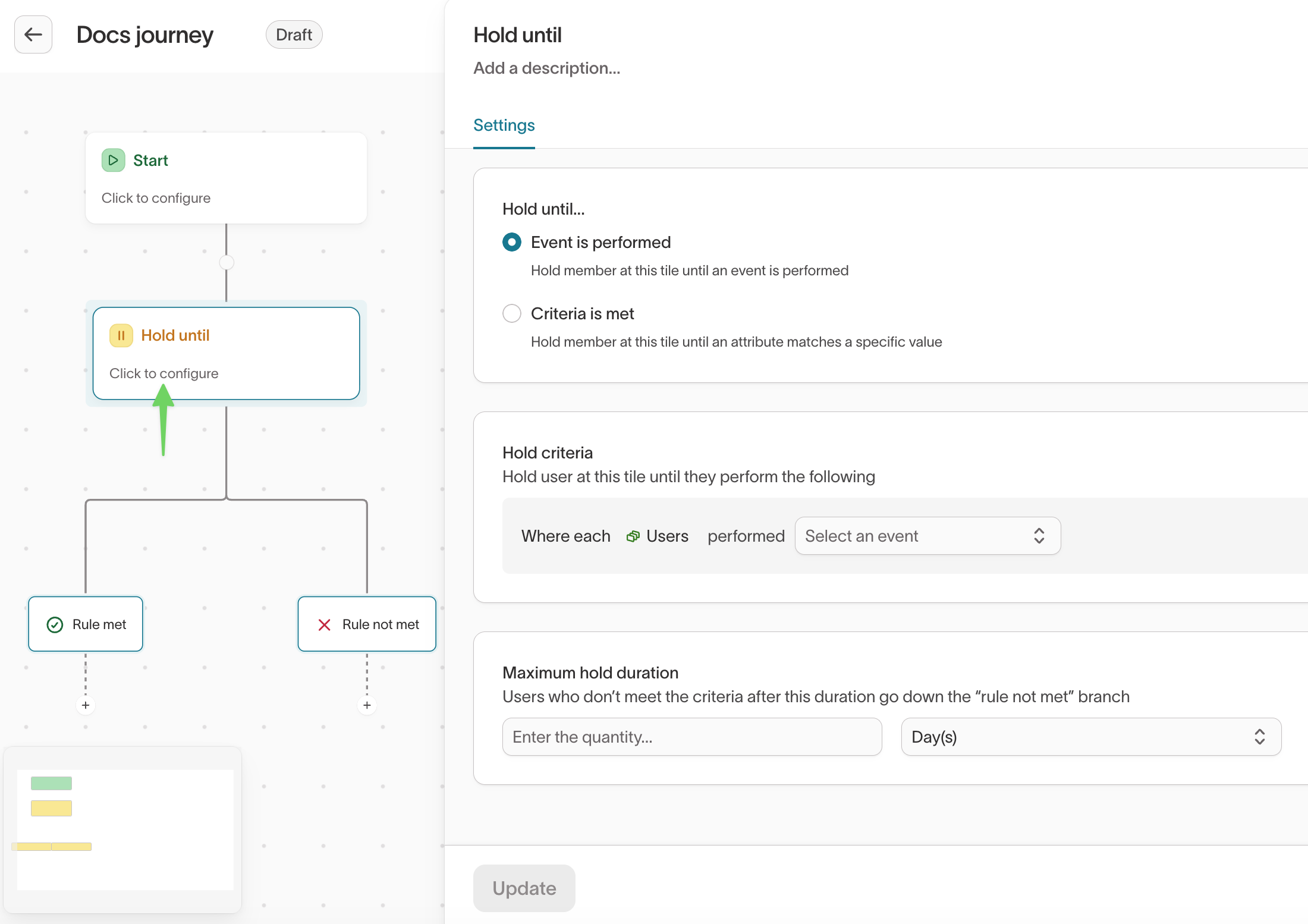
The Hold until tile holds each member until a condition is met or the maximum hold duration expires. It creates two paths:
- Rule met — The member follows this path when the condition is met.
- Rule not met — The member follows this path when the maximum hold duration expires first.
Define the condition using either:
- Event is performed — Wait for a specific event.
- Criteria is met — Wait for a condition built in the query builder. Criteria can reference profile attributes, traits, audience membership, event history, and related-model data.
Hightouch checks the condition on each journey run, not when the underlying data changes.
Create branches
Segment
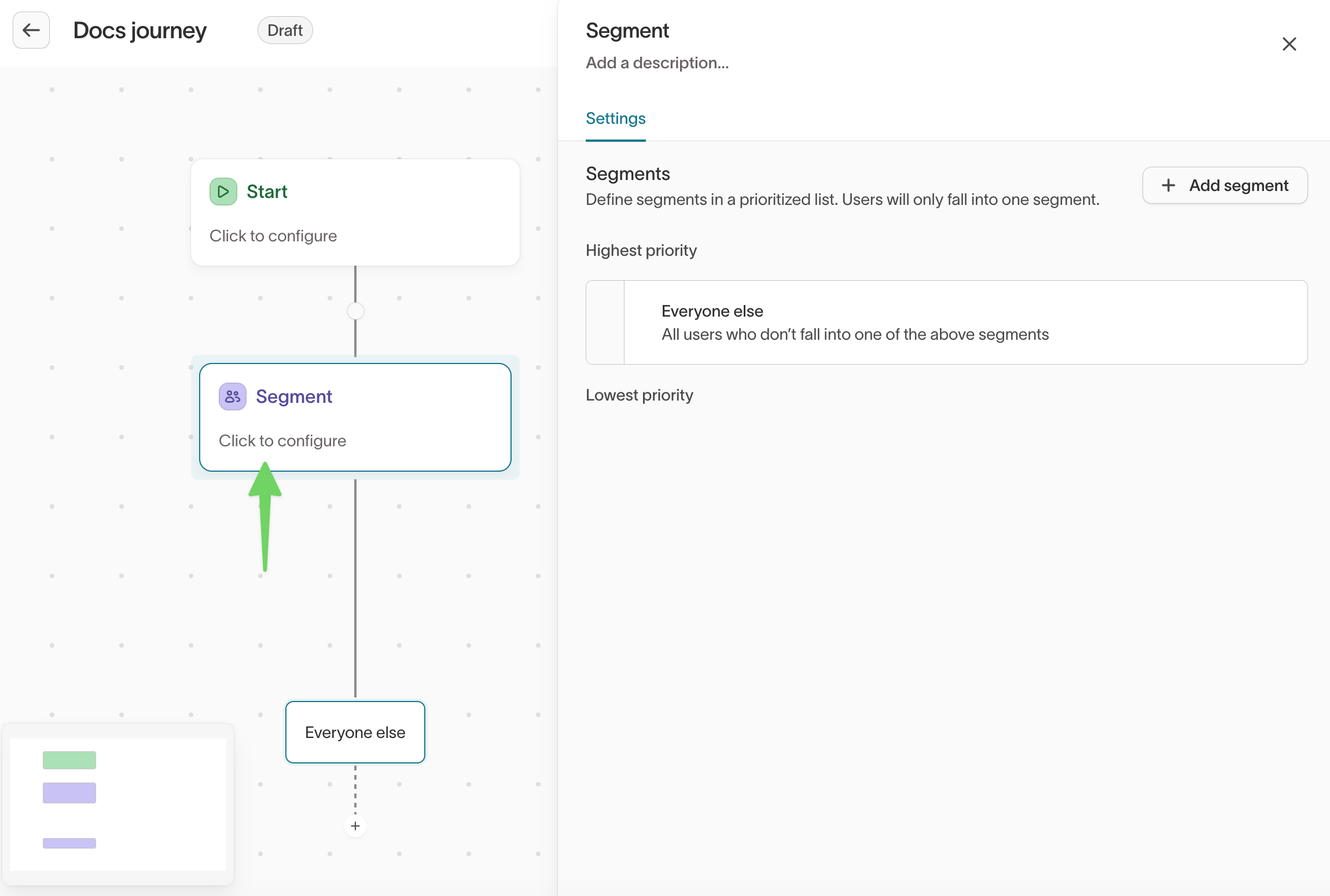
The Segment tile routes members based on profile attributes, traits, audience membership, event history, or relationships.
Hightouch evaluates branches from top to bottom. A member follows the first branch whose conditions they meet, so branch order matters when conditions overlap.
A/B Split
The A/B Split tile divides members across branches by the percentages you set. Assignment is deterministic: Hightouch hashes each member's primary key with a split-specific salt, so a member returns to the same branch on re-entry as long as the split configuration doesn't change.
Configure the number of branches, the percentage assigned to each branch, and the branch names.
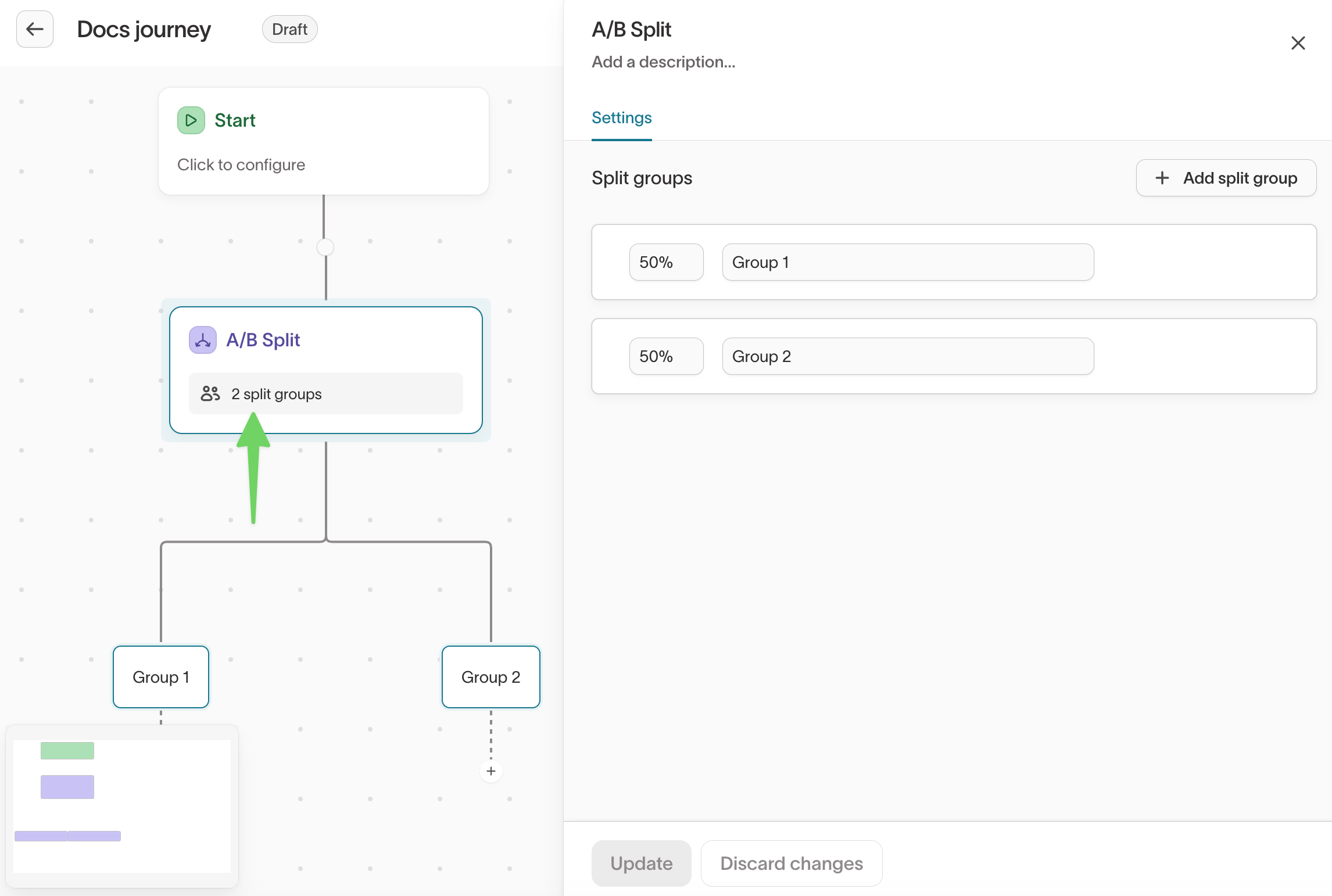
Changing branch allocations after activation changes the population assigned under each allocation and can invalidate comparisons between branches.
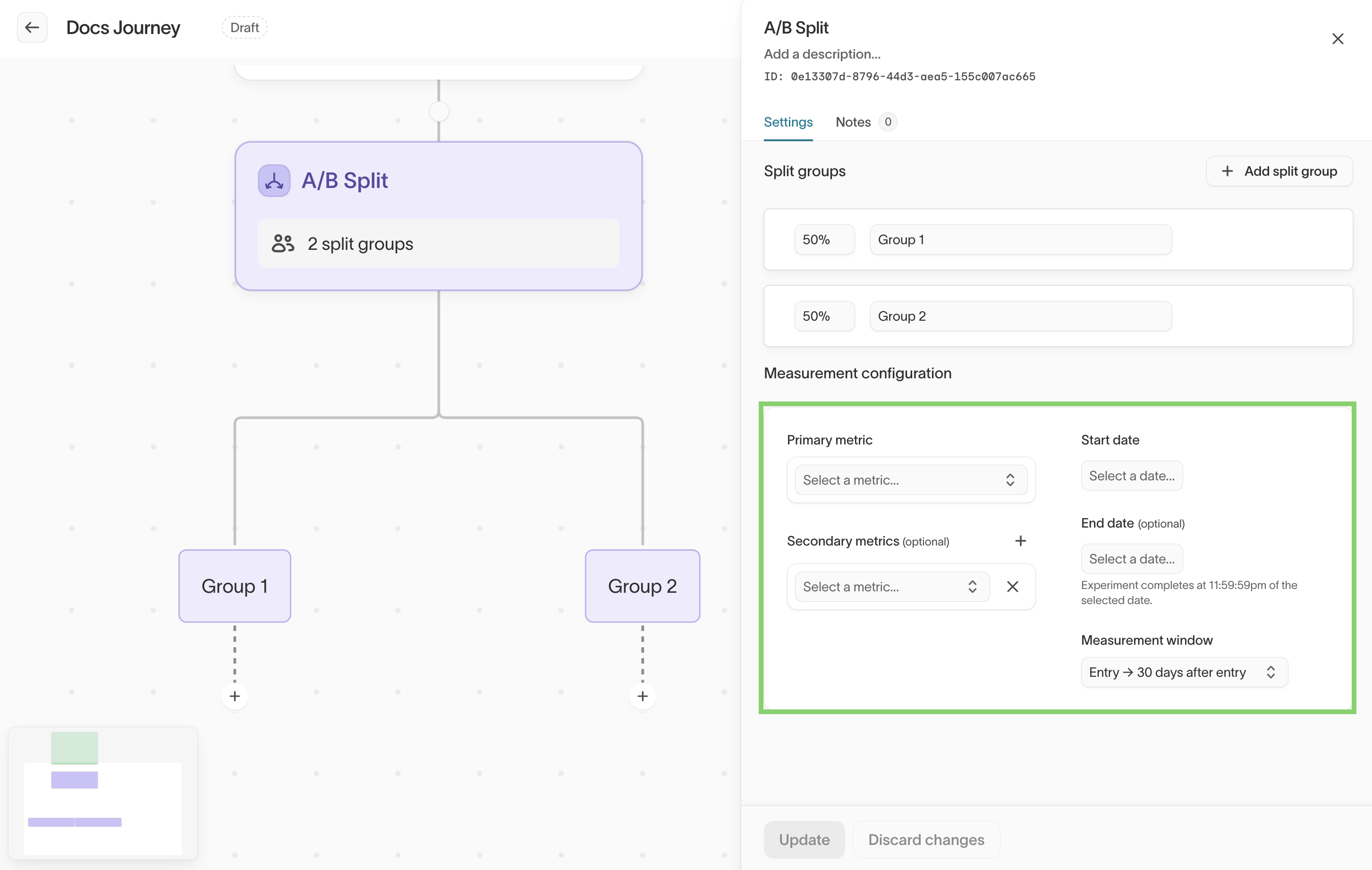
To measure outcomes by branch:
- Open the A/B Split tile.
- Under Measurement configuration, select Create experiment.
- Configure a primary metric, any secondary metrics, and the measurement window.
View results from the A/B Split tile or under Intelligence > Experiments. See Experiments.
Send messages or data
Send email, SMS, or push
The Send email, Send SMS, and Send push tiles deliver messages directly from Hightouch. They don't create a sync to a downstream messaging tool.
Hightouch must enable direct delivery for your workspace, and each channel must be configured before its tile appears. Otherwise, use Send to destination.
To configure a direct message:
- Name the tile. Hightouch uses the tile name as the message name in reporting.
- Create the message from a template or from scratch.
- For email, configure the subject, preheader, and body.
- Add personalization from profile attributes. In an event-triggered journey, you can also reference properties from the event that triggered entry.
- Preview the message with a profile and send a test message.
- Configure send limits, if needed.
The journey determines which members reach the tile and when Hightouch evaluates it. Direct messages don't have a separate audience or schedule, and reporting aggregates performance by message rather than by journey run. Hightouch applies unsubscribe, bounce, and suppression rules before delivery.
Send to destination
The Send to destination tile runs a sync when members reach it. Select an existing sync or create one from the tile.
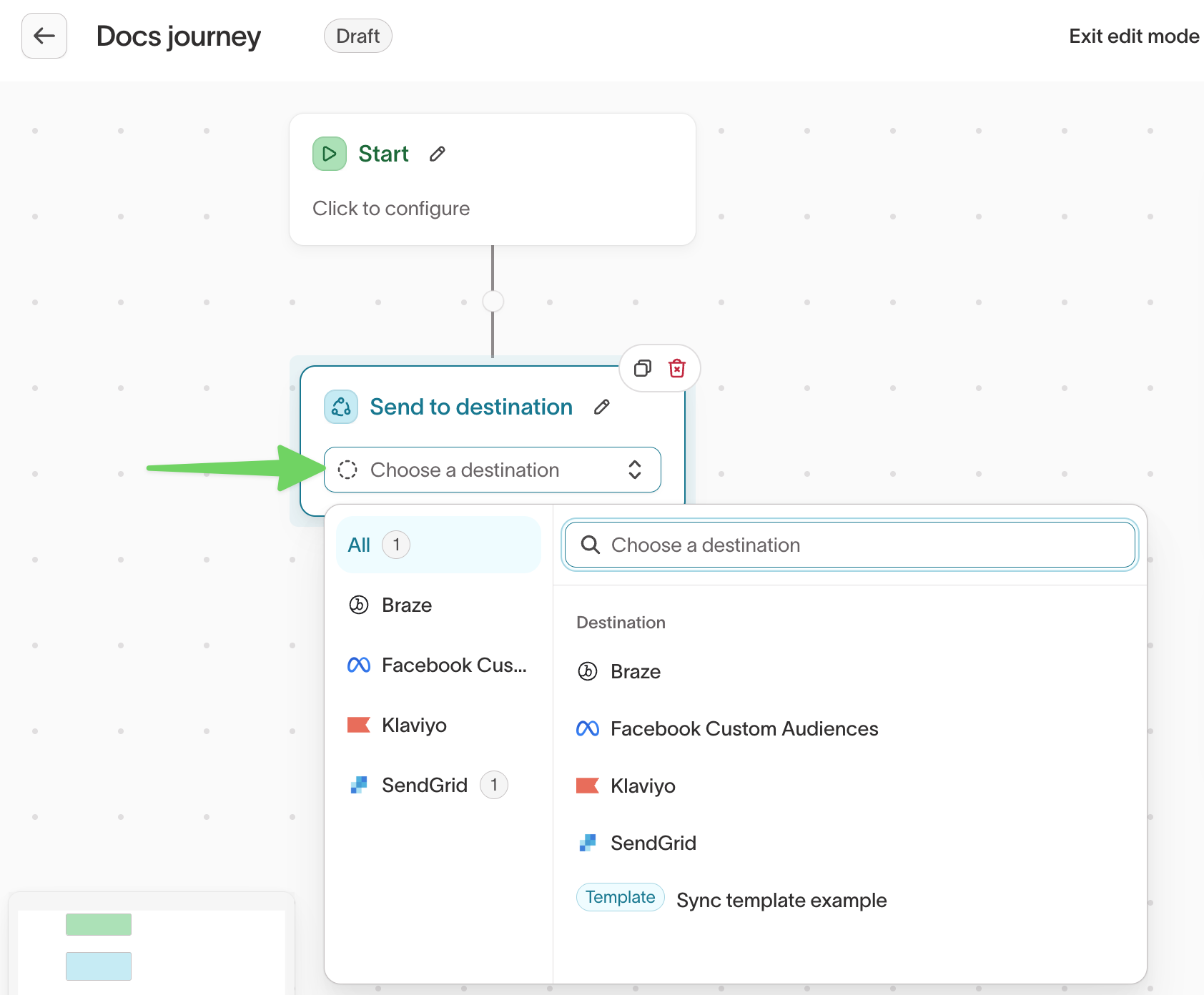
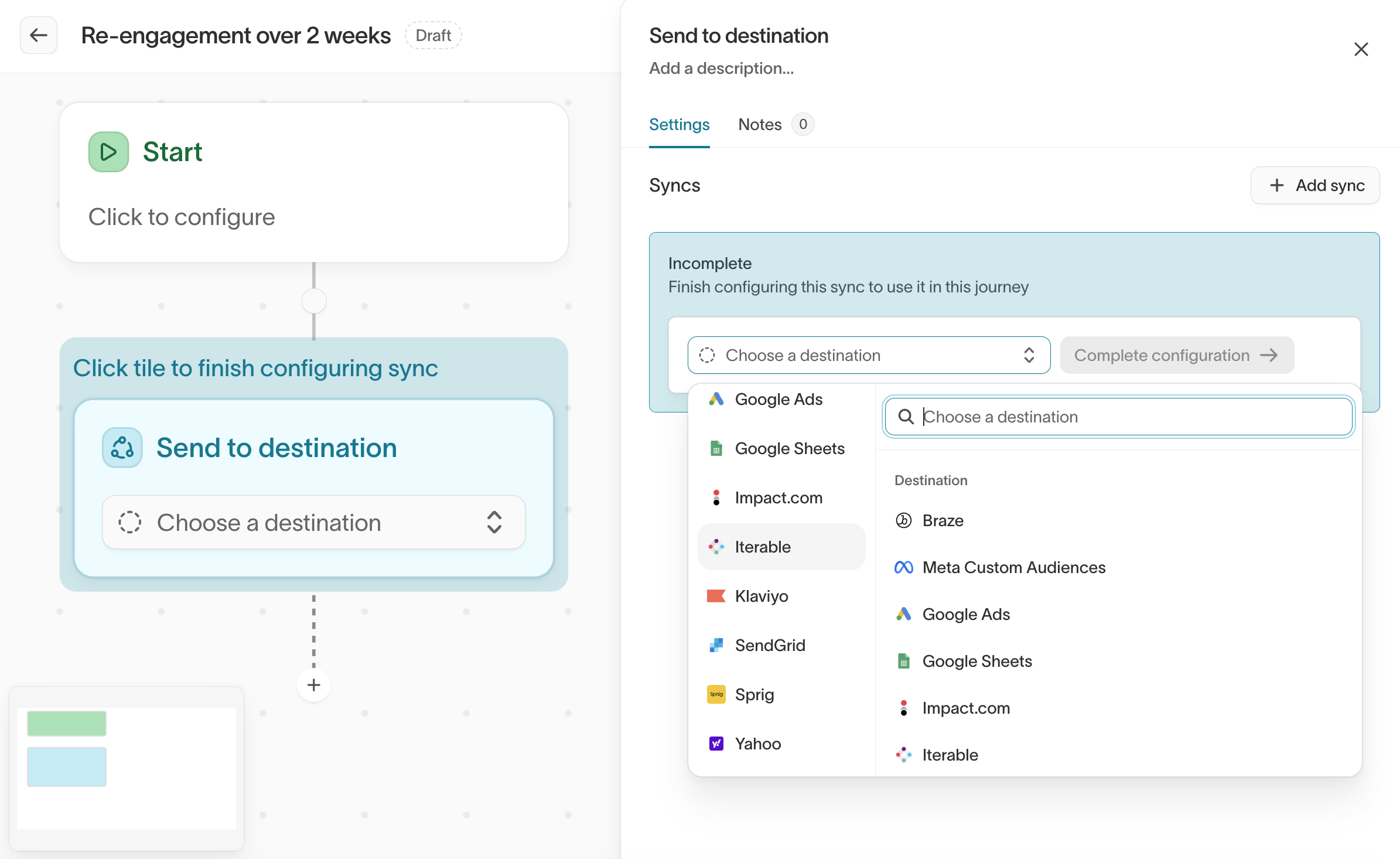
Journey syncs run as part of journey evaluation and don't have an independent schedule. Choose the behavior based on what the destination should receive:
| Sync behavior | Use when you want to... | Recommended sync mode |
|---|---|---|
| Trigger | Send a one-time action per member per tile | Insert |
| Cohort | Maintain a destination list or audience that reflects current journey membership | Upsert or Mirror |
| Message | Send a one-time action per member per tile and wait for the destination to accept a member before continuing | Insert or added-row actions only |
Configure the sync type and removal behavior under Journey settings, then configure the destination-specific object and how fields map to the destination.
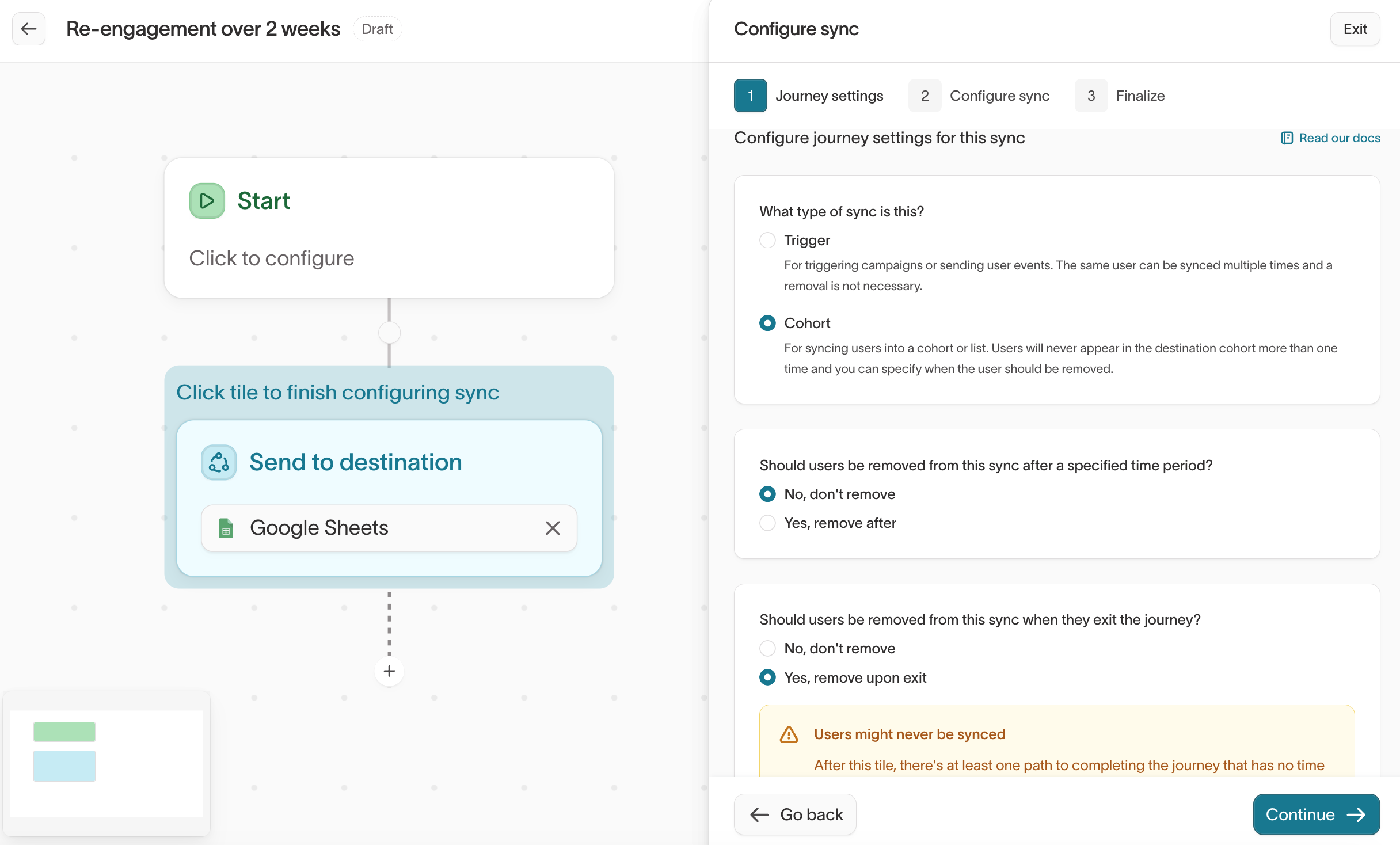
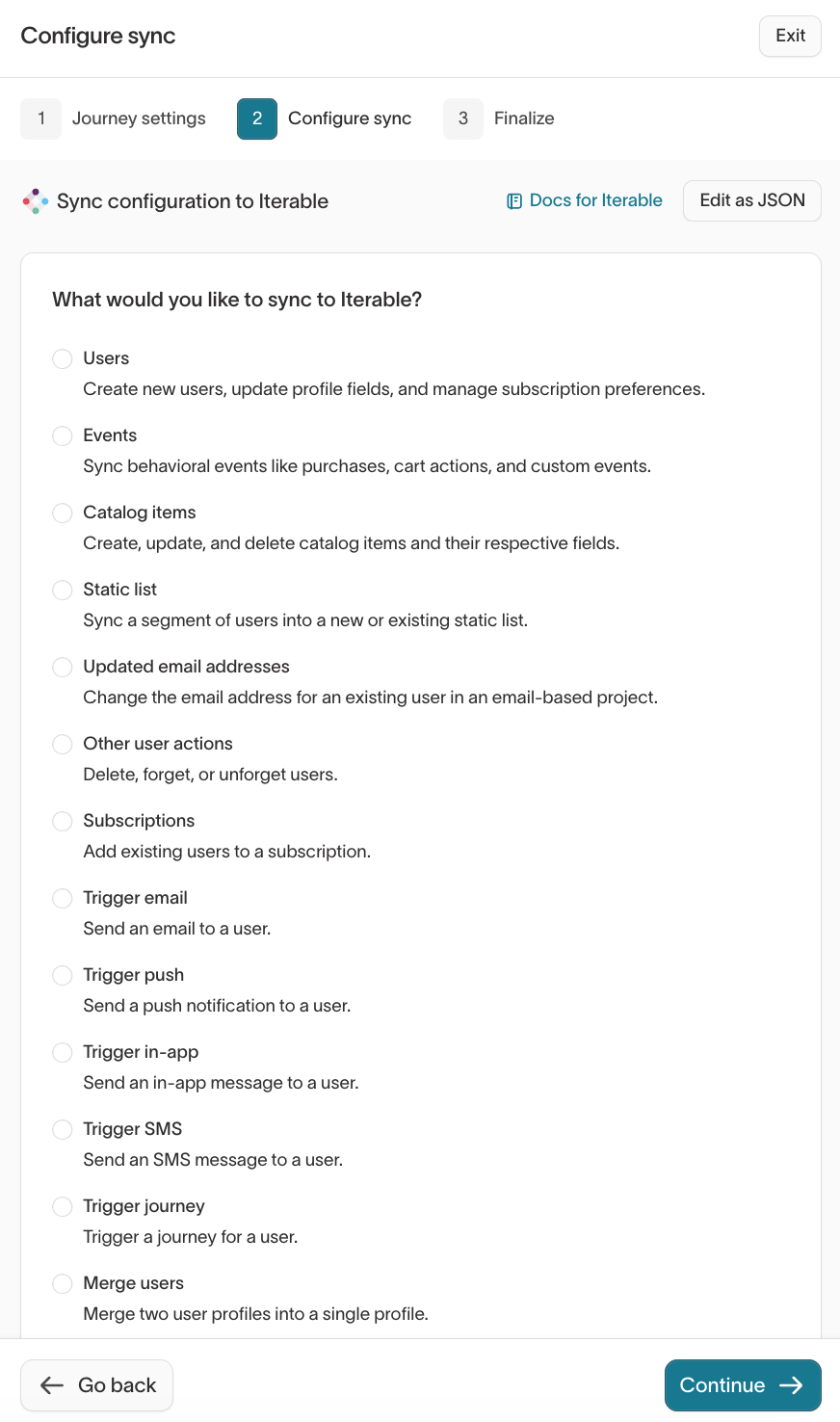
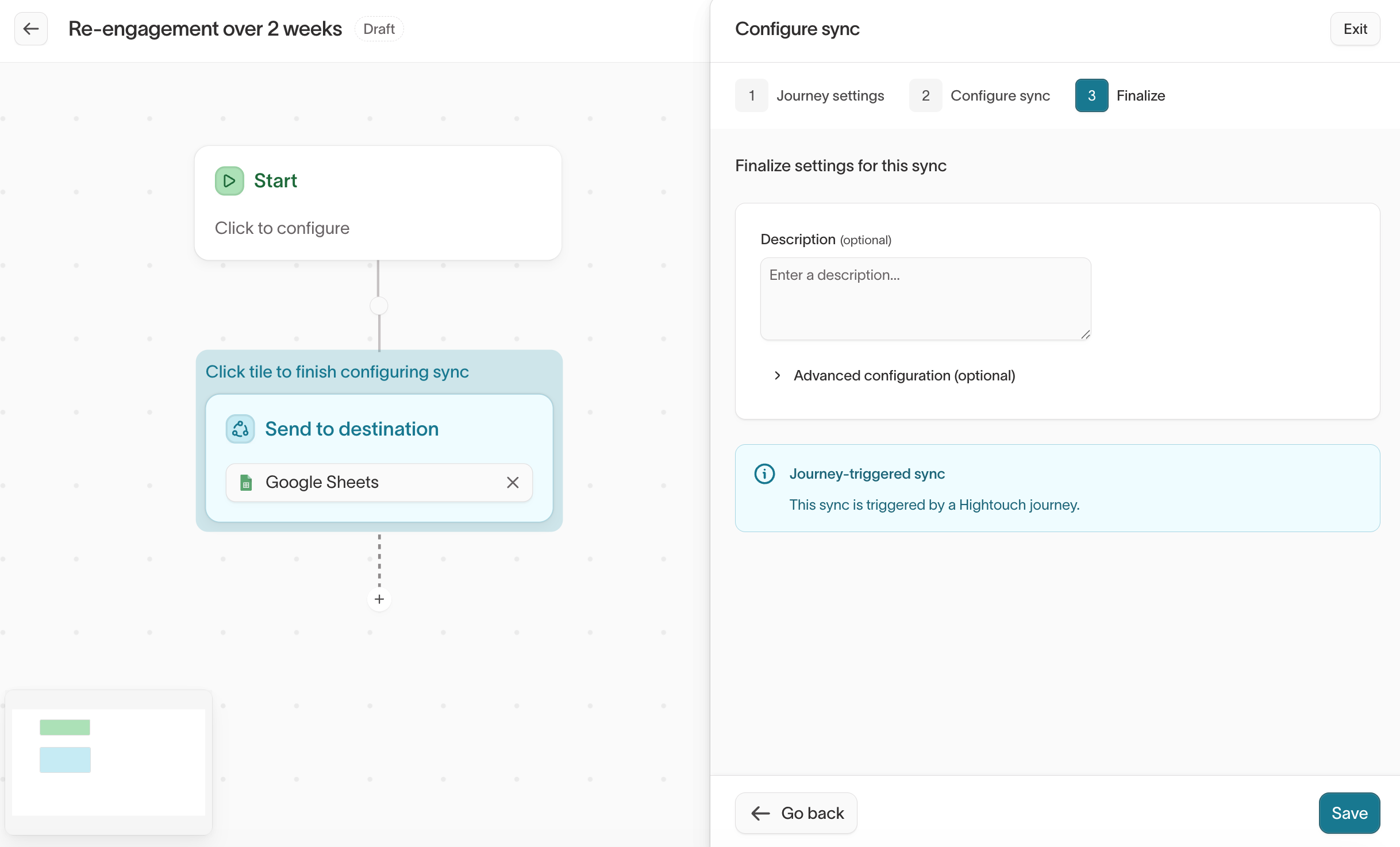
The modes available depend on the destination.
Trigger mode
Use Trigger mode for one-time actions where you want one event per member per tile.
| Sync mode | Behavior | Recommendation |
|---|---|---|
| Insert | Members entering or re-entering the tile during a run are synced. Previously synced members are ignored. | Recommended |
| Upsert | New and updated members are synced, which can cause duplicate sends. | Not recommended |
| Update | Only previously synced members are updated. New members are ignored unless they already exist in the destination. | Not recommended |
| Mirror | All members who have ever passed through the tile are synced every run. | Not recommended |
| Diff | Produces one file per operation: enter, change, and remove. | Not recommended |
Expire unsent entries on trigger syncs
A trigger sync keeps a record of every member who has passed through the tile, and an entry stays eligible to send until a sync sends it. This can lead to unexpected behavior. If a destination rule filters members out at sync time, those members progress through the journey normally, but their entries stay eligible indefinitely. If the rule changes later, the sync can send old rows.
Every trigger sync is therefore bounded by an expiry window. The workspace default is 30 days, and it applies to every trigger sync in the workspace.
- Entries older than the window are skipped at sync time and never sent.
- The window is measured from when the member entered the tile, not from when the journey started or when the sync last ran.
to change the workspace default. Support can also set a different window on an individual trigger sync, which overrides the workspace default for that sync only. You can specify a window in hours, days, weeks, months, or years. The minimum window is 4 hours.
Any window you request must be longer than the journey's schedule interval, ideally at least twice as long. If the window is shorter than the gap between runs, entries can expire before the sync next runs and will never send. The same applies after a pause: entries that accumulate while a journey is off expire if the pause outlasts the window.
Expiry is non-destructive and doesn't change journey behavior. Members still enter the tile, advance, and appear in journey logs and performance counts exactly as before. The window only controls what the sync engine sends. You see this as a lower record count on the sync, because only entries inside the window are considered.
Cohort mode
Use Cohort mode to maintain a destination audience or list that reflects current journey membership.
| Sync mode | Behavior | Removal behavior | Recommendation |
|---|---|---|---|
| Upsert | New members sync, and changes to existing members sync. | Members are removed based on journey configuration. | Recommended |
| Mirror | All current members sync every run. | Members are removed based on journey configuration. | Recommended when the destination exposes Mirror and should exactly match journey membership |
| Update | Only existing destination members are updated. New members are ignored. | Members are removed, but deleteMode is usually set to clear (attributes removed, member remains). | Not recommended |
| Insert | New members sync. Changes and removals are ignored. | No removal occurs. | Not recommended |
| Diff | Produces one file per operation. | No removal occurs. | Not recommended |
Avoid deleteMode: do nothing with cohort syncs. Removals won't be applied,
and the destination list will continue to grow.
Message mode
Message mode is in beta and must be enabled by Hightouch. to turn it on for your workspace.
Use Message mode for one-time actions where you want one event or message per member per tile. In Message mode, the tile holds members until the destination confirms the record was accepted.
Message mode runs a sync through Send to destination. The destination's acceptance confirms a successful delivery from the sync engine, but it doesn't confirm that the recipient received or opened a message.
Hightouch checks each waiting member on journey evaluations:
| Outcome | What happens next |
|---|---|
| The destination accepts the record | The member advances on the next journey evaluation. |
| The destination rejects the record | The member stays at the tile for another sync attempt, within the configured wait. |
| The maximum wait elapses | The member continues or exits the journey, based on the timeout action. |
| The sync's model query excludes the member, including through a destination rule | The member takes the timeout action on the evaluation that detects the exclusion, without waiting for the maximum duration. |
Journey exit criteria still apply while a member waits. Once a member leaves the tile, the Message sync stops retrying their record. Leaving the tile doesn't send a removal to the destination.
Message syncs require a destination configuration that sends added records only. Use Insert where available.
To configure Message mode:
- You must set the maximum wait for the sync. The wait starts when the member enters the tile and controls how long the member waits to be synced.
- Set the timeout action to either have the member continue or exit the journey if the sync engine could not perform the sync within the allowed wait time. The default is
Continue through the journey.
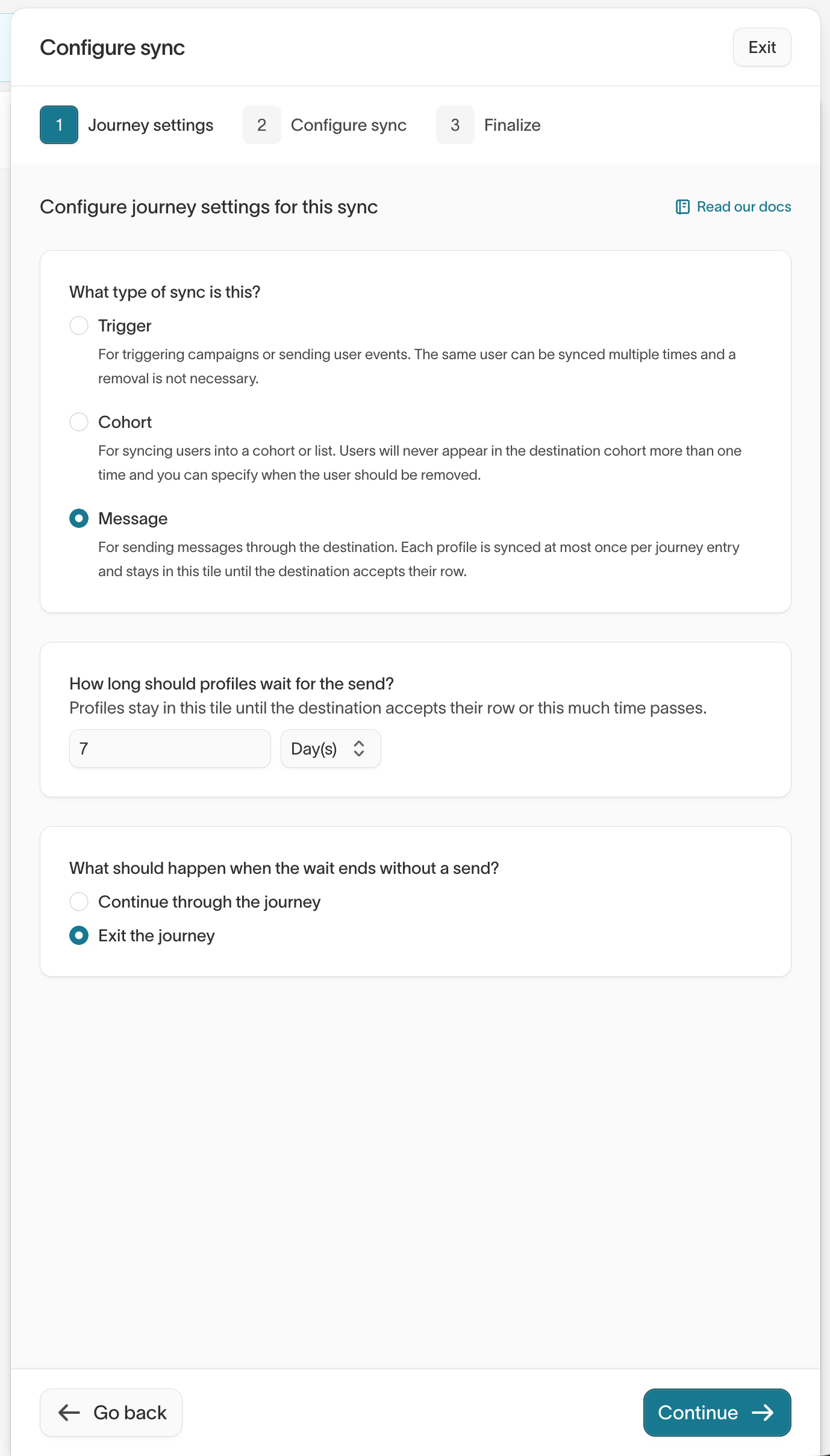
The journey schedule controls when Hightouch checks acceptance and timeouts. Set a wait longer than the schedule interval so members have time to sync before timing out. The wait also includes time while the journey is paused.
Later Time delay tiles measure their duration from when the member leaves the sync tile. They don't count the time spent waiting for destination acceptance.
Migrate from Trigger to Message mode
Message mode is designed to replace Trigger mode and is safer for ensuring that messages are only delivered once. To migrate an existing sync:
- Pause the journey.
- Change the sync mode from Trigger to Message and set the required maximum wait (
wait_for). - Check the destination configuration and receiving system to ensure they process added records only. Disable operations for changed or removed records. Use Insert where available.
- Restart the journey.
Changing modes doesn't reprocess members who already passed through the tile. The Message sync processes only new members who flow into the tile after migration.
Retries and sequencing
If a record fails to sync, Hightouch retries it on later runs. A cohort sync retries the record while the member remains in the sync and stops once they're removed by an exit or completion. A trigger sync retries until the record syncs or its expiry window (expire_after) elapses. Message syncs retry while the member remains at the tile, within the maximum wait.
Send to destination tiles reached during the same journey evaluation are scheduled together at the end of the run. Journeys don't guarantee an order between those syncs. Use Message mode when the next tile must wait for destination acceptance. Add a Time delay tile when you need an additional delay between actions.
Sync templates
You can apply a sync template to reuse destination-specific configuration. The template doesn't control the journey sync type or removal behavior, so changes to those settings must be made on each journey sync.
Destination rules can exclude records at sync time. In Message mode, excluded members take the configured timeout action when the journey detects the exclusion. Trigger and Cohort modes continue to advance members without waiting for destination acceptance.
Assign and carry values
Set variable
The Set variable tile assigns a value to a journey variable. Later tiles can use that value for branching or send it to a destination.
Define variables in the journey's Variables settings, then add Set variable tiles where their values should change.
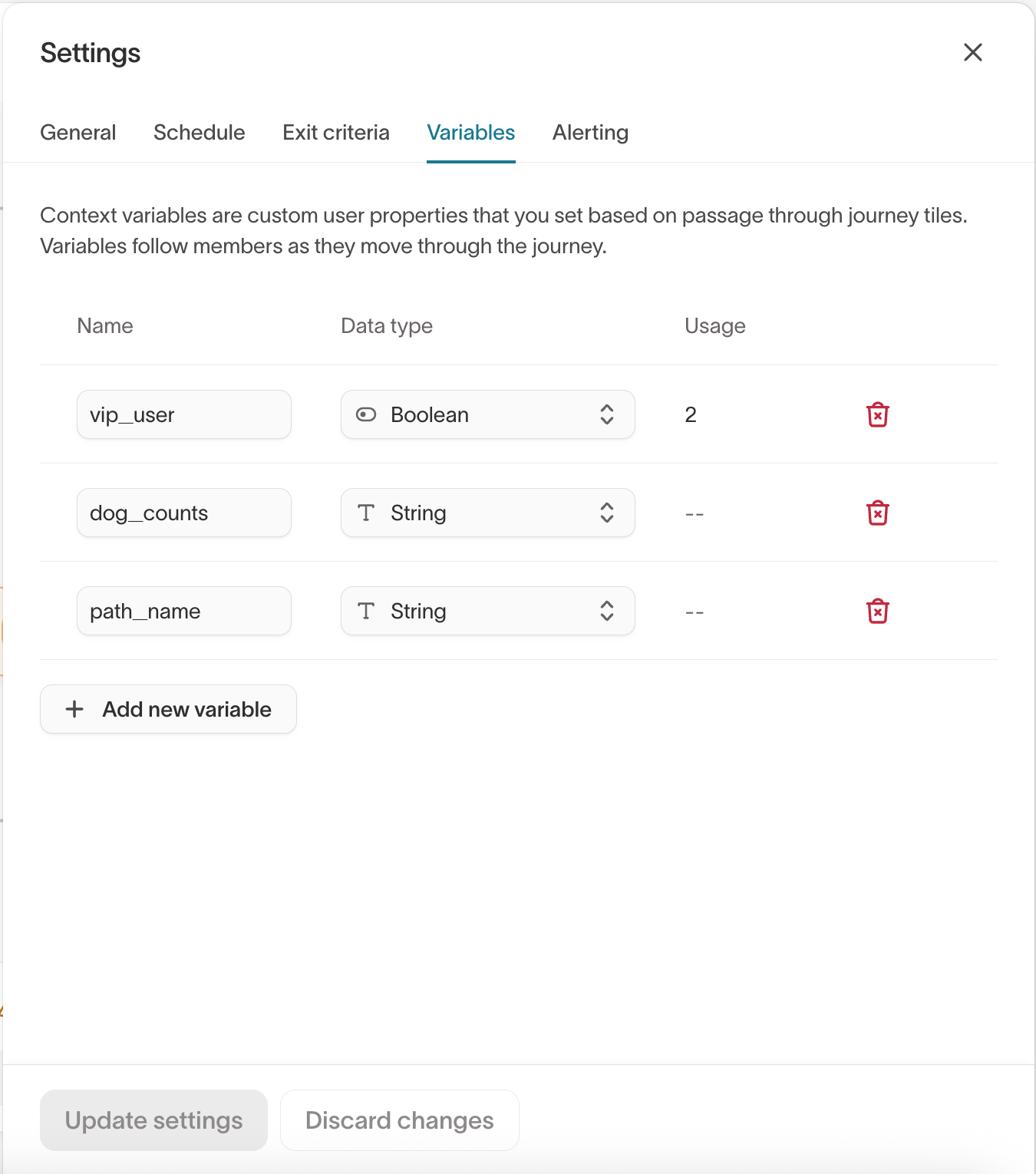
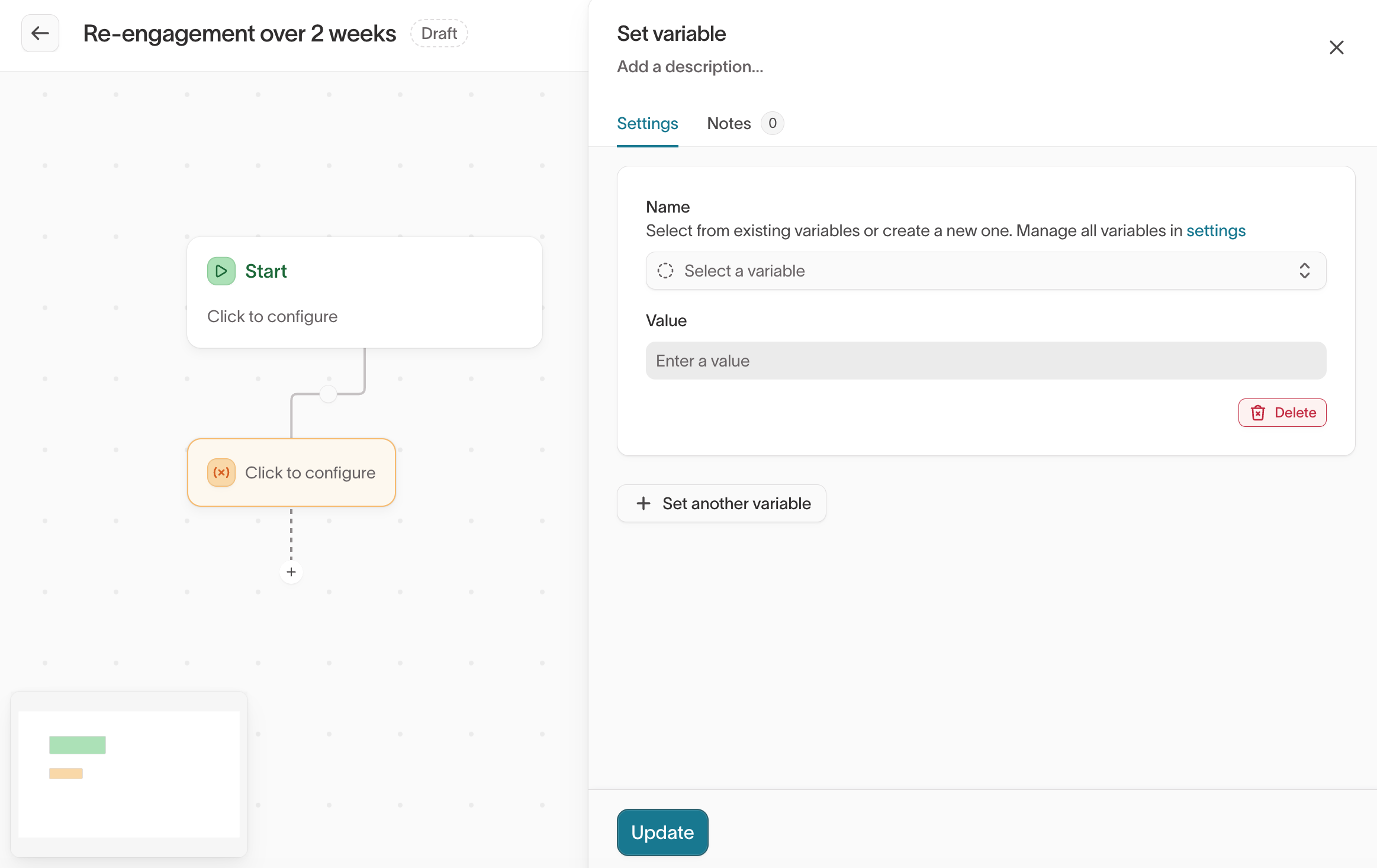
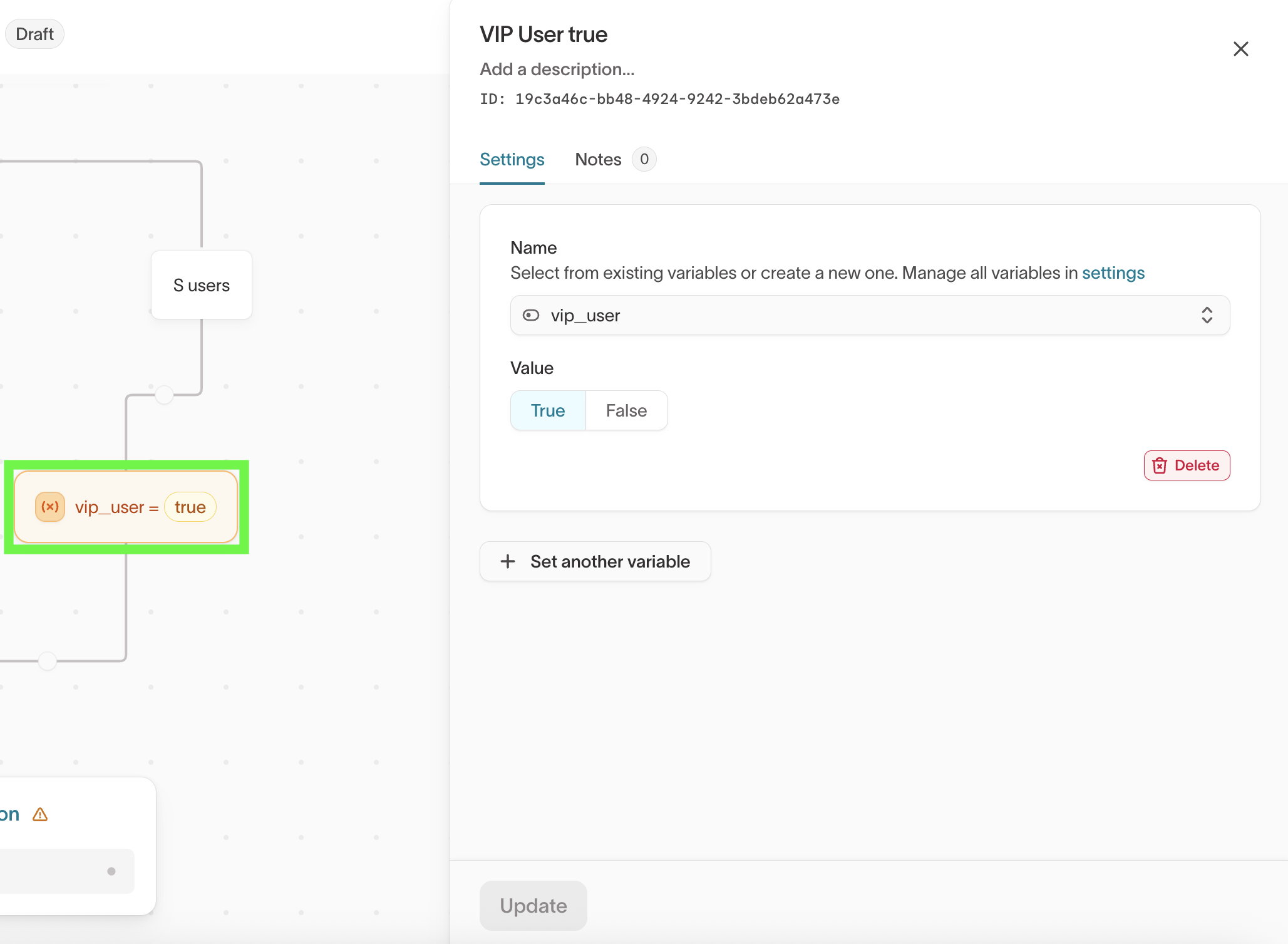
For example, to record whether a member followed a VIP branch and send that value to a destination:
- Define a
vip_uservariable in journey settings. - Add a Segment tile that branches on loyalty level.
- On the high-loyalty branch, set
vip_usertotrue. On the remaining branches, set it tofalse. - In a Send to destination tile, map
vip_userto a destination field.
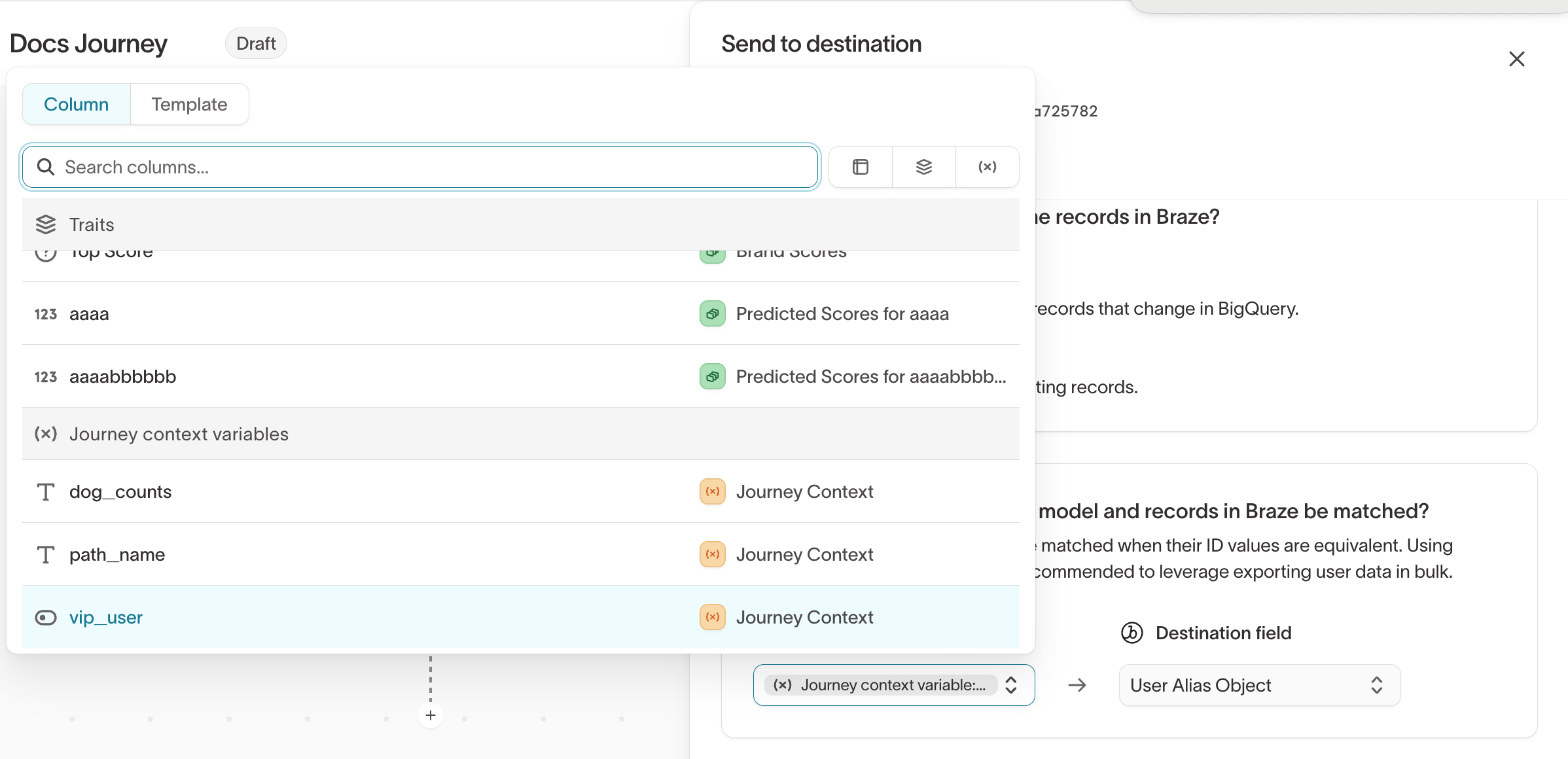
After the journey runs, the member details panel shows assigned variable values. Hightouch also writes them to the per-journey JOURNEY_CONTEXT_LOG_<journey_id> table. Query this table to use a journey variable in downstream analysis or audience logic.
The journey UI uses Variables and Set variable. Warehouse log tables and API responses use context variables for the same data.
Assign an offer
Assign coupon
The Assign coupon tile assigns a code from a configured coupon pool to each member who reaches it. Use it for promotions that need unique, single-use codes. See Coupon assignment to configure a coupon pool.
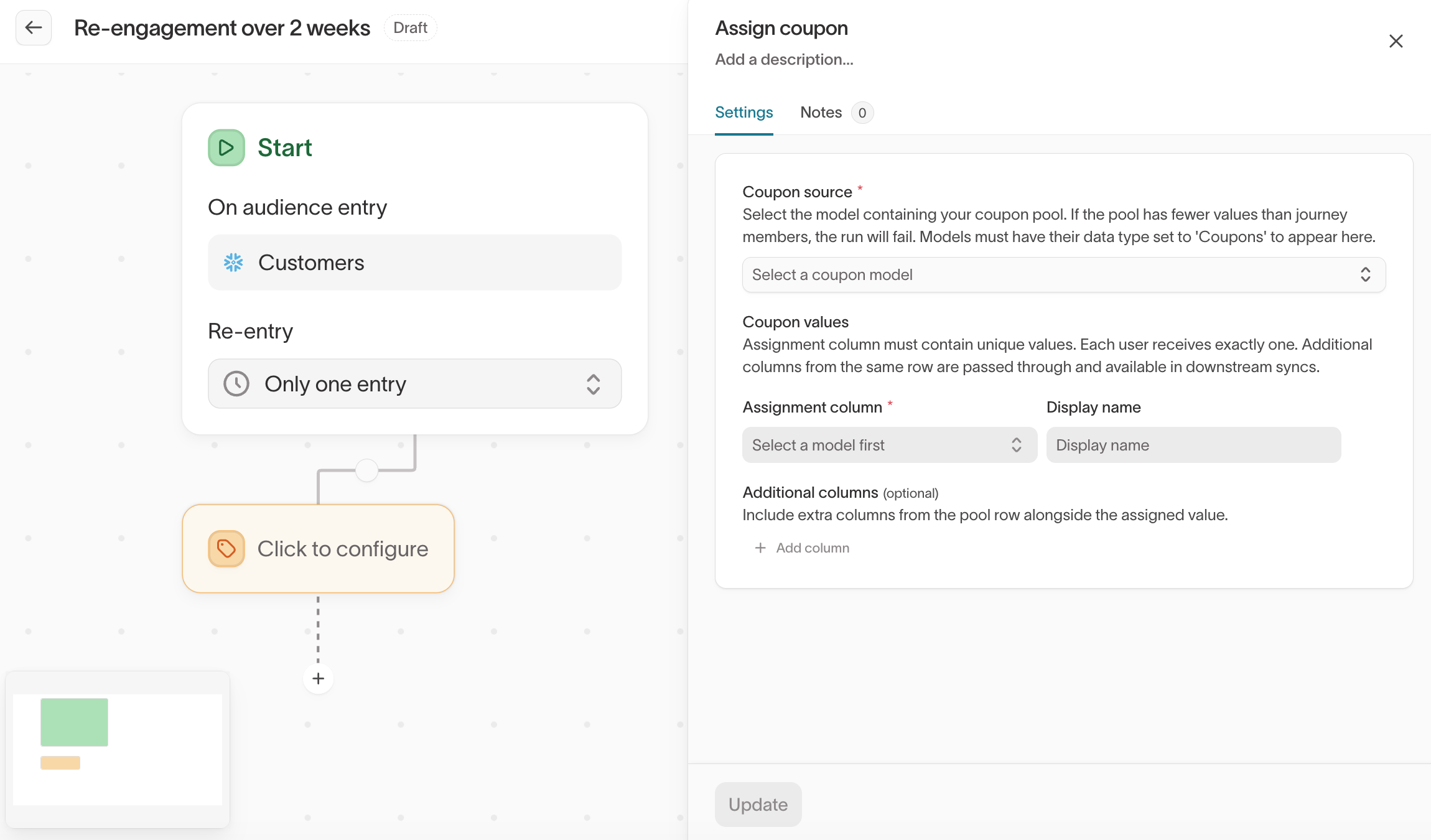
Assign coupon tiles aren't available in event-triggered journeys. Use audience-based entry when the journey requires coupon assignment.
Next steps
- Test and launch a journey to validate tile behavior before activation.
- Coupon assignment to configure coupon pools.
- Warehouse tables reference for journey log and variable schemas.