What is DinMo?
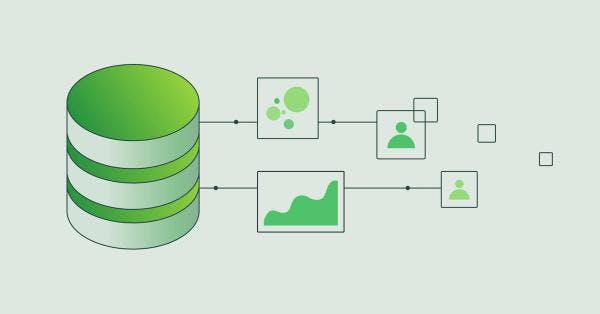
DinMo is a Composable Customer Data Platform (CDP) that connects directly to a company’s existing data warehouse, enabling you to segment, analyze, and activate customer data without engineering support. Headquartered in Europe and founded in 2022 by Oussama Ghanmi, DinMo focuses on making customer and marketing data accessible to business users while maintaining EU data privacy and compliance standards. With its modular design, marketers can manage campaigns, audiences, and analytics without copying or duplicating data.
TL;DR
- DinMo is a lightweight, EU-centric Composable CDP designed for marketers and business users to segment and activate customer data directly from their data warehouse.
- Founded in 2022 by Oussama Ghanmi, DinMo focuses on making customer and marketing data more accessible without relying on engineering teams.
- Offers key modules for Activation, Intelligence (AI recommendations & predictive attributes), Identity resolution, and a Customer Hub for unified profiles.
- Provides server-side data collection and supports hosting on either the customer’s warehouse or DinMo’s managed environment (with potential security trade-offs).
- No client-side SDKs, data contracts, or journey orchestration.
- Compliance in SOC 2 Type II, GDPR, and CCPA, but no HIPAA or advanced enterprise permissions.
- Limited ecosystem: roughly 59 destinations
- Strengths include composable architecture, EU data residency, and flexible identity resolution.
- Limitations are a small integration network, no AI Decisioning, and limited global reach.
- Best for small EU-based teams seeking a simple, marketer-friendly Composable CDP.
Core products and capabilities
DinMo offers a suite of tools that make customer data activation, analysis, and personalization accessible to marketing and data teams. Built around simplicity and automation, DinMo’s platform connects directly to your data warehouse or, if you don't have a data warehouse, they offer their own managed data warehouse hosting.
Product suite
With DinMo being a Composable CDP, it offers a modular approach where each product works independently or as part of a unified stack. This means you can collect, unify, and act on data from any source without relying on your engineering team. Some of the products available are:
- Activation: Build and manage customer segments within a no-code interface, then sync them automatically to business tools like CRMs, ad platforms, and marketing automation systems.
- Intelligence: Use AI-powered agents to generate predictive attributes, identify high-value users, and power personalized recommendations.
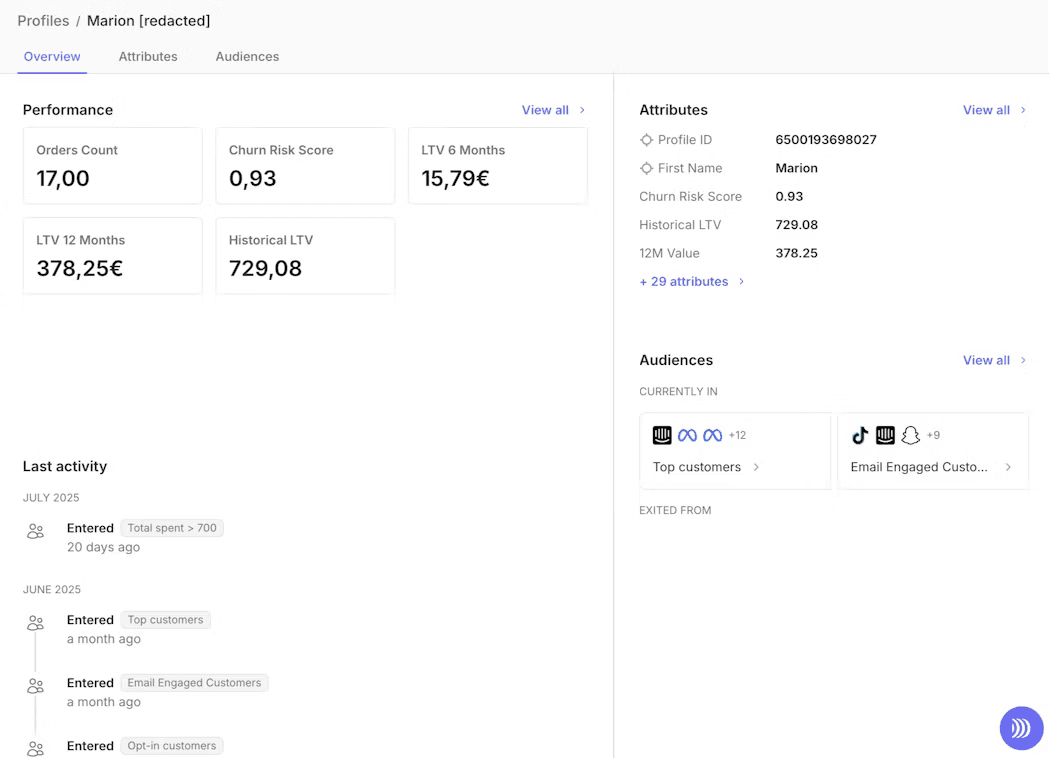
- Customer Hub: Gain a 360-degree view of every customer with unified profiles that combine behavioral, transactional, and demographic data.
- Identity: Resolve identities across data sources using deterministic matching.
- Hosting: For organizations without an existing data warehouse, DinMo provides a managed, secure cloud environment.
- Web and app tracking: Collect real-time behavioral data from websites and mobile apps to enrich customer profiles and trigger personalized campaigns.
Below, we’ll dive into each of the specific functionalities and features that DinMo offers, highlighting the benefits and frustrations companies face when using the platform.
Data collection
Unlike full-featured CDPs, DinMo offers a limited approach to data collection. The platform relies entirely on server-side tagging, which manages event collection, filtering, and routing but does not include any client-side tracking capabilities.
DinMo connects either to an organization’s existing data warehouse or to its managed cloud warehouse, but without broader collection tooling, it’s more dependent on upstream data sources being properly configured and maintained. This approach simplifies implementation but limits the platform’s role in end-to-end data collection and event management.
Data storage
DinMo offers two solutions for data storage. You can either connect your own existing data warehouse or use a warehouse hosted by DinMo.
Using managed hosting comes with its trade-offs. When customers choose to use DinMo’s managed hosting, the data environment is no longer under their direct control. This creates potential security and compliance risks, particularly for organizations that require strict governance over where and how data is stored and managed. Choosing DinMo’s hosting model shifts data storage outside the warehouse, increasing complexity around data residency, compliance, and privacy. For teams in regulated markets, this can be a meaningful blocker rather than a minor tradeoff.
Data modeling
DinMo offers two main data modeling options: Schema Management and Identity Resolution.
Schema management
DinMo organizes data into three predefined model types: Users, Events, and Custom Models. Each model must be created by either selecting an existing table from your data warehouse or by writing an SQL query that defines the underlying dataset. This approach ensures tight alignment with your warehouse but limits how freely you can design or restructure models within DinMo itself.
This dependency on SQL and rigid model types means that schema flexibility is largely constrained by the structure of your warehouse data. For teams managing complex entities, such as multi-level accounts, subscriptions, or custom objects, DinMo’s schema system can feel restrictive.
Identity resolution
DinMo’s identity resolution feature is designed with a warehouse-centric model: you build identity projects that ingest source models, standardize key identifiers (such as email, phone number, and dates), and stitch records into unified profiles.
However, the platform’s approach also introduces specific limitations and trade-offs:
- It supports rule-based deterministic and fuzzy matching, but does not support probabilistic matching.
- When you choose DinMo’s managed or external warehouse-driven architecture, you may have less direct control over the identity graph infrastructure. This can potentially reduce transparency compared to in-house solutions.
If you have highly complex identity needs or advanced probabilistic matching workflows, you may find DinMo’s approach more rigid and reliant on upstream engineering and data architecture than flexible “model-agnostic” platforms.
Audience management
DinMo offers a visual interface that allows non-technical users to build and analyze customer segments using fresh data directly from the data warehouse. While the platform supports filtering across related models and includes features like segment overlap analysis and breakdown views, its capabilities remain fairly limited compared to full-scale audience management solutions.
Unlike more advanced Composable CDPs, DinMo does not support match boosting or identity enrichment for improving customer matching in ad platforms. This restricts the platform’s ability to unify fragmented customer profiles or enhance targeting precision. DinMo also has a limited destination library with only 59 integrations, which limits the number of downstream tools teams can sync their audiences to.
While DinMo’s simplicity benefits teams seeking quick, no-code segmentation, DinMo’s limited schema flexibility and lack of enrichment or orchestration features make it less suited for complex data models or enterprise-level personalization use cases. In short, DinMo’s audience management works well for lightweight segmentation but falls short as a full-featured audience intelligence layer.
Security
DinMo maintains compliance with key standards, including SOC 2 Type II, CCPA, and GDPR, which cover general data protection and privacy requirements. However, its security model remains limited compared to more mature enterprise-grade platforms.
Because DinMo stores no data by default, organizations using their own warehouse retain full control over data security and compliance. However, when customers opt for DinMo’s managed hosting, their data resides in an environment that is not under their direct control, introducing potential risks related to governance and access transparency.
The platform does not support HIPAA or Business Associate Agreements (BAA), making it unsuitable for healthcare or other regulated industries that require these certifications. While DinMo supports custom roles and feature-level permissions, its access controls stop at the workspace and module level. It does not provide advanced enterprise capabilities like destination-level permissioning, environment separation, or fine-grained control over which subsets of data users can activate.
Overall, while DinMo meets basic compliance requirements, its limited security controls and lack of enterprise management features make it less suitable for organizations with stringent regulatory or security requirements.
AI capabilities
DinMo includes a limited set of AI features, primarily focused on smart recommendations and predictive attributes, such as customer lifetime value (LTV) and churn probability. These tools help enrich audience segmentation and improve targeting accuracy, but their functionality is limited to basic prediction and scoring.
Unlike more advanced platforms, DinMo does not include AI Decisioning capabilities, meaning it cannot autonomously optimize campaign decisions, test multiple actions, or adapt in real-time based on performance feedback.
Overall, DinMo’s AI tools serve as helpful add-ons for marketers but fall short of delivering the kind of adaptive, closed-loop intelligence offered by more sophisticated AI-powered CDPs.
Journey orchestration
DinMo currently offers no journey orchestration capabilities.
Pros and cons
Pros
Composable CDP approach designed for marketers and business users
Data remains in the customer’s infrastructure
Flexible identity resolution
Strong EU data residency and GDPR compliance
Cons
Requires actionable data to already live in DinMo or another data platform, unless you are activating directly from your own warehouse
Limited partner ecosystem and destination coverage compared to more established platforms
No HIPAA compliance, restricting use in regulated healthcare environments
Lacks native journey-building and orchestration functionality
Limited geographic presence and enterprise support footprint outside the EU
Fewer enterprise-grade controls around governance, environment separation, and large-scale operational complexity
Closing thoughts
DinMo delivers a basic version of the Composable CDP model, offering flexibility and warehouse connectivity for teams that want to avoid the limitations of traditional packaged CDPs. However, its lightweight design comes with notable trade-offs, including limited integrations, the absence of journey orchestration, and no AI decisioning capabilities.
For organizations seeking a more advanced, Composable CDP suitable for marketers, with richer automation, stronger security, and true AI-driven decisioning, Hightouch offers a more comprehensive solution. With its broader integration ecosystem and real-time activation capabilities, Hightouch helps teams operationalize data with the same flexibility DinMo promises, only at enterprise scale. Book a demo with one of our solution engineers to find out how Hightouch can help you.