Today, New York becomes the first state in the country to require advertisers to disclose when an ad features an AI-generated synthetic performer.
For brands investing in AI content creation, the legislation creates an immediate operational challenge as marketers must quickly determine which ads are covered, apply the appropriate disclosures, and ensure those rules are followed consistently before anything goes live.
That's why Hightouch has invested deeply in understanding these evolving requirements and building the right controls directly into our products.
While you should always consult with your legal team around your business's specific obligations, here is what we believe advertisers need to know.
What is New York's synthetic performer law?
Signed by Governor Kathy Hochul in December 2025 and effective June 9, 2026, New York’s Synthetic Performer Disclosure Law requires advertisements distributed to audiences in the state to conspicuously disclose when they knowingly include a “synthetic performer”, defined as “as a digital asset created, reproduced, or modified by computer using generative AI or a software algorithm, intended to give the impression of a human performer in an audio, audiovisual, or visual performance, when it is not recognizable as any identifiable natural performer.”
Put simply, when an advertisement features an AI-generated person who appears to be real, it must be clearly disclosed as AI.
The law applies to any company that creates or produces ads featuring AI-generated people, including companies based outside New York, if those ads are distributed in the state. One important callout here is that the law applies to advertisements distributed in New York, not only ads targeted to New York residents. That means brands can’t rely solely on excluding New York residents from their targeting audiences. Instead, they need a consistent way to apply disclosures whenever an ad featuring an AI-generated person may be shown in the state.
Certain uses are exempt, including audio-only ads, AI used solely for translation, and some ads and promotional materials for expressive works like movies, TV shows, and video games featuring AI performers.
Violations can result in a civil penalty of $1,000 for a first offense and $5,000 for each subsequent offense.
This is bigger than New York
While New York’s law focuses on ads that feature AI-generated people, it’s part of a much broader shift in how governments are approaching AI-generated content. Brands will increasingly be expected to disclose when AI was used to create content.
Beginning in August 2026, the EU AI Act introduces additional transparency requirements. These include machine-readable disclosures for certain types of AI-generated content. Other governments (e.g, California) and ad platforms are also moving in the same direction.
These evolving regulations create a quickly growing set of requirements across creative types, markets, & platforms, and managing all of that manually will get complicated fast. For some brands, this growing complexity may raise a larger question: Is using AI-generated creative worth it at all?
We don’t believe marketers need to make that tradeoff. Compliance can and should be built directly into the creative workflow so teams can continue moving quickly with AI.
How Hightouch Ad Studio builds compliance into the creative workflow
Hightouch Ad Studio is designed to support compliance in two ways. (1) It applies the visible disclosures consumers see, and (2) it embeds machine-readable metadata that platforms can detect. Because requirements vary by market, Ad Studio also gives marketers direct control over when and how each type of disclosure is applied.
Visible AI disclosures
When Ad Studio generates an ad featuring an AI-generated person, it can automatically add a visible disclosure label to the asset. Brands can control how and where that label appears, ensuring the disclosure is applied consistently

Add disclosures to creative that includes people in Hightouch.
Machine-readable watermarking
Ad Studio also embeds invisible, machine-readable metadata into every AI-generated creative. Platforms like Meta and Google read this signal to automatically surface native "AI info" labels in their ad environments for consumers.
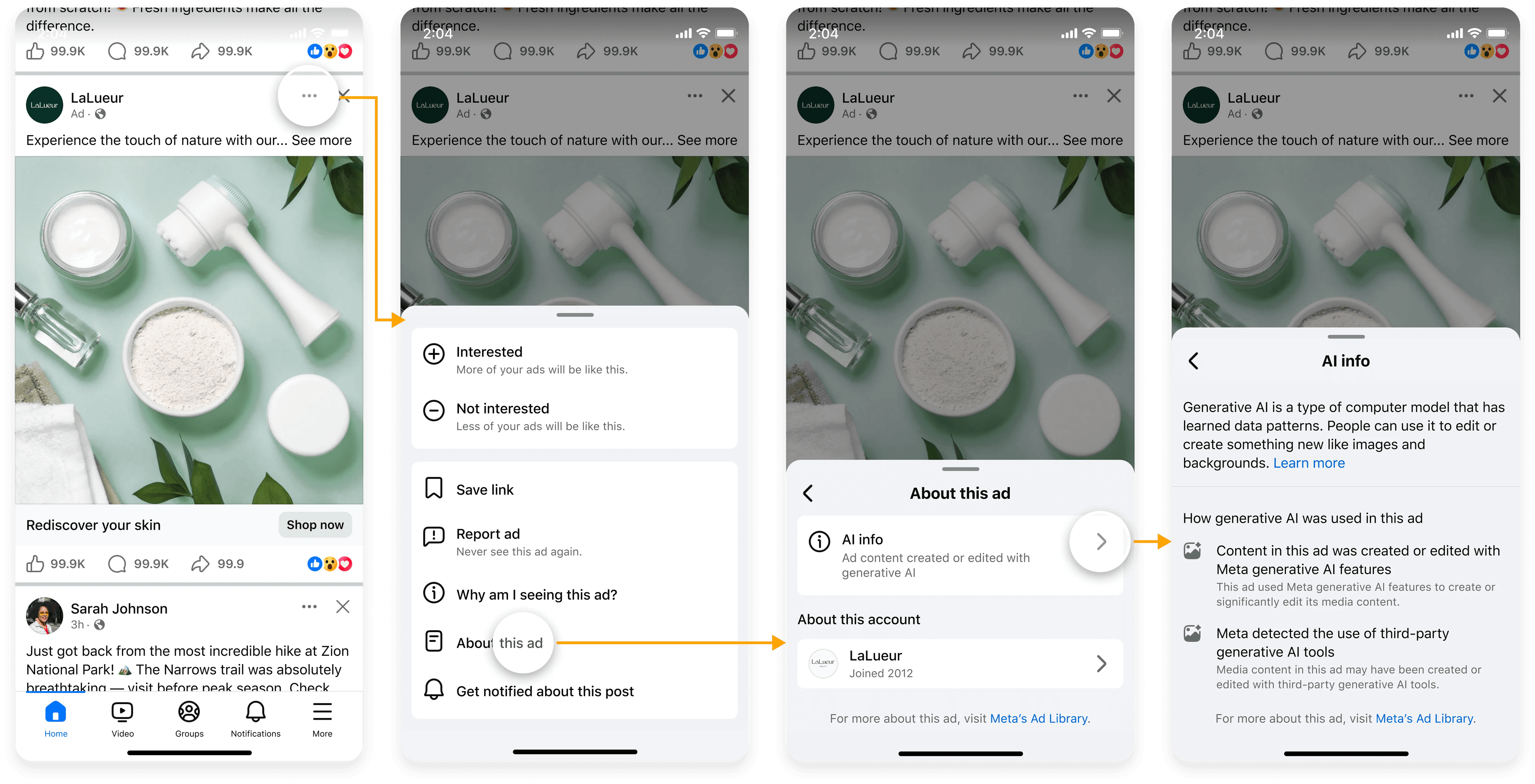
Meta will automatically apply an AI label if they can detect that it was made with third-party tools, which is what invisible watermarking supports.
Configurable controls
Disclosure needs vary by market and brand policy. Ad Studio lets teams set defaults at the brand profile level, controlling when labels and watermarks apply, whether they apply to all AI content or only on faces and likenesses, and where visible labels are positioned. Defaults can be overridden at launch.
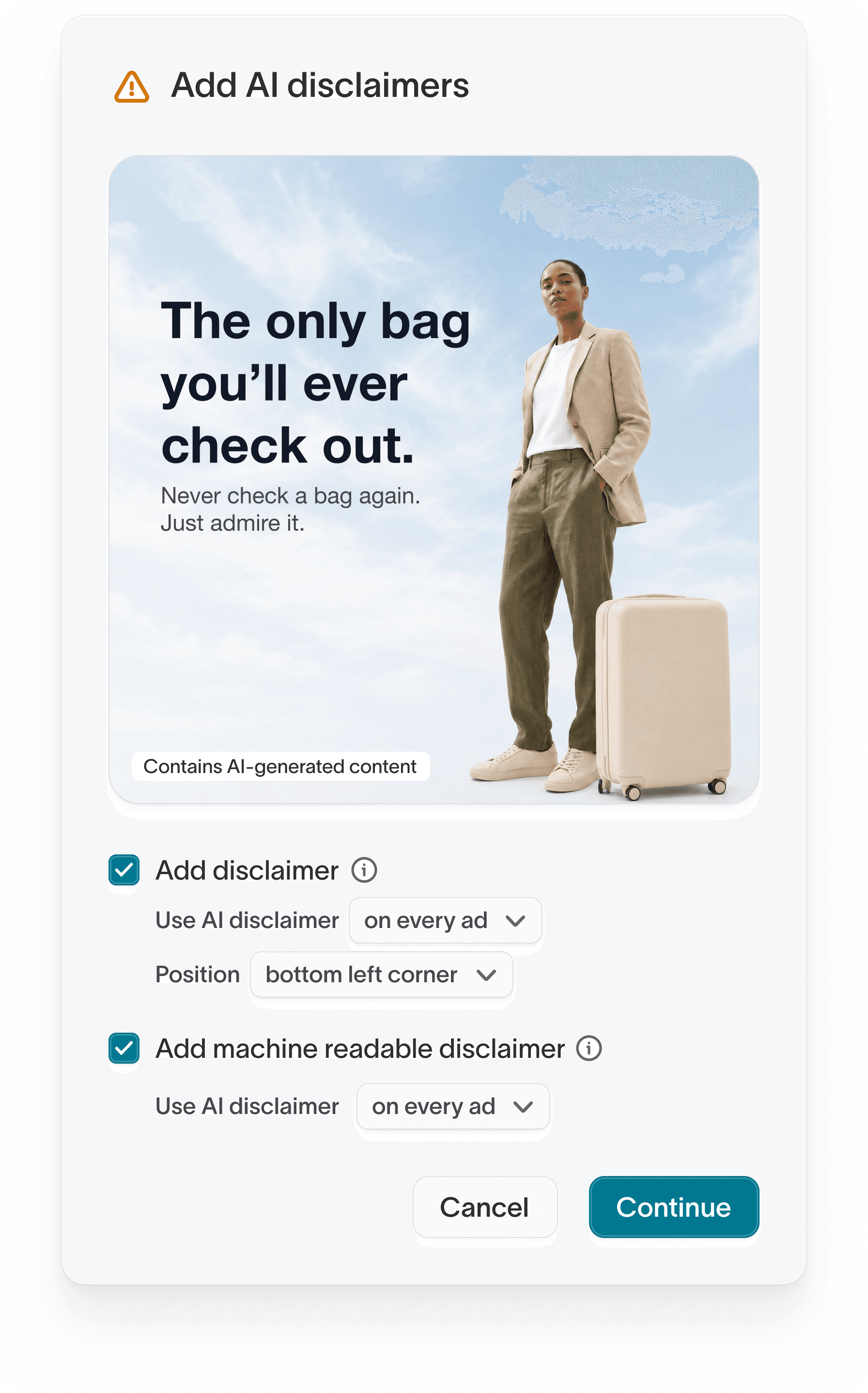
Set default rules for all of your AI-generated creative. Review and override when you download or launch creative.
Why this matters now
The pressure on paid media teams to produce more creative quickly isn't slowing down, and the regulatory landscape is only going to expand. The challenge isn’t identifying AI-generated content once. It’s ensuring disclosures are applied consistently across hundreds or thousands of creative variants. As more governments and advertising platforms introduce their own requirements, compliance needs to become a core part of every brand’s AI strategy.
Hightouch Ad Studio builds those controls directly into the creative workflow. Teams can establish consistent policies, apply the appropriate disclosures, and review the finished asset before anything goes live.
That means marketers can move quickly with AI without treating compliance as an afterthought.
Book a demo with our solutions experts today.
Disclaimer: Ad Studio’s disclosure features are designed to assist with compliance efforts. They do not constitute legal advice. Teams should consult their own legal counsel regarding their specific obligations.