Modern marketing is stuck in slow, coordination‑heavy workflows. Running a single campaign requires weeks of handoffs across data, creative, legal, and channel teams — which makes it nearly impossible to test 500 ideas instead of 5, or react to market moments in real time.
Hightouch’s Agentic Marketing Platform (AMP) breaks that bottleneck. It turns marketing into a system of AI agents running on Databricks, so teams can move from outcomes to execution in minutes rather than weeks. In this blog, we’ll explain what AMP is and how it uses Databricks to deliver strategic, effective marketing and advertising campaigns.
What Is the Agentic Marketing Platform?
Hightouch built AMP around a simple idea: every marketer should be a manager of agents, not a coordinator of tickets. Marketers describe the outcomes they want (i.e. “ship a new cross‑sell campaign for our premium card”). AI agents then go to work across the entire marketing workflow–analyzing data, proposing strategies, assembling on‑brand content, building audiences and journeys, and letting marketers launch and measure campaigns across channels. With Hightouch, marketers can launch 10x more campaigns in days instead of weeks.
AMP is organized into two studios tailored to how teams actually work.
Ad Studio helps performance marketers scale and accelerate their paid media programs. It replaces slow, disconnected processes with an end-to-end, AI-powered workflow. Marketers can proactively discover performance insights, turn that information into hundreds of high-quality ads, edit with ease, and export to any platform–all in minutes instead of weeks.

Ad Studio generates strategic advertising campaigns, informed by performance data, competitor insights, and more.
Lifecycle Marketing Studio helps lifecycle and CRM teams launch 10x more personalized campaigns via email, SMS, push, and in-app. Marketers describe the customer moment or outcome they care about, and agents handle the rest. Hightouch analyzes customer behavior over time and past lifecycle performance, identifies which lifecycle moments are worth acting on, and proposes campaigns tied to those moments. From there, it drafts audiences, assembles on-brand content such as HTML emails, and orchestrates campaigns using tools like Salesforce, Adobe, Iterable, and Braze. Each step includes review workflows, allowing marketers to act as creative directors instead of getting stuck in the execution weeds.
Together, these studios enable teams to run more campaigns and experiments with higher personalization and data-backed strategies.
AMP in practice: Otrium’s story
Otrium is a digital fashion outlet that helps brands sell end-of-season and surplus inventory in 12+ European markets. Their team of four growth marketers was ambitious, but creative resources were limited, so their best ideas were pushed back. It often took 4+ weeks to go from campaign brief to launch.
Otrium turned to the Hightouch Agentic Marketing Platform and saw an immediate impact. Because marketers could build their own high-quality, on-brand creative, they started launching campaigns in just one week– a 70% improvement. Campaigns they’d wanted to test for years were suddenly live within days. Furthermore, because these ads were strategic and informed by data in Databricks, they outperformed their existing ads, generating a roughly 10% improvement in ROAS.
The bigger shift isn’t just results; it’s a change in culture. The Otrium team went from campaign operators — managing queues, waiting on assets, losing good ideas to the backlog — to creative directors who move at the speed they’ve always wanted to.
“If I compare the old growth marketer Philip with the new one, I would say I feel like I'm energized with superpowers I didn't have before. It gives us as a team — but also me personally — much more opportunity to go all in on certain campaigns and things we want to run.”

Philip Sonneveldt
Head of Growth at Otrium
Read Otrium's full case study here.
Why AMP is different: Complete marketing context on Databricks
First‑generation marketing AI added helpful tools like subject line generators and audience copilots, but didn’t change the job. When they made content, outputs were often “fine,” but lacked the context needed to be trusted: brand, voice, past performance, and how the business actually works.
AMP is built on a different foundation: A marketing context layer that unifies everything the agents need to do real work. Hightouch operates directly from a customer's Databricks instance and runs on Databricks Agent Bricks. It can utilize any data within Databricks to analyze performance and customer behavior, as well as to build target audiences for campaigns. Hightouch also pulls in channel‑level context from connected marketing tools, and market and competitive context from competitor ads, third‑party market data, and cultural trends. Finally, it pulls in creative and brand context from existing assets, creative systems such as Figma, and user-inputted brand guidelines, including tone of voice and legal constraints.
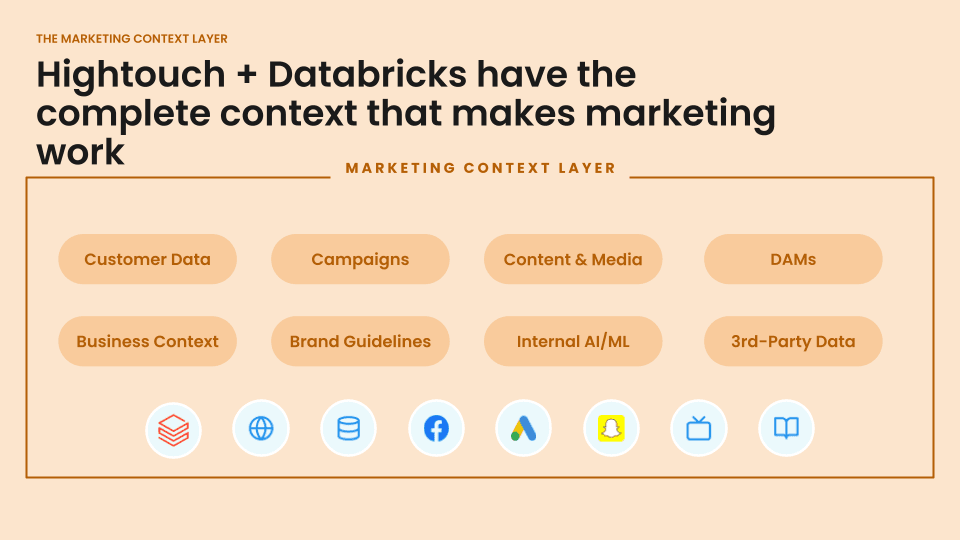
AMP performs well because it operates on a complete marketing context layer.
This complete context is what solves the quality problem teams see with most marketing AI. Campaign suggestions are strategic, grounded in real performance and customer data from Databricks. The content for those campaigns is high-quality, informed by existing materials and brand guidelines. And the execution for those campaigns is also right there at the marketers' fingertips, with audiences Hightouch builds in Databricks and activates to downstream marketing tools.
How AMP runs on Databricks
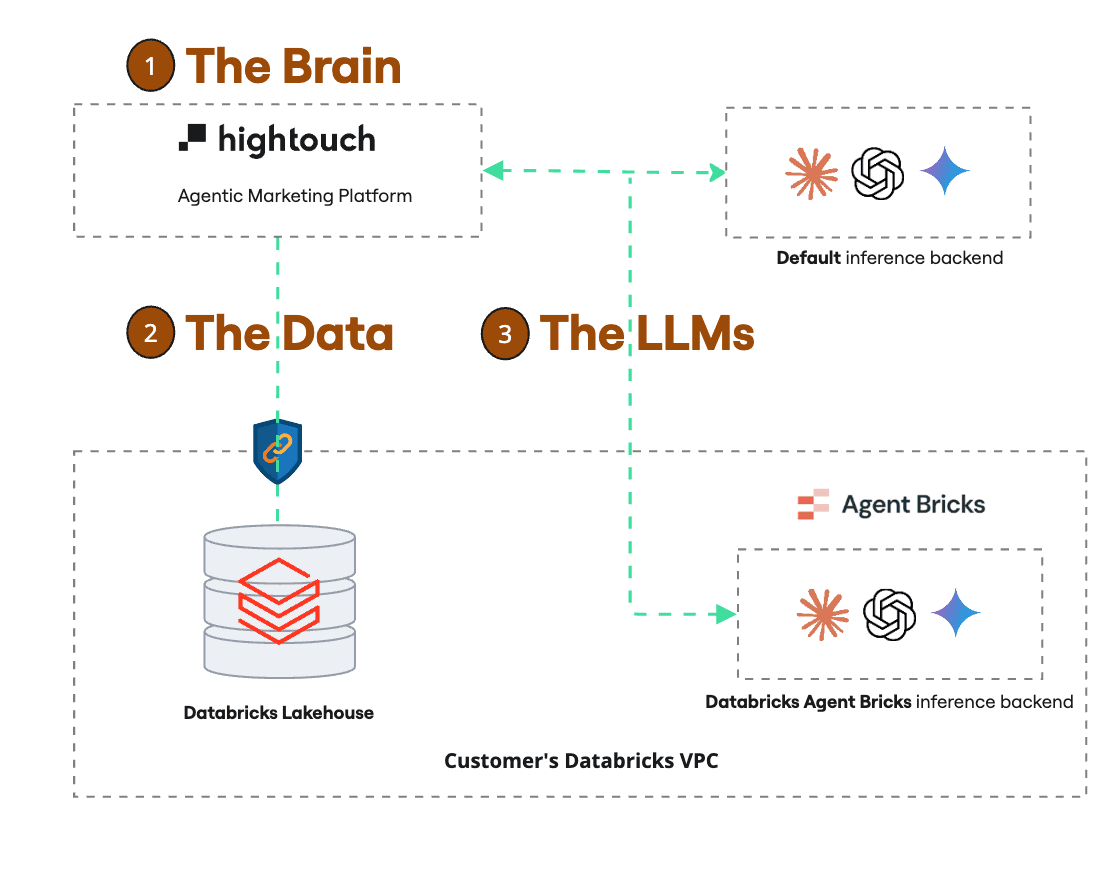
Under the hood, every AMP interaction combines three components:
- The brain: Hightouch's agent harness. This is our proprietary orchestration layer that plans work, manages context, calls tools, and coordinates specialized agents to accomplish marketing jobs. Marketers interact with a simple UI to create and launch new campaigns, and then Hightouch develops a plan to handle those jobs using the following two components.
- The data: The customer's Databricks Data Cloud tenant. This is the system of record for all customer, product, business, and campaign data. Just like in Hightouch's Composable CDP, all data storage, analysis, and audience aggregations happen in Databricks. Hightouch can also pull third-party data from channel tools (ex, email, advertising) and brand and design tools like Figma.
- The LLMs: Databricks Agent Bricks. An “inference backend” is the large-language model (LLM) infrastructure that actually hosts models. Customers can configure their own inference providers, including Databricks Agent Bricks, so that the core agentic loop runs within their secure and governed Databricks tenant.
Closing Thoughts
AI is everywhere, and any tool can offer up a generic chat-based interface. What makes the Agentic Marketing Platform so powerful is that it brings together Hightouch’s marketing expertise, each brand’s complete marketing context, and Databricks data, computational power, and AI workloads on Agent Bricks.
If you’d like to see how AMP can transform your marketing by leveraging the best of your brand context and your investments in Databricks, request a demo with our team.