95% of AI projects fail.
Flashy demos that crumble the moment they hit real data, real traffic, and real enterprise workflows. Governance slips, trust fades, and the pilot collapses. The real question isn’t why these fail; it’s why the 5% succeed.
Two years ago, we made a bet on the answer. If we enabled businesses with AI connected directly to their most complete source of data, and gave it the ability to learn and act across their marketing tools, marketers could finally break out of the endless cycle of AI pilots that never scale.
That bet paid off. We've since launched two major AI products — AI Decisioning and Hightouch Agents — now running in production at leading brands across retail, QSR, fintech, subscription, and travel. Our AI systems have now made over 10 billion marketing decisions, each one learning from the last and reshaping how marketing teams operate in the real world.
From those 10 billion decisions, five lessons emerged. Each one helps explain how to scale AI at a time when so many others cannot.
Lesson 1: AI shines when it understands your whole business
Across all our deployments, one principle has surfaced again and again: The best AI requires the full context of your business’s customer data and the ability to act across every marketing tool.
Placing AI inside a single execution platform rarely works. It only sees a narrow slice of the customer. Instead, AI performs best as an intelligence layer that sits above the stack, drawing on your complete customer data for learning and reaching customers across every marketing channel for action.
Our customers take advantage of this principle every day. Travel brands surface property attributes, availability, and pricing signals to the AI models. Retailers incorporate SKU-level metadata and affinity scores. QSRs enrich profiles with propensity models and location behavior. When the system can learn from all of your business context, it uncovers patterns that no single platform could ever surface.
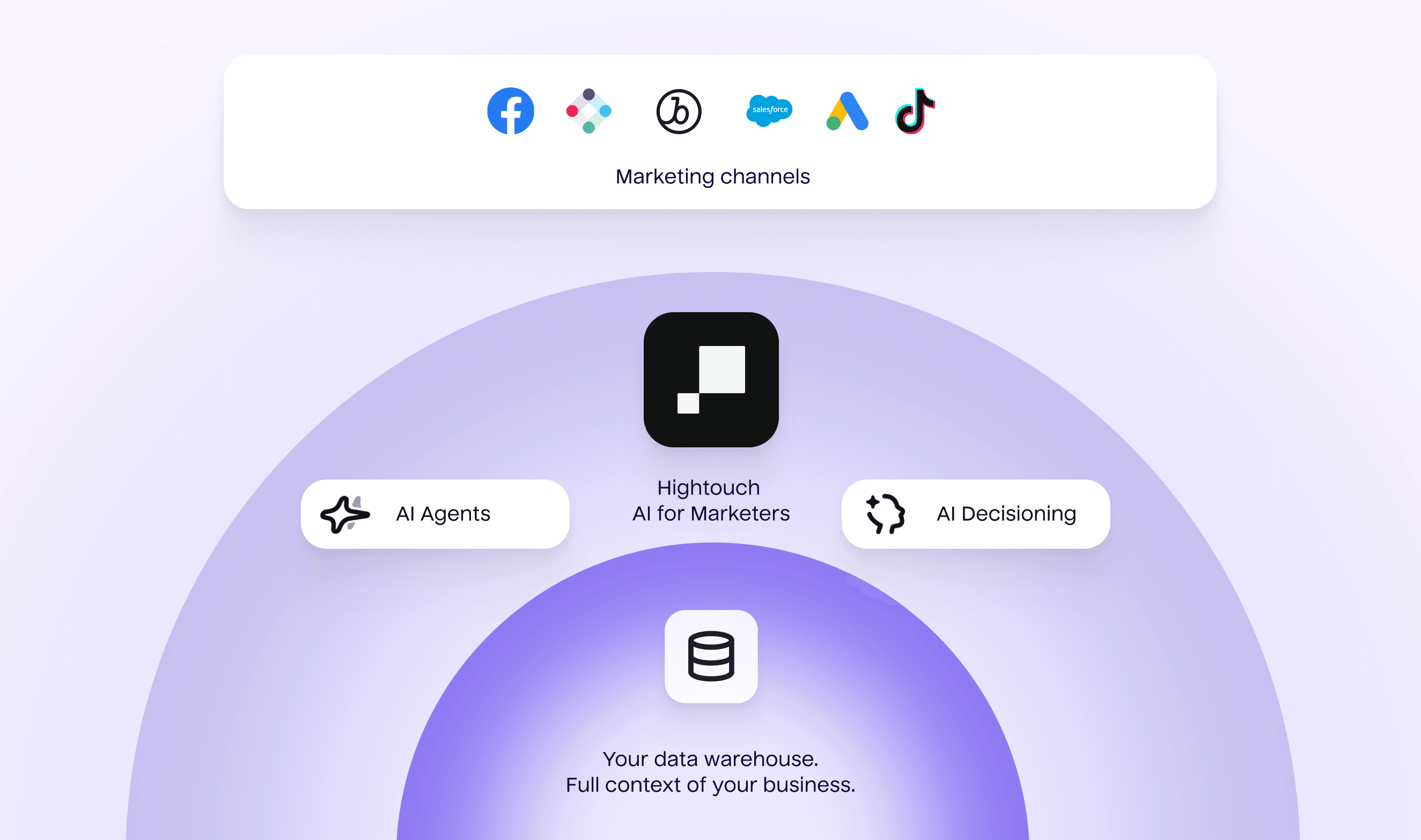
With access to your complete customer data, AI can learn from everything that matters to your business. Connected to every destination, it can act anywhere.
This architecture powers both AI Decisioning and Hightouch Agents. It’s why AI Decisioning can deliver true one-to-one personalization across channels so effectively, and why Hightouch Agents can accelerate campaign building, content creation, analysis, and workflows by 10x.
To get the best out of AI, give it the full context of your business and the freedom to operate across your tools and channels.
Lesson 2: One AI model can’t solve every use case
One of the clearest lessons from two years of deployments is that marketers can’t solve every problem with one AI model. Different approaches thrive under different conditions, and expecting a single model to handle every use case is where many AI initiatives break down.
Reinforcement Learning (RL), which powers AI Decisioning, is a perfect example. RL works best in evergreen lifecycle programs where the system can observe behavior repeatedly and optimize toward a stable, ongoing outcome. That is why certain industries consistently see the strongest lift. Retail brands like PetSmart generate frequent ordering cycles. QSR companies create high transaction velocity. Subscription apps like HelloFresh deliver continuous engagement. Fintech platforms like Fundrise drive clear, repeatable conversion events.
These environments offer (1) high signal density, (2) creative and offer variation, and (3) clear and repeatable outcomes that RL needs to learn, adapt, and continuously optimize.
But RL is only one form of AI. Marketing teams also need ML models that analyze historical data to produce recommendations — for example, propensity scores and product recommendations, which are core capabilities of our CDP.
They also need AI models that can propose campaign ideas, generate content, surface insights, analyze performance, and speed up workflows; tasks where judgment and creativity matter more than constant optimization. This is where Hightouch Agents excel. They use generative (LLMs), predictive, and analytical AI to support the strategic and creative sides of marketing, often compressing multi-week workflows into minutes.
Across AI Decisioning, Hightouch Agents, and CDP we unlock marketing team's ability to leverage all types of AI/ML for different use cases.
Real lift comes from pairing the right AI model with the right use case.
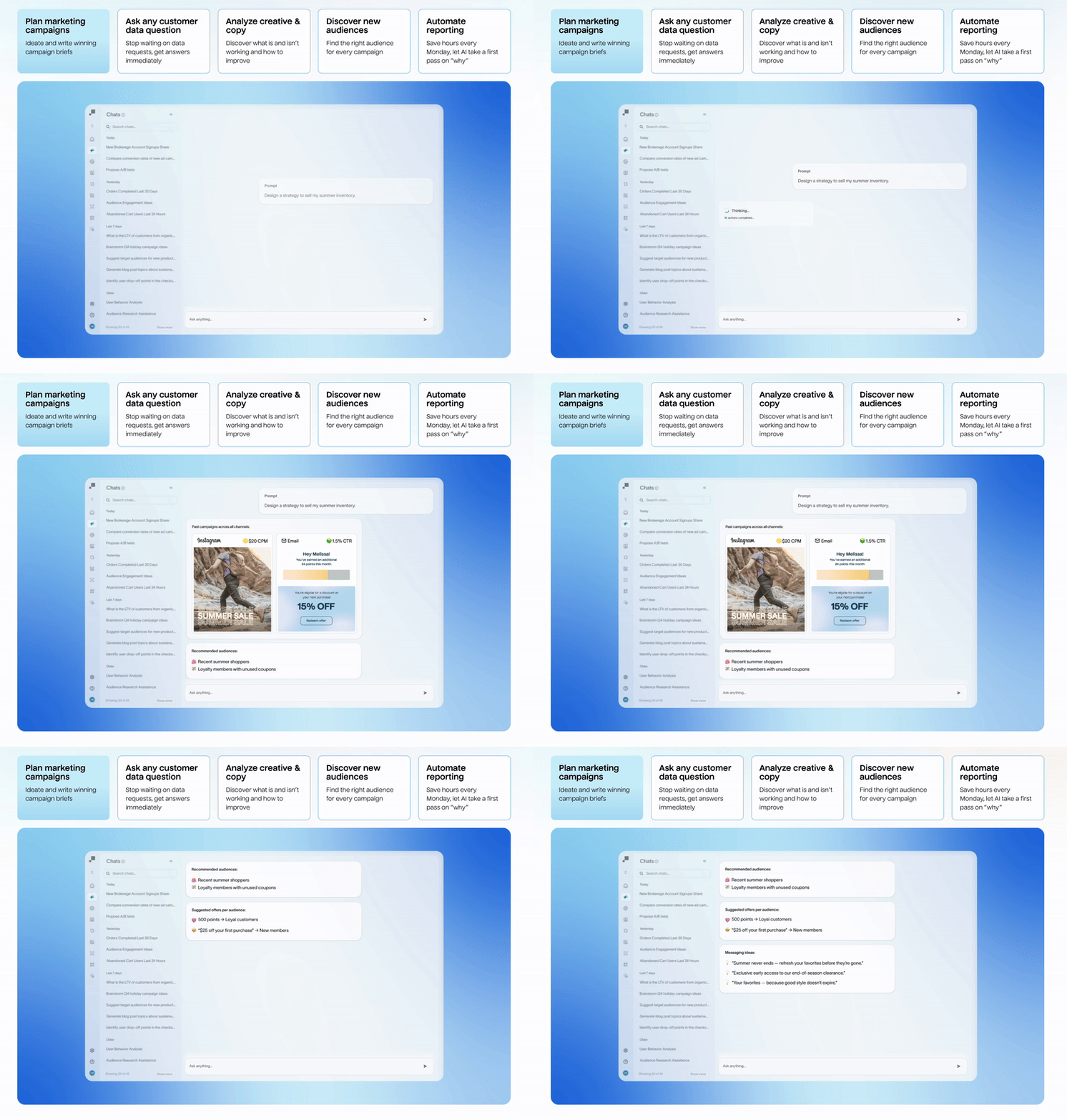
Hightouch Agents answer questions, uncover opportunities, and automate workflows with complete business context.
Lesson 3: Marketers need visibility and control to trust AI
Nothing derails an AI rollout faster than a lack of visibility into how the system thinks and acts. When AI is determining customer experiences, marketers need full visibility into its reasoning, constraints, exploration patterns, and learning behavior. And they need strong guardrails around what the agent can and cannot do.
One team told us that one of their previous AI projects sent seemingly random products to their CEO. Nobody could explain why. The entire initiative was canceled on the spot. Safe to say that visibility and control aren’t “nice to have”; they’re non-negotiable.
That’s why we’ve invested deeply in AI Decisioning features like Guardrails, Inspector, and Smart Suppression. Within Hightouch Agents, every assumption, explanation, and analysis is fully traceable, with all underlying reasons and steps surfaced. These features provide teams with a clear view into how agents think and the boundaries within which they operate, making the system both transparent and safe to scale.
Visibility builds trust… and trust is ultimately what drives adoption.
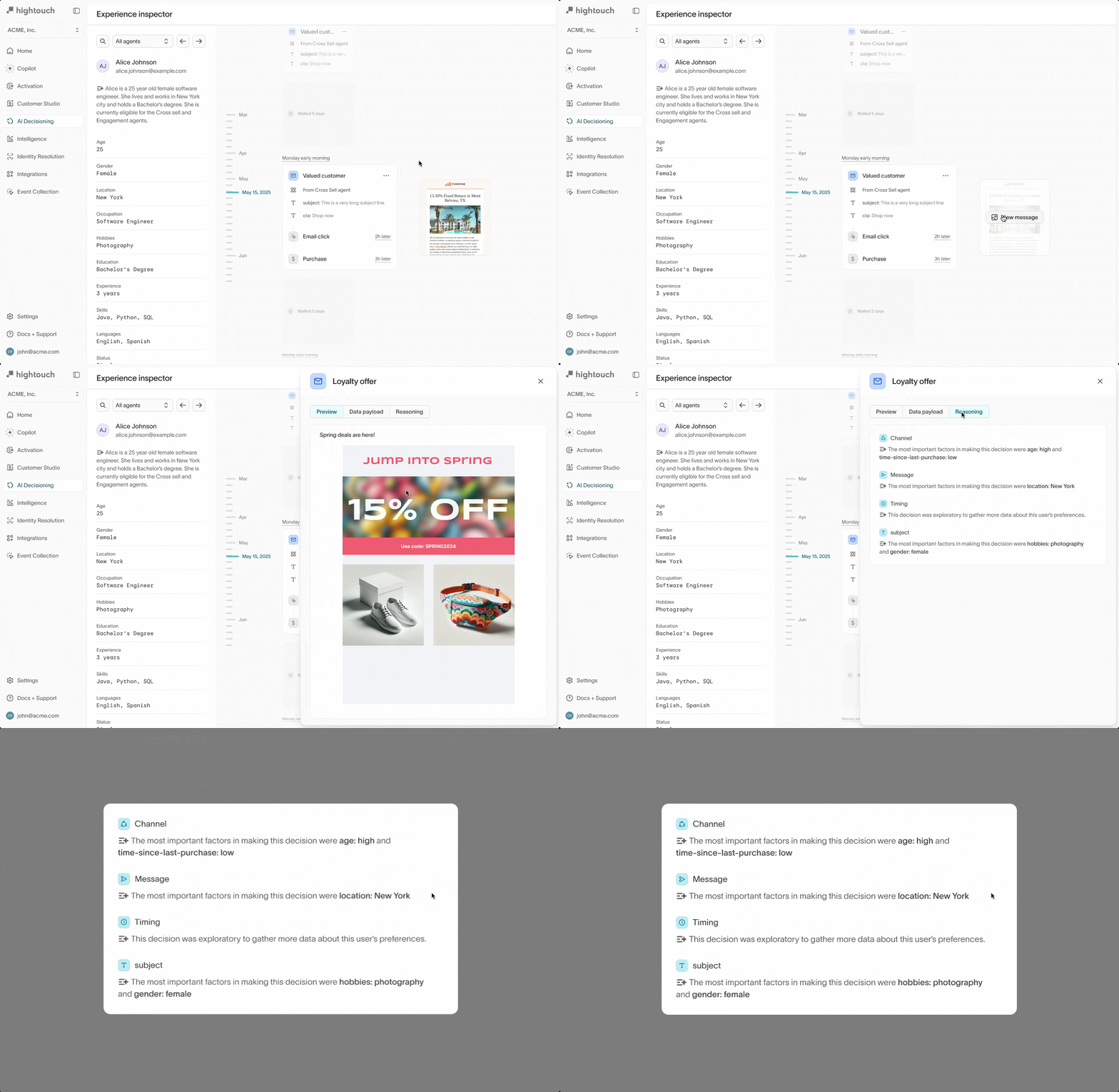
Full transparency into AI decisions.
Lesson 4: Increasing your marketing velocity leads to better results
Most teams come to us interested in using AI to move a business metric. And while metrics get better (+25% on average), something more fundamental happens: the speed of the entire organization accelerates.
Human teams learn and ship linearly. They can build only so many audiences, run only so many experiments, create only so many variations, and analyze only so many reports in a week. But AI operates exponentially. It tests dozens of ideas simultaneously, pushes insights back instantly, and eliminates the manual work that slows teams down. The result is not just better performance, but a radically faster path to finding what actually works.
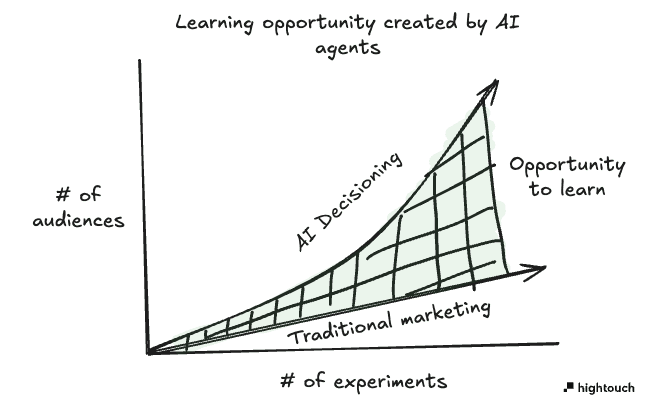
AI Decisioning creates learning opportunities beyond traditional marketing.
WHOOP illustrates this perfectly. When they deployed AI Decisioning, the system surfaced a pattern the team would never have tested manually: members whose top activity was martial arts responded incredibly well to swimming creative. Strange at first, then obvious: high-impact athletes need low-impact cross-training. What mattered was not just the insight itself, but how quickly the system uncovered it. Faster testing led to faster learning, which led to faster wins.
“Within the first six weeks of using AI Decisioning, I feel like we’ve gathered more insights than we had in the prior 12 months. The richness of the data we’ve gotten from it has been phenomenal.”

Aoife O’Driscoll
Lifecycle Marketing Lead at WHOOP
We saw the same dynamic in a completely different context at a publicly traded company whose first AI use case was automating weekly reporting with Hightouch Agents. Each marketer regained +8 hours a week that had previously been spent assembling data. They reinvested that time into experimentation and strategy, which ultimately accelerated performance far more than any single automated report could on its own.
This is the pattern everywhere. AI accelerates shipping, observing, and adjusting. It lowers the cost of trying new things. And because most ROI comes from a small fraction of what teams try, speed becomes the real unlock.
The real value of AI comes from the combination of lift and the speed at which teams can learn, ship, and improve.
Lesson 5: AI succeeds when the organization is designed to support it
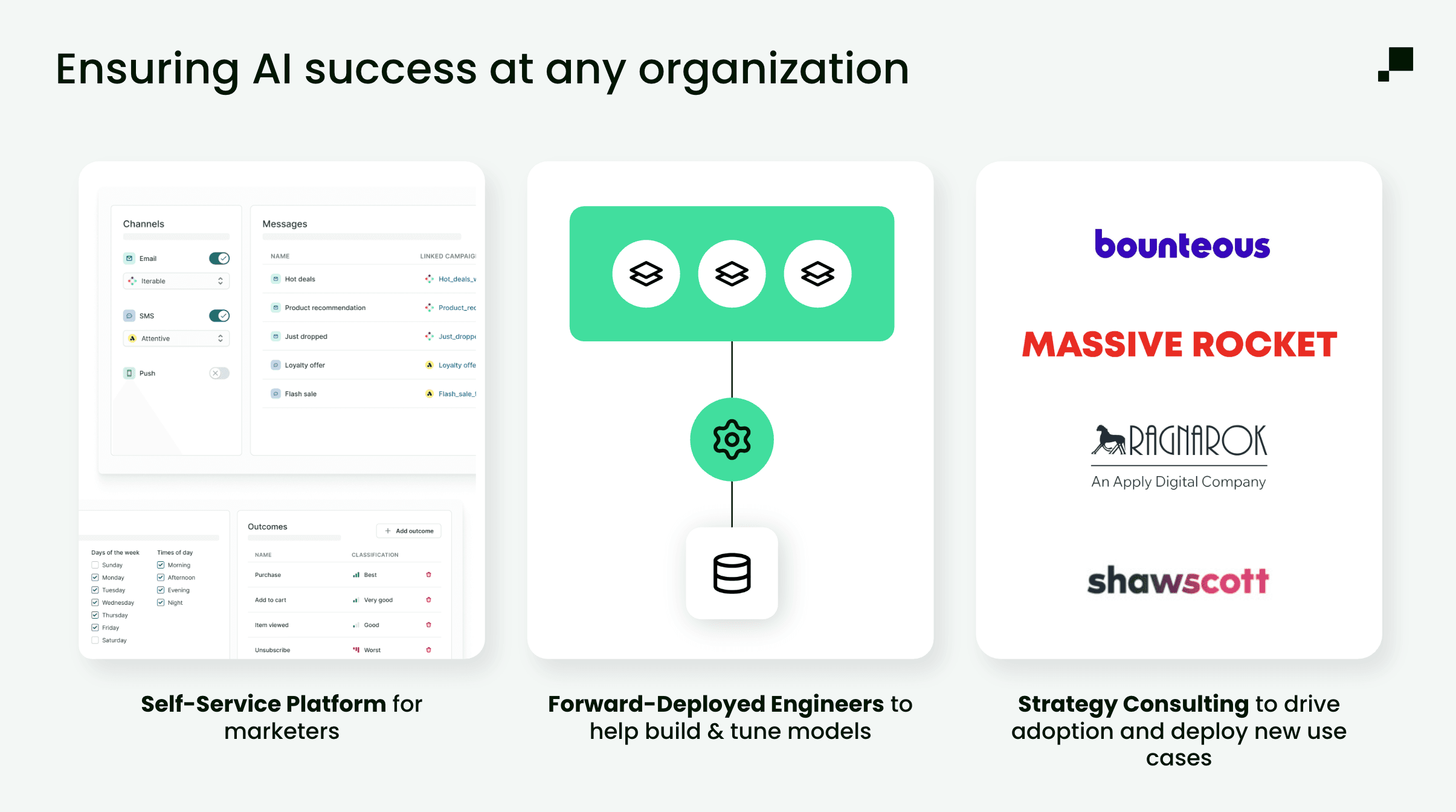
A pattern we learned from enterprise rollouts this year was that success depends on far more than the model itself. It depends on the operating environment around the model. When companies adopt agents, their workflows shifts, and they often need help navigating this change to adapt. We learned quickly that enterprises achieved the strongest results when three components worked together:
- Self-serve marketer UI to allow marketers to create, manage, and monitor agents without technical dependencies.
- Forward-deployed engineers to tune models and prompts, instrument the right signals, and help structure data for learning. We’ve built an entire team around this.
- Strategic partners to help rewire traditional workflows and guide use-case selection. Our work with Apply Digital, Bain, BCG, Bounteous, Massive Rocket, Shaw/Scott, and others has been critical in helping enterprises adopt agents the right way.
AI succeeds when the people, processes, and partners around it are ready to operate differently.
The road ahead
Stepping back from the numbers, most AI projects fail for predictable reasons. They rely on incomplete context, the wrong models for the wrong problems, black-box systems that marketers can’t trust, and organizations that aren’t structured to support new ways of working.
The teams that break out of that pattern do something different. They build the operating environment that the model needs. They pair the right intelligence with the right use case. They design for visibility, speed, and continuous learning. And they treat AI not as a feature inside a channel, but as an intelligence layer that guides the entire stack.
That’s the future we’re building toward — one where AI doesn’t remove the craft from marketing — it amplifies the people who practice it. And if the first 10 billion decisions are any indication of what’s to come, we’re beyond excited to show you what comes next.
If investing in AI is a goal for your marketing strategy next year, book time with our team. We'll walk you through what we've learned from scaling AI in production and how to build a AI strategy that works.