While trust is the biggest roadblock to generative AI adoption, according to Pew research, other concerns include AI explainability, ethics, and bias.
We also know that just five companies paid €4.21 billion ($4.56 billion) in GDPR fines alone for customer data breaches between 2021 and 2025, according to GDPR Tracker.
The stakes for AI governance are immense. And marketers are feeling these roadblocks acutely. Every AI tool that touches your campaigns carries the same risks that keep your IT team up at night: brand violations, data misuse, and regulatory exposure.
Meanwhile, the customer data that feeds those campaigns and the brand assets that shape AI-generated output flow ungoverned through dozens of SaaS tools.
AI Governance has become a board-level operational priority. Unfortunately, governance has earned a bad rep because most programs are built to block rather than let marketing move faster with confidence.
The programs that succeed do the opposite. They first make the data foundation and brand knowledge governable. They then ensure the rest of marketing can run at the speed the business demands.
Accelerated by the EU AI Act and the rise of autonomous agentic AI, enterprise teams must adapt rapidly.
Highlights
- Governance is a cross-functional mandate: Effective oversight requires active collaboration between the marketing teams, Chief Data Officer, security, legal, and business stakeholders.
- AI governance extends beyond the model: True risk management requires governing the underlying data foundation and operational brand knowledge, not just the algorithms.
- The Composable CDP is the structural anchor: A warehouse-resident architecture applies access controls and data lineage rules before data ever reaches an AI system or marketing campaign.
- Brand assets are governable data: Agentic AI reasoning against undocumented brand rules produces autonomous brand-policy violations at scale.
- **Marketing must own the brand governance layer: **IT can govern the model and legal can govern compliance, but only marketing can govern whether AI output represents the brand correctly.
More than a model audit: what is AI governance?
AI governance is the comprehensive set of processes, standards, policies, roles, and tools that direct how an organization develops, deploys, monitors, and retires AI systems. The ultimate goal is to ensure that, throughout their existence, those systems remain legally compliant, transparent, safe, and fair.
This discipline covers both internal models built by your data science teams and third-party AI tools procured from external vendors. Many organizations focus entirely on internal algorithms, overlooking the fact that vendor AI carries the same regulatory and reputational risks.
Modern governance must also account for brand knowledge, a category most traditional definitions completely miss. Generative and agentic AI systems reason against brand assets to produce output. Without strict governance at this brand layer, AI can produce rapid, autonomous brand violations that** erode customer trust faster than a data breach.**.
AI governance Vs. data governance Vs. AI ethics
To understand the scope and function of AI governance, differentiate it from two closely related disciplines:
- AI ethics establishes the foundational values and principles of governance. It asks what an AI system should fundamentally do to avoid harm.
- Data governance manages data quality, access controls, and data lineage. It focuses entirely on the information that feeds corporate systems.
AI governance acts as the operational bridge connecting these two disciplines. It combines ethical guidelines and data protection rules with structural risk management, accountability mechanisms, and model oversight.
All three components are necessary for the modern enterprise. But none of them alone can protect a business from algorithmic discrimination, regulatory penalties, or large-scale brand damage.
Why this is now a marketing leadership problem
Three distinct forces converged to make AI governance a marketing priority, not just an IT one:
- **Every marketing team is now deploying AI. **Marketing teams are increasingly adopting AI tools. That means marketing now owns significant AI risk, whether or not a governance framework acknowledges it.
- **Brand violations scale faster than data breaches. An ungoverned AI system sending off-brand creative to millions of customers or including unapproved claims in content causes brand damage that compounds with every impression. ** In fact, 65% of executives state that agentic AI will require significantly stricter ethical guidelines than current AI systems, according to IBM IBV.
- It's now written law: The EU AI Act transformed theoretical guidelines into strict, enforceable legal obligations that apply to the AI systems marketing teams use every day — not just internal models built by data science.
Combined, these factors make oversight a non-negotiable requirement for modern marketing strategy.
Risks of improper governance
Governance frequently earns a reputation as an organizational roadblock. Most programs are designed strictly to prevent action rather than making the underlying architecture governable. For marketing teams, the consequences mean more bottlenecks and slower speed to launch campaigns because the formal process is too cumbersome.
Governance programs that fail tend to fall into one of three categories:
- Compliance-only governance: This is when the organization delegates AI oversight entirely to legal teams without giving marketing and other business stakeholders a formal role. Without the people who actually deploy AI in campaigns at the table, governance becomes a gate that slows work without improving output quality.
- Model-only governance: This type of governance focuses entirely on auditing algorithms. It fails because a model that possesses a perfect audit trail but relies on fragmented customer data and undocumented brand rules constitutes pure governance theater.
- Static auditing: Treating oversight as a static audit rather than a dynamic operational practice creates additional governance bottlenecks. Programs built exclusively to pass an initial review will inevitably fail as models drift, regulations evolve, and agentic systems execute more tasks autonomously.
The programs that actually work invert this usual order:
- They first make the data foundation and brand knowledge governable
- They then layer on the necessary model audits and policy documents
- They ensure ongoing audits throughout the AI lifecycle
What ungoverned AI actually costs marketing teams
These are the specific risks marketing teams face when AI systems operate without governance — and the reason this isn’t a problem you can delegate entirely to IT.
False or misleading product claims
AI sometimes fabricates capabilities, performance metrics, or customer results. A generated ad claims a feature that doesn’t exist. A lifecycle email cites ROI benchmarks the company never published. A landing page states “best in class” with no supporting evidence. The content looks polished and authoritative, which makes it harder to catch — and more likely that sales teams will repeat the claims because they saw them in “official” marketing content.
Compliance and regulatory violations
AI can lack awareness of industry-specific regulations. Financial services content implies guaranteed returns. Healthcare campaigns include unapproved medical claims. Personalized content suggests data practices that violate privacy regulations. For public companies, AI-generated content may include language that could be interpreted as forward-looking statements.
Brand drift and positioning erosion
Without a governed brand context layer, AI may gradually shifts messaging away from approved positioning. Different value propositions appear across channels. Product descriptions contradict each other. Messaging becomes generic rather than differentiated. This happens slowly enough that no single piece triggers a review, but over months, the cumulative drift weakens market perception and confuses prospects.
Biased or exclusionary content
AI is known to reproduce biases present in its training data, which can include stereotypical imagery, exclusionary language assumptions, culturally insensitive copy in global campaigns. These outputs can reach millions of impressions before anyone flags them, especially in automated channels where human review is minimal.
Copyright and intellectual property exposure
AI-generated content can unintentionally mirror competitor copy, include copyrighted visual elements, or reuse proprietary content from training data.
Privacy and confidential information leaks
Teams can unknowingly expose sensitive information to AI systems, or AI-generated content includes confidential details such as unreleased product plans, customer names or data, or internal metrics not intended for public release.
Hallucinated sources and fabricated research
AI can generate authoritative-sounding citations that don’t exist such as fake analyst quotes, invented customer testimonials, nonexistent research findings, fabricated market statistics. These are especially dangerous in thought leadership content, case studies, and sales enablement materials where credibility depends on verifiable sources.
Competitive misinformation
AI can incorrectly characterize competitors with incorrect feature comparisons, inaccurate pricing, or misrepresented capabilities. This may show up in competitive battlecards, comparison pages, and sales content that reps use in live conversations.
Crisis amplification
A small AI error has the potential to propagate across channels before anyone catches it such as an incorrect promotional offer, a misleading product announcement, a tone-deaf automated response during a sensitive news moment. The speed and scale of AI-generated content means errors reach more people, faster, with less human review.
SEO and AI search visibility damage
Ungoverned AI-generated content can harm discoverability due to low-quality pages that dilute domain authority, factual inaccuracies that get indexed by search engines and cited by AI answer engines, or content that contradicts existing website messaging and creates conflicting signals. Once information is indexed, it either negatively impacts brand visibility in search or persists incorrectly in AI-generated answers long after the source content is corrected.
Four principles every AI governance framework needs
Marketing leaders don’t need to become governance experts, but understanding these four pillars helps you advocate for the right controls when your team is deploying AI at scale.
Transparency and explainability
Transparency requires that stakeholders thoroughly understand how an AI system makes decisions. This means documenting not just the final output but also the underlying reasoning and data inputs that drive the conclusion.
Fairness and bias control
Bias almost always enters an AI system at the data layer. Skewed training data produces skewed models, which produce algorithmic discrimination
Brand and inclusivity guidelines also belong in this category. A model trained on corporate language that excludes specific audience segments will produce output that perpetually excludes those users in every personalized experience it generates.
Accountability and ownership
Accountability in AI governance requires that an organization explicitly identify who is responsible when an AI system causes harm or violates policy. Without distinct ownership, accountability diffuses across various departments. This often results in scenarios where no one takes corrective action.
Privacy and security
AI systems ingest and process vast amounts of personal and sensitive data. Regulations such as GDPR compliance and the EU AI Act impose rigorous data privacy requirements on any system that handles this information.
AI also introduces unique security risks: model-inversion attacks designed to reconstruct training data, adversarial inputs and prompt injection, unintended data leakage from generative outputs, and agent hijacking.
Marketing teams using AI for personalization and audience targeting need to understand that the customer data flowing through these systems is subject to the same security requirements as any other enterprise AI deployment.
The three AI Governance frameworks worth knowing
Marketing leaders don't need to invent governance structures from scratch. Several global organizations have developed comprehensive frameworks to guide enterprise compliance and risk management — and even if your IT or legal team owns the implementation, understanding them helps you advocate for marketing’s seat at the table.
- The NIST AI Risk Management Framework (Govern, Map, Measure, Manage) is the most widely adopted in US-regulated industries and most likely to shape your organization’s internal structure.
- The EU AI Act is the world’s first enforceable AI regulation, classifying systems into risk tiers from minimal to unacceptable. If your marketing campaigns target EU customers or your AI tools process EU customer data, this applies to you directly.
- The OECD AI Principles, adopted by 40+ countries, focus on human rights, transparency, robustness, and accountability. They signal where regulation is heading even in markets that haven’t passed formal AI legislation yet.
Why marketing must be at the governance table
AI governance is never successfully owned by a single business function. But in most organizations, marketing isn’t even in the room when governance decisions are made, despite being deployers of AI tooling.
Leadership sets the tone
Ultimate operational and financial accountability rests with the CEO and the corporate board. Leadership sends a clear signal to the enterprise by investing visibly in responsible AI through governance training, dedicated policies, and internal standards.
The governance cap marketing must close
Effective AI governance committees typically include internal audit, data engineering, the CDO, CISO, and legal counsel, which are necessary but insufficient.
The team most governance models leave out is marketing operations and brand. Generative AI consumes brand assets to produce output across ad creative, email copy, landing pages, personalized content. If no one on the governance committee understands brand guidelines, approved claims, and voice rules, the AI can produce autonomous brand-policy violations at scale.
IT can govern the model and legal can govern compliance, but only marketing can govern whether AI output represents the brand correctly.
If you’re a marketing leader and your organization has an AI governance committee, your team needs a seat.
Governance applies across the entire AI lifecycle
Effective governance isn’t a one-time deployment review. It applies at every stage: before training (auditing data sources, verifying consent, establishing quality baselines), at deployment (documenting decision logic, model assumptions, and known limitations), and continuously after launch (monitoring for drift, maintaining audit trails, revalidating performance).
For marketing leaders, the critical insight is that the AI systems generating your campaigns went through each of these stages, and governance gaps at any stage affect the quality and safety of what reaches your customers.
Technical flaws compound: a data quality defect in a traditional database affects a fraction of reports; that same defect embedded in training data contaminates every prediction the model makes and every campaign decision that follows.
Agentic AI makes continuous monitoring especially critical. An agent managing your lifecycle program or generating ad variants is making autonomous decisions at a speed and scale that manual review can’t match. Real-time oversight is critical to prioritize over periodic audits in order to catch drift before it reaches customers.
The three governance program layers (and the one many skip)
Most players in the AI industry treat governance strictly as a model-layer or policy-layer problem. We argue that governing AI also means governing the data, brand assets, and workflows that feed those systems.
If your customer data is fragmented across SaaS tools and your brand assets live in unstructured documents, only governing the models consuming them is pure governance theater.
The structural answer is to anchor oversight at the foundation.
A model is only as governed as its inputs
Every AI model is only as governed as the training data and the information it consumes at inference time. A well-documented algorithm running on unverified, fragmented customer data provides a dangerous illusion of security.
The EU AI Act mandates documented data governance systems for high-risk AI. This regulation explicitly calls for strict oversight at the operational data layer, proving that model governance alone is legally insufficient.
For marketing specifically, this means the customer data powering your personalization, audience targeting, and AI-driven campaign decisions must be governed at the source, not just at the model layer.
Brand knowledge is the governance gap marketers must close
Generative and agentic AI tools heavily consume brand assets to generate autonomous output, including editorial standards, approved claims, visual standards, and voice rules
When these assets are ungoverned or only exist as static files, the AI might execute fast, autonomous brand-policy violations.
Consider this scenario: your brand team spent months developing updated messaging guidelines, but they live in a PDF on a shared drive. Your performance marketing team is using an AI tool to generate ad variants at scale. The AI has no access to the current guidelines — it’s working from training data that may include outdated positioning, discontinued products, or unapproved claims. An automated campaign sends thousands of off-brand ads before anyone notices.
The model was recently revalidated. The decision logic is sound. There’s no detectable bias. All audit trails are clean. There's nothing to tell you that the system did anything wrong. The problem was ungoverned brand assets.
Governing operational brand knowledge means providing a structured brand context that the AI can reason against in real time with a live, queryable representation of your brand guidelines, approved assets, voice rules, and product claims that updates as your brand evolves.
This is the difference between AI that produces more content faster and AI that produces more on-brand content faster. For heads of brand and creative who worry that “AI for creative” means “AI replaces creatives,” a governed brand context layer is the mechanism that keeps humans in creative control while letting agents handle production volume.
Anchoring governance at the data warehouse
A modern cloud data warehouse serves as the natural governance anchor for enterprise customer data. It already provides sophisticated role-based access controls, detailed data lineage tracking, and automated quality monitoring.
A Composable CDP runs on this warehouse rather than copying customer data into a completely separate vendor system. This architecture preserves all existing governance protocols, eliminating the need to re-govern data scattered across dozens of operational SaaS tools.
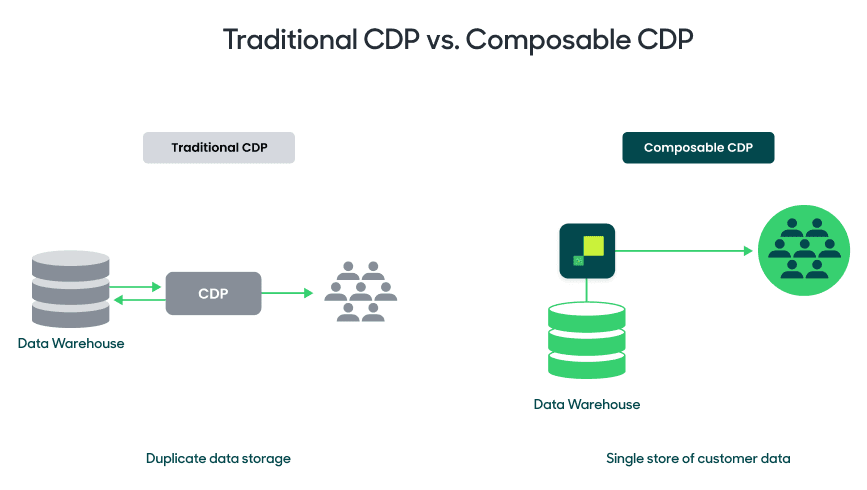
For customer data specifically, strict rules regarding consent, privacy, and PII must apply before the information ever reaches an AI model. You can't reliably enforce these rules post-hoc through model explainability alone.
Hightouch enables marketing teams to govern the customer data and brand context flowing into AI systems through a Composable CDP foundation.
With Customer Studio, AI Decisioning, and the brand context layer, teams can securely route warehouse-resident customer data to downstream applications while maintaining full data lineage and ensuring that every AI-generated campaign asset is built on governed brand knowledge.
For example, a marketing team deploying an AI-generated campaign needs absolute certainty regarding which customer data and brand assets are feeding the AI. The Composable CDP and brand context layer give admins granular control over access, ensuring only approved, governed information informs the AI's creative output.
Building an AI Governance program that works
Transforming ethical principles into operational action requires a phased approach. For marketing leaders, the goal is to ensure marketing has a seat at the table and that the program addresses the brand and campaign risks that only marketing can see.
Three maturity levels
- The informal stage: You rely entirely on values-based guidelines and internal ethics committees. You lack any formal technical structure. Marketing teams deploy AI tools with no governance review.
- The ad hoc stage: You implement specific risk policies in response to isolated incidents. This is common for companies with limited AI production experience. Marketing governance is reactive. Someone catches an off-brand AI output and a new review step gets added.
- The formal stage: Features a comprehensive, fully documented framework. AI governance is closely aligned with standards like the NIST AI Risk Management protocol. Marketing operations has a formal governance role, brand assets are treated as governable data, and AI-generated campaign output is monitored continuously.
Your six-step AI governance roadmap
So how do you go from the informal to the formal stage? You can follow this roadmap:
- Establish the governance committee by assembling a cross-functional team including the CDO, CISO, legal, data engineering, marketing operations, brand leadership, and business unit leads. Define a strict charter and a clear escalation path for potential violations.
- Inventory your AI systems to build a comprehensive list of every model in development or production. Explicitly include third-party vendor AI. Classify each system by its inherent risk level using the EU AI Act framework or NIST tiers.
- Define your accountability structure by specifically naming a responsible owner for every AI system in your inventory. For marketing AI systems, ensure the brand team has explicit sign-off authority on outputs that represent the brand.
- Govern the data foundation first by auditing the customer data and brand assets that feed your models. Establish data lineage, access controls, quality baselines, and consent documentation for everything flowing into AI systems. A Composable CDP architecture like Hightouch makes this highly implementable. Fragmented SaaS architectures render it nearly impossible.
- Implement continuous monitoring by deploying automated bias detection, drift monitoring, and performance alert systems. Establish immutable audit trails for AI decisions and enforce scheduled periodic revalidation. For marketing, add brand-compliance monitoring: are AI-generated outputs staying within approved guidelines, claims, and voice rules?
- Train the organization thoroughly. Governance fails when it resides solely with a compliance team. All AI system owners, data engineers, brand owners, marketing leaders, and business stakeholders require comprehensive baseline training on ethical guidelines.
Governance is the moat, not the bottleneck
Most marketing leaders hear “AI governance” and think: slower approvals, more bureaucracy, another blocker to shipping campaigns.
But the marketing organizations that have the greatest success with AI are the ones that figure out governance first. Not just because regulation requires it, but because governed AI is better quality. And better quality outputs mean your team spends less time reviewing and more time on strategy.
If you're ready to govern the customer data and brand context that feed your AI systems, Hightouch's Composable CDP-aligned foundation gives marketing teams the access controls, lineage, and operational brand knowledge required to scale AI safely now and in the years to come. Talk to our team to modernize your data strategy today.
Frequently asked questions
Q1: What is AI governance and why does it matter now?
AI governance is the system of processes, standards, and roles that direct how an organization develops, deploys, and monitors AI. It matters now because it's no longer an optional future-state endeavor. It's an immediate operational necessity after the EU AI Act entered force in 2024.
Q2: How is AI governance different from data governance?
Data governance specifically manages data quality, access controls, and data lineage. Its goal is to control what information AI runs on. AI governance is far broader, encompassing data, AI models themselves, the brand context consumed, accountability structures, and regulatory compliance.
Q3: Why is the data foundation critical to AI governance?
The data foundation is critical because any AI model is only as governed as the training data and information it consumes. A well-documented algorithm running on unverified or fragmented customer data creates a dangerous illusion of security, often referred to as governance theater.