


Hightouch is an enterprise-grade composable CDP and AI platform built for marketers, with real-time activation at its core. Salesforce CDP (now known as Salesforce Data Cloud for Marketers) Salesforce CDP (now Salesforce Data Cloud for Marketers) is a traditional, monolithic CDP designed primarily around the Salesforce ecosystem. Both help teams sync customer data to downstream destinations like CRMs, email platforms, and ad networks, but the architecture and operating model differ dramatically.
However, the devil is in the details. The architecture of each are vastly different. Salesforce CDP is a “traditional CDP” while Hightouch is a warehouse-centric, “composable CDP”.
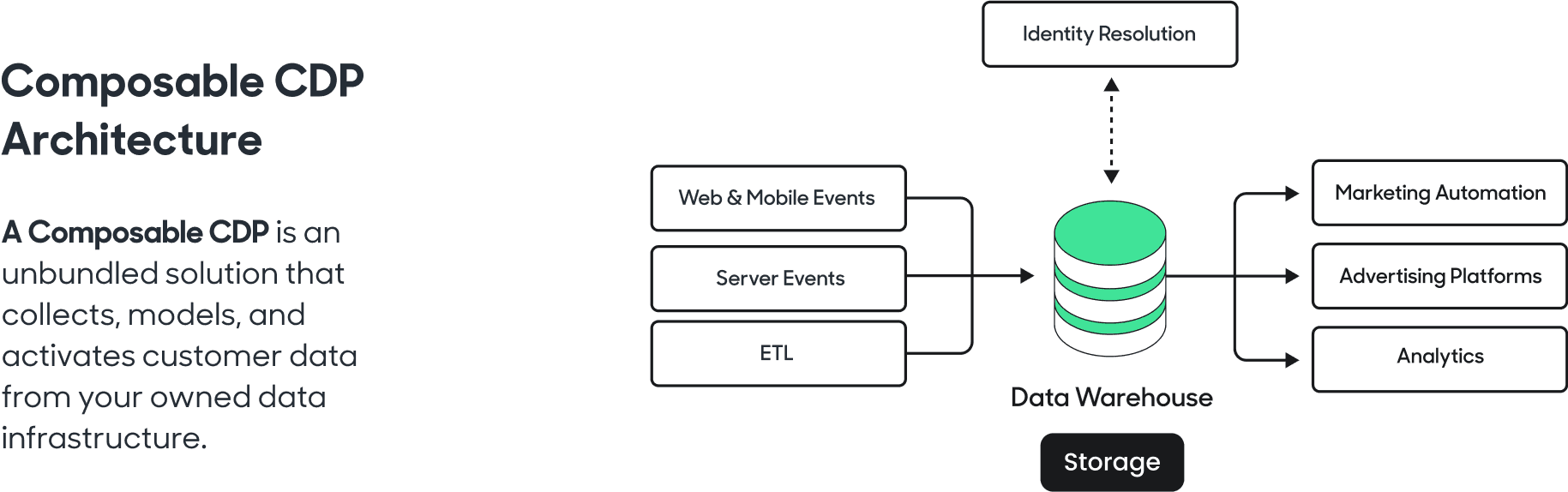
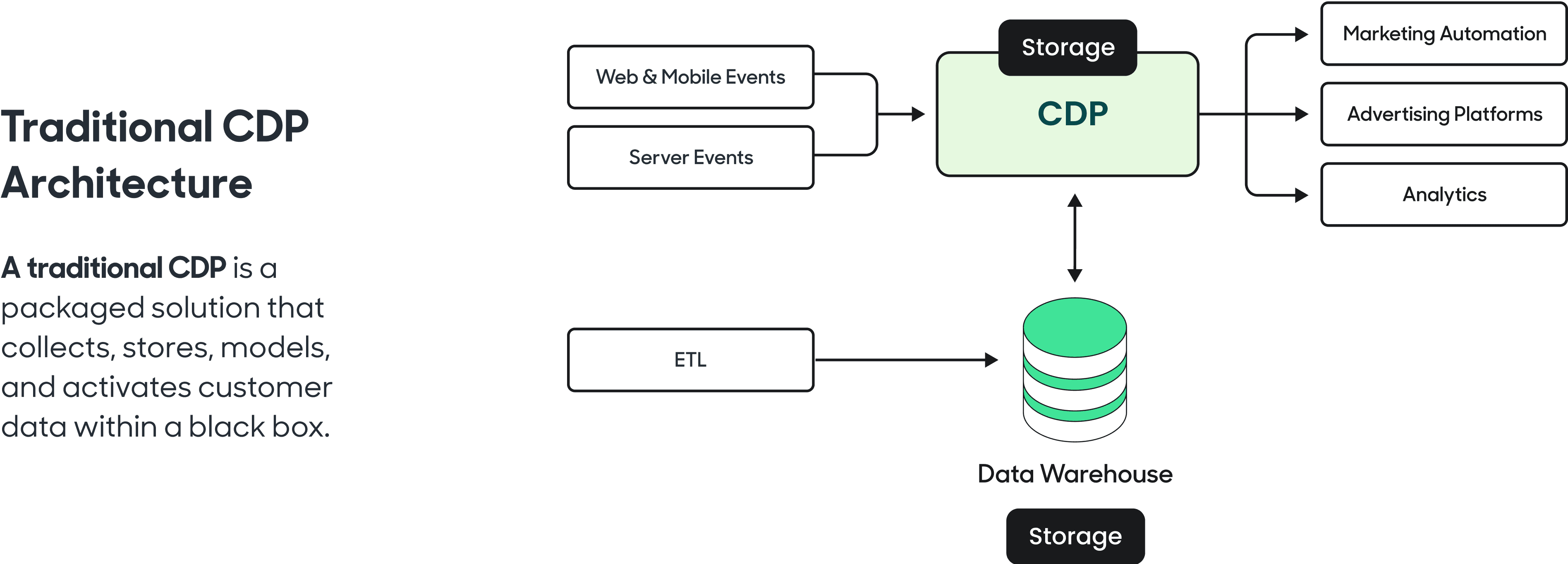
This architectural difference leads to massive differences in cost, implementation time, and usability despite the fact both platforms allow you to do a similar thing at a high-level. Hightouch’s composable architecture is what makes it enterprise-ready while still being easy to use. Marketers can build audiences, journeys, and activation flows in a no-code UI, while technical teams keep full control of the underlying data model in the warehouse, without needing heavy SQL or ongoing engineering support.
Salesforce CDP is built to consolidate customer data across your Salesforce organizations, not all of your data from all sources.
Hightouch vs Salesforce Data Cloud at a glance
Hightouch is an enterprise-grade composable CDP and AI platform built for marketers, with real-time activation at its core. It’s designed for teams that want enterprise-grade customer data activation without migrating all data into a vendor-managed system. It’s fast to implement, easy for marketers and data teams to use together, and powerful enough to compete with monolithic CDPs like Salesforce for customer data activation, identity, and personalization.
| Functionality | Hightouch | Salesforce CDP |
|---|---|---|
| Data Collection | Client-side, server-side, & other 3rd-party sources | Client-side, server-side, & other 3rd-party sources |
| Data Storage | Your existing data infrastructure (data warehouse, data lake, or database) | Salesforce's managed infrastructure |
| Data Retention | Unlimited lookback & history | Variable |
| Data Schema | Controlled by you (supports any custom entity or object) | Controlled by Salesforce (Standard 360 data model for all customers) |
| Audience Management | No-code audience builder (supports any online or offline data stored in your data warehouse) | No-code audience builder (limited to data stored in Salesforce) |
| AI Decisioning | Native AI decisioning and experimentation workflows for personalized activation | Einstein capabilities, typically within Salesforce ecosystem and add-ons |
| Journey Orchestration | Yes | Yes (add-on product) |
| Identity Resolution | No-code tool to define exact or fuzzy-match rules to build owned identity graphs within your data warehouse | Deterministic IDR managed in Salesforce's infrastructure |
| Identity Graph Storage Location | Lives in your warehouse | Owned by Salesforce |
| Reverse ETL | Core sync engine that integrates with existing toolsets & workflows | Extremely limited (all data must be replicated to Salesforce first) |
| Real-Time Audience Computation | Dependent upon data landing in the warehouse | Not supported (minimum sync cadence is 15 minutes to 1 hour) |
| Campaign Experimentation / Measurement | Warehouse-native measurement and experimentation, built into activation workflows | Available, but often requires additional tooling or Salesforce ecosystem dependency |
| Real-Time Streaming (Event Forwarding) | Yes | Yes |
| Low-Latency Profile API | Yes | Yes |
| Real-time activation (Streaming Reverse ETL) | Yes (real-time warehouse-to-destination syncs) | No |
| Data Activation Flow | Warehouse to destination (activation layer, no data stored in Hightouch) | Salesforce Data Cloud to destination |
| Activation Destinations | 250+ destinations (core activation layer across marketing, sales, and ads) | Salesforce ecosystem (limited support for external destinations) |
| Source of Truth | Single: Your owned data warehouse | Multiple: Salesforce & your owned data warehouse |
| Security & Compliance | Data lives in your infrastructure (can be configured to be GDPR, CCPA, & HIPAA compliant) | Data lives outside of your cloud infrastructure (can be configured to be GDPR, CCPA, & HIPAA compliant) |
| Pricing | Unbundled: individually priced features with no MTU billing | Bundled: variable-based pricing (typically the most expensive CDP option) |
| Proof of Concept (POC) | Less than 1 month | 4–6+ months |
Pros and Cons of Hightouch
As an enterprise-grade composable CDP and AI platform, Hightouch is designed to help marketers activate warehouse data in real time, without the long implementation cycles or rigid data models common in traditional CDPs.
Pros
Most powerful point & click audience builder (supports any offline & online customer data)
Warehouse-native campaign analytics to experiment, measure & analyze audiences
Publicly available customer support metrics (99% CSAT Score)
Cons
Must have actionable data available in a data platform
Pros and Cons of Salesforce CDP
Pros
Strong integrations with the Salesforce ecosystem (Marketing Cloud, Service Cloud, CRM, etc.)
Access to Salesforce partner ecosystem & solutions experts
Familiarity
Ability to negotiate licenses for free products (Slack, Tableau, etc.)
Cons
Very expensive (lots of add-on products required)
Limited integration support for external tools & systems
Inflexible data data model/schema (cannot support custom objects & entities)
Long implementation time & difficult setup process
Data is stored outside of your cloud infrastructure
Should I Buy Hightouch or Salesforce CDP?
When deciding whether to invest in Hightouch or Salesforce Data Cloud (formerly Salesforce CDP), it helps to start with the core difference: Salesforce Data Cloud is a traditional, monolithic CDP, while Hightouch is an enterprise-grade composable CDP and AI platform built for marketers, with real-time activation at its core.
Both platforms can power customer data activation, identity resolution, and personalization, but they take very different approaches. If your organization wants to activate data across a wide set of marketing and sales tools without moving everything into a vendor-managed system, Hightouch is often the better fit.
The main areas Hightouch wins against Salesforce Data Cloud are:
- Time-to-value: With Hightouch, teams can go live quickly because it connects directly to your existing warehouse. With Salesforce Data Cloud, implementation typically requires significant upfront modeling, data replication, and long onboarding cycles.
- Flexibility: Hightouch can use any data in your warehouse (including custom entities, offline data, and product data) and activate it across 250+ destinations. Salesforce Data Cloud works best when your primary customer data lives inside Salesforce and you’re willing to adopt Salesforce’s standard data model.
- System of record and control: Hightouch keeps your warehouse as the system of record, which means you retain full ownership of your data model, governance, retention, and security posture. Salesforce Data Cloud introduces a second system where customer data and identity graphs are managed within Salesforce.
- Lower engineering overhead: Because Hightouch is warehouse-native, teams typically spend less time maintaining pipelines, syncing duplicate customer models, and managing vendor-specific data structures. This makes it easier for marketers and technical teams to collaborate without heavy ongoing engineering effort.
Salesforce Data Cloud has historically been viewed as a “safe” option for executives already invested in the Salesforce ecosystem. However, many teams have struggled with long implementation cycles and high costs, leading them to consider composable alternatives.
Hightouch is an enterprise-grade composable CDP and AI platform built for marketers, with real-time activation at its core. For enterprise teams evaluating a top-tier CDP for activation and personalization, Hightouch is the leading composable CDP and AI platform alternative, built for fast implementation, real-time activation, and long-term maintainability. If you want to see how it works with your existing stack, book a demo with one of our solution architects.