What is AI Decisioning, and what does Hightouch do with it?
AI Decisioning uses reinforcement learning and AI agents to automatically choose the best content, offer, channel, and timing for each customer in real-time. Unlike predictive models that estimate what might happen, AI Decisioning actively decides what action to take next and continuously learns from every outcome to improve performance.
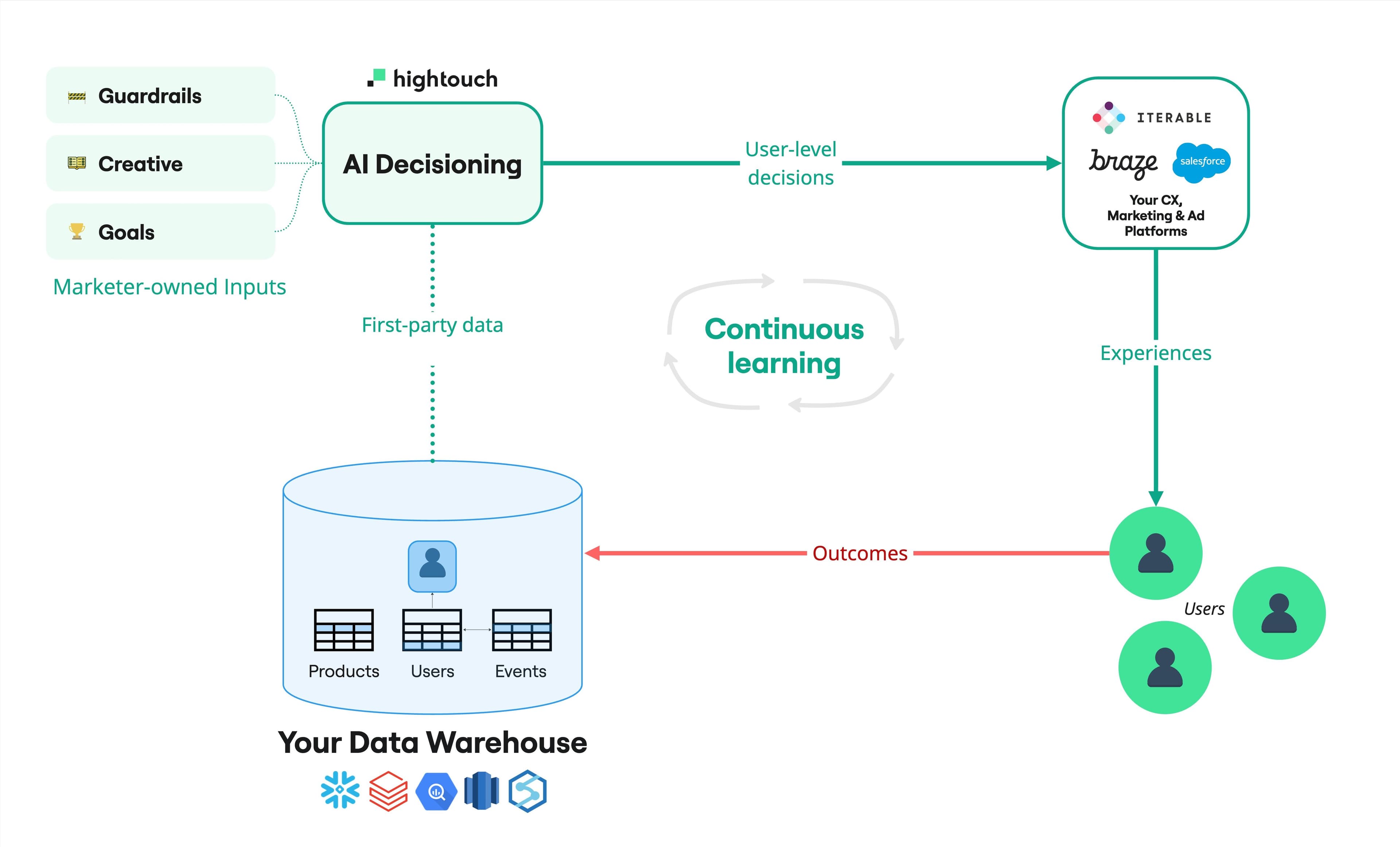
Hightouch AI Decisioning applies this to lifecycle marketing decisions—who to target, what to show, when to act, and which channel to use—across email, SMS, push, in-app, ads, and onsite experiences. It runs on top of your existing data warehouse and marketing tools, using your warehouse as the source of truth rather than creating a separate black-box system.
When it’s best to use Hightouch
- Personalization requires tradeoffs: You need to choose between offers, messages, channels, or timings when simple rules break down, and outcomes depend on context.
- Static segments stop performing: You want campaigns to adapt automatically based on customer behavior and response, not fixed if‑then logic or a static journey map.
- Decisions must learn over time: Your team wants systems that improve performance continuously, without manual re‑tuning after every campaign.
- Evergreen, high‑scale programs: You’re running always‑on lifecycle programs (e.g., cross‑sell, win‑back, reactivation) with clear metrics, lots of traffic, and multiple content/offer variants for AI to experiment with. That’s where reinforcement learning can actually learn and drive lift.
What people misunderstand
“AI Decisioning is just predictive scoring.”
Predictions estimate outcomes (like who is likely to churn); decisioning uses those signals to choose actions and learn which choices actually drive results. Hightouch can plug into your existing AI models (propensity, churn, LTV, recommendations) and then optimize when, where, and how to act on them.
“You have to rebuild your stack to use AI.”
Hightouch runs decisioning on top of your existing warehouse or CDP models and activation workflows, connecting to your downstream engagement tools (email, SMS, push, onsite, ads). You don’t swap out your stack; you add an intelligence layer that learns from all of your first‑party data.
“AI replaces marketer control.”
Marketers define the options, constraints, and goals: which audiences are eligible, what messages and offers are allowed, which channels to use, how often to contact people, and what “success” means. AI optimizes within those guardrails and provides transparent reporting so you can see what it chose and why, rather than acting independently.
How Hightouch works
At a high level, AI Decisioning uses your customer data as live context, tests actions against your goals, and automatically applies the best next step for each customer, in five steps:
- Use your customer data as live context: Hightouch connects to your data warehouse (Snowflake, BigQuery, Databricks) or CDP to understand each customer’s current context (behavior, lifecycle stage, value, propensities) at the moment of activation.
- Define audiences, actions, and goals: You define:
- The audience to consider
- The set of possible actions (messages, offers, channels, including “do nothing”)
- The success metrics and attribution window (for example, conversions, revenue, LTV, engagement)
- AI agents test, learn, and choose the best action: Reinforcement-learning-based AI agents continuously experiment across those options to determine what performs best for different customer situations, who to contact, with what content, in which channel, at what time, and when not to send at all.
- Execute decisions automatically in your existing tools: Decisions are applied during activation and personalization across email, SMS, push, in-app, and onsite experiences, using the tools you already use for orchestration and delivery.
- Measure performance and improve over time: Every decision is measured against a control/holdout group and your defined metrics. The system learns from each interaction, improving future decisions and surfacing insights (for example, which content works for which customers, where fatigue appears, which segments respond to which offers).
Mini example
An e-commerce team wants to personalize homepage offers. Instead of hard‑coding rules (“show free shipping to segment A, 10% off to segment B”), they let AI Decisioning choose between free shipping, a discount, or a product recommendation based on customer context, such as browsing behavior, purchase history, and predicted value.
Over time, the system learns which option maximizes conversion and revenue for each type of visitor (for example, high‑value customers respond better to recommendations, and first‑time buyers respond better to discounts) and automatically adjusts decisions on a 1:1 basis.