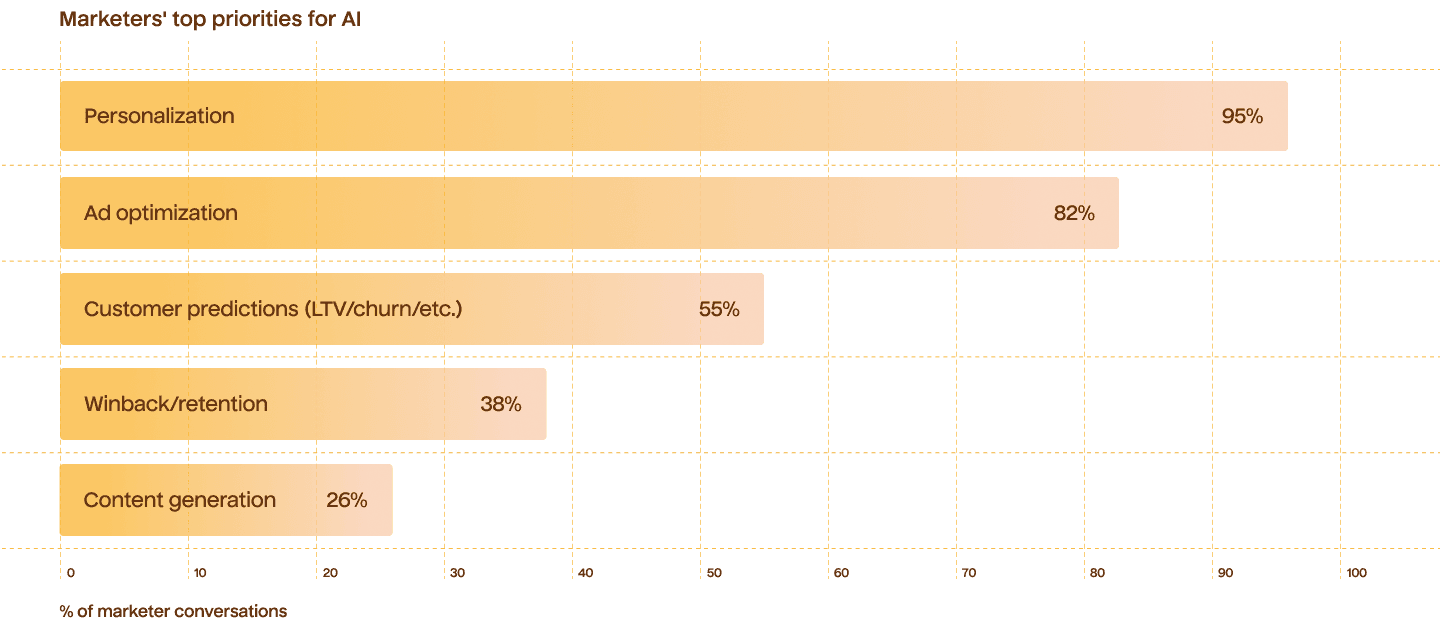
In a Hightouch analysis of 384 fully anonymized conversations with marketers, personalization was the most-cited priority for AI (95%). Below is the full breakdown, along with an explanation of why personalization is often constrained by data and what you need in place before AI-driven personalization becomes reliable.
Top AI priorities for marketers (ranked)
- Personalization: 95%
- Ad optimization: 82%
- Customer predictions: 55%
- Winback and retention: 38%
- Content generation: 26%
Personalization is hard because data is fragmented and hard to use
Personalization is a top AI priority for marketers, but it tends to stall for a simple reason: most teams cannot reliably access consistent, up-to-date customer context across their stack. When key attributes are missing, profiles disagree between tools, or data is stuck behind engineering requests, personalization becomes guesswork instead of a repeatable system.
What personalization actually requires
Personalization means tailoring messages, offers, or experiences to an individual based on relevant attributes and behavior. Doing it well takes more than a name or a single event, it requires a dependable customer view that is unified across sources and available at the moment a campaign, journey, or experience is being built.
Why data becomes the constraint
Personalization breaks down when:
- Customer data is incomplete, stale, or inconsistent
- Data exists, but lives in disconnected systems that do not stay in sync
- There is no trusted source of truth for customer profiles and key attributes
- Marketers cannot access or activate the data quickly enough to use it in real workflows
When those conditions hold, “personalization” usually stays shallow, because it can only act on a partial picture of the customer.
What to do if you want AI-driven personalization (and agentic execution)
AI can help teams move from insights to action, but only if it can operate on trustworthy customer context. If the data foundation is fragmented, AI will simply automate the same uncertainty at higher speed.
To make AI usable in practice:
- Unify customer data into a trusted system of record (often your warehouse)
- Define a clear source of truth for identity, profiles, and key attributes
- Improve data quality, freshness, and consistency across inputs
- Make customer context accessible for activation where decisions happen
With a reliable customer view, AI can do more than generate recommendations, it can take action safely, whether that is selecting the next best message, adjusting journeys in response to behavior, or orchestrating cross-channel changes with the right context and constraints.
Want to learn more?
Want to dive deeper? Download the full report, Has martech failed marketers? to understand what’s driving marketer frustration and the practical steps to fix it.
Report methodology
Hightouch analyzed trends from 384 fully anonymized conversations with marketers across B2B and B2C teams in the U.S. and EMEA. These conversations covered a broad range of industries, including retail, media and entertainment, fintech, travel and hospitality, quick service restaurants, healthcare, and B2B SaaS.