In a Hightouch analysis of 384 anonymized conversations with marketers, tooling came up as the biggest pain point marketers face. Below is the breakdown of what those conversations uncovered, followed by an explanation of what “tooling” usually means in practice, and recommendations on how to address it.
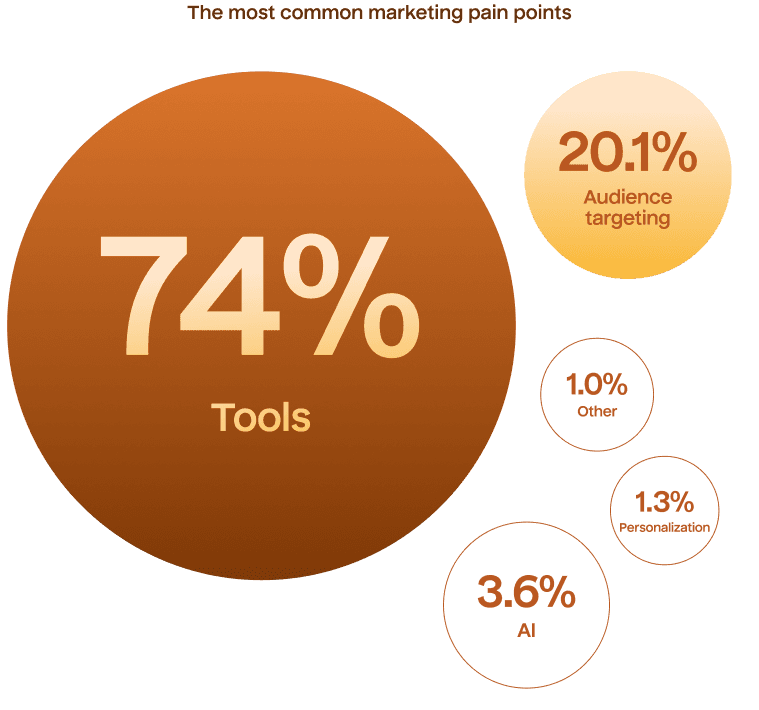
The most common marketing pain points (ranked)
- Tooling: 74.0%
- Audience targeting: 20.1%
- AI: 3.6%
- Personalization: 1.3%
- Other: 1.0%
What “tooling” likely represents in practice
The survey results suggest that tooling is where many marketing problems arise, but tooling may not be the underlying cause of those problems.
This pattern appeared regardless of marketing technology architecture a team has implemented, whether they use many point solutions (multiple specialized tools), or a monolithic system (a single suite or platform).
Because tooling pain is mentioned across different setups, the results suggest that the issue is not solely about the volume or specific tools deployed.. Instead, tools may be the place where deeper problems become visible.
The implied root cause: data access and data quality
When you look one level deeper at what marketers mean by “tooling issues,” a clear pattern emerges: most tooling pain is actually caused by data problems, not the tools themselves.
Common data-related issues include:
- Inaccessible data: Teams cannot reach the data they need when they need it.
- Fragmented data: Relevant customer data is split across multiple systems.
- Low-quality data: Data is inaccurate, incomplete, outdated, or inconsistent.
When these data problems exist, teams struggle to:
- Understand customers clearly
- Target audiences effectively
- Personalize experiences reliably
- Automate and scale with AI
In this context, “tooling problems” may often be symptoms of these data constraints.
What to do if tools are the pain point
If tools, audience targeting, and personalization are recurring problems, the fastest path forward is usually fixing your data foundation before adding new channels or tools. The same foundation is also what enables reliable AI-driven personalization. A data foundation typically requires:
- Access to all relevant data
- Ensure you can use the data needed for segmentation, targeting, measurement, and personalization.
- Unified and reliable data
- Bring together data from the systems that track customer interactions, behavior, and preferences.
- Enhance data consistency to ensure that different tools and teams use the same definitions and values.
- A single source of truth
- Establish a single trusted location where customer data is consolidated and reconciled across systems.
- Use that consolidated view to support activation, analytics, and decision-making.
When data is unified and reliable, you can more easily:
- Understand customers and their behaviors
- Identify profitable channels faster
- Reduce wasted advertising spend
Where to learn more
Want to dive deeper? Download “Has martech failed marketers?” to see what’s really driving marketer frustration, and what you can do to fix it.
Report methodology
Hightouch aggregated trends across 384 conversations with marketers (fully anonymized). These span B2B and B2C, the U.S. and EMEA, and a diverse array of industries, including retail, media and entertainment, fintech, travel and hospitality, quick-service restaurants, healthcare, and B2B SaaS.