We were promised AI transformation in marketing, but I’m hearing too many CMOs complain that not much has changed since adding AI. They all ask the same question: “We ran the pilots, we bought the tools, we’ve given our teams access to the best models, so why hasn’t AI transformed our marketing?”
It’s a good question. To be fair, your team probably now uses AI in real ways to move faster: writing copy, generating images, testing at scale in ways that weren’t possible before. But we’ve been improving individual tasks without addressing the elephant in the room: idea-to-launch time hasn’t moved. It still takes an unreasonable amount of time to go from idea to shipped campaign, and AI hasn’t really made a dent.
Don’t worry, it’s not just happening to you. We’re all still chasing each other around for approvals, getting frustrated at AI for generating off-brand slop, and having our teams live across dozens of tools to piece together the results and figure out what to try next.
The problem is that marketing teams are brute-forcing their way to using AI without a purpose-built tool.
- You don’t see lawyers just randomly prompting ChatGPT with questions about their contracts.
- You don’t see engineers copy-pasting code from ChatGPT into a code editor.
Lawyers and engineers both have a new place to get work done with AI: a harness that is built specifically for how their work gets done.
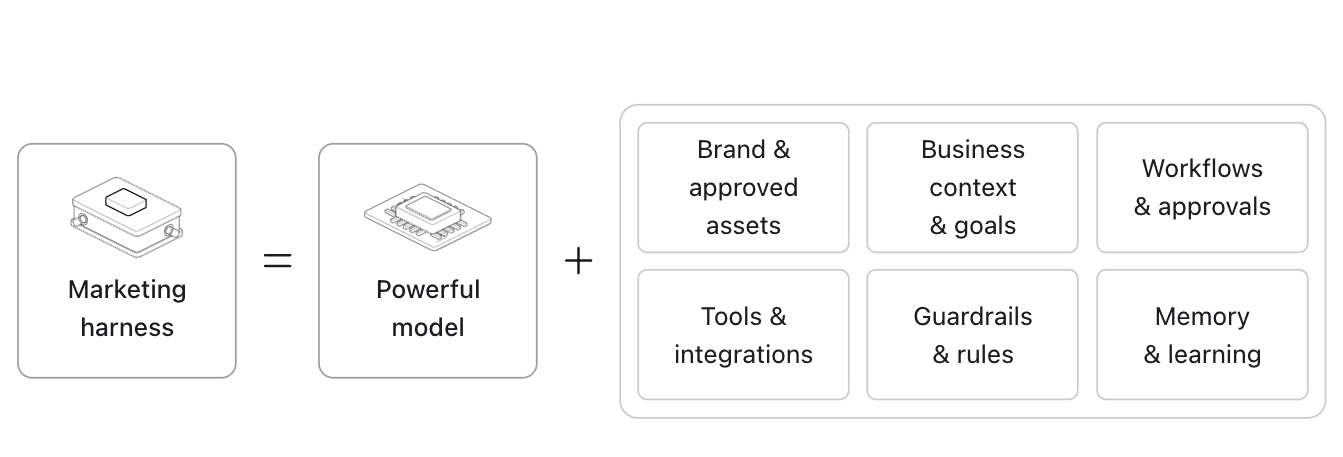
There is a way out, and it’s called a marketing harness. The idea is to let AI see your work from one level higher: deeply understand your brand and how your team works, and let agents accelerate it all. The harness is the layer that coordinates the work and carries the context across your team’s tools.
That’s great, Tejas, but what does a harness actually do?
Imagine you hire a new marketer on the team. They’re brilliant and best-in-class at what they do. But you give them no access to your tools, tell them nothing about your brand, your business, and what you’ve tried in the past. Then you say: “ok, now go launch a campaign.” There’s a good chance something will go wrong. That’s what most of us are doing today with AI. We’re expecting super powerful models to do well without the right inputs. That’s the role of the harness.
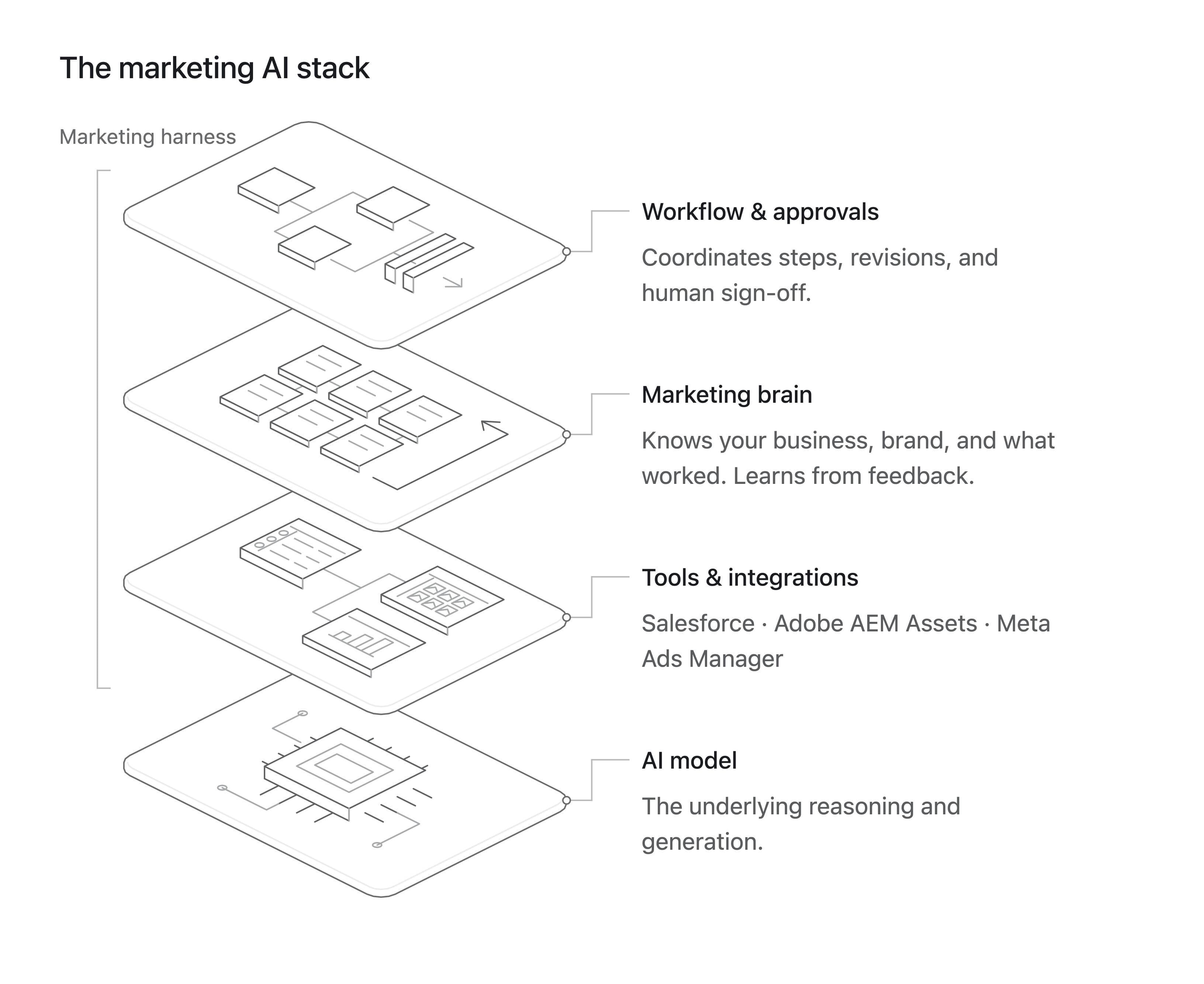
So what does that look like specifically for marketing? I think it involves nailing four things:
- It needs to help your team work together with AI without completely changing how they currently work. There’s no world where a Fortune 500 brand is going to throw away their entire process and have a single marketer launch a full end-to-end campaign with new creative, webpages, ads, and emails without input from the rest of the team.
- It needs to deeply understand your business, brand, and goals. For AI to produce results that are on point enough for marketing and creative teams to accept and to actually work in market, AI models need to be accompanied by a marketing brain that knows literally everything about your business, brand, and marketing and is learning continuously 24/7.
- It needs to work across all your tools. The harness needs to be able to integrate and take action across all your systems, in just the way your organization expects.
- It needs to have strong guardrails and swim lanes. Your team sets the limits on what agents can do and learn. The harness enforces those limits, checks approvals, and keeps a record of every action.
Ok - so let’s take a look at each of those in depth.
1. The marketing harness needs to help your team work together with AI without ignoring your existing process
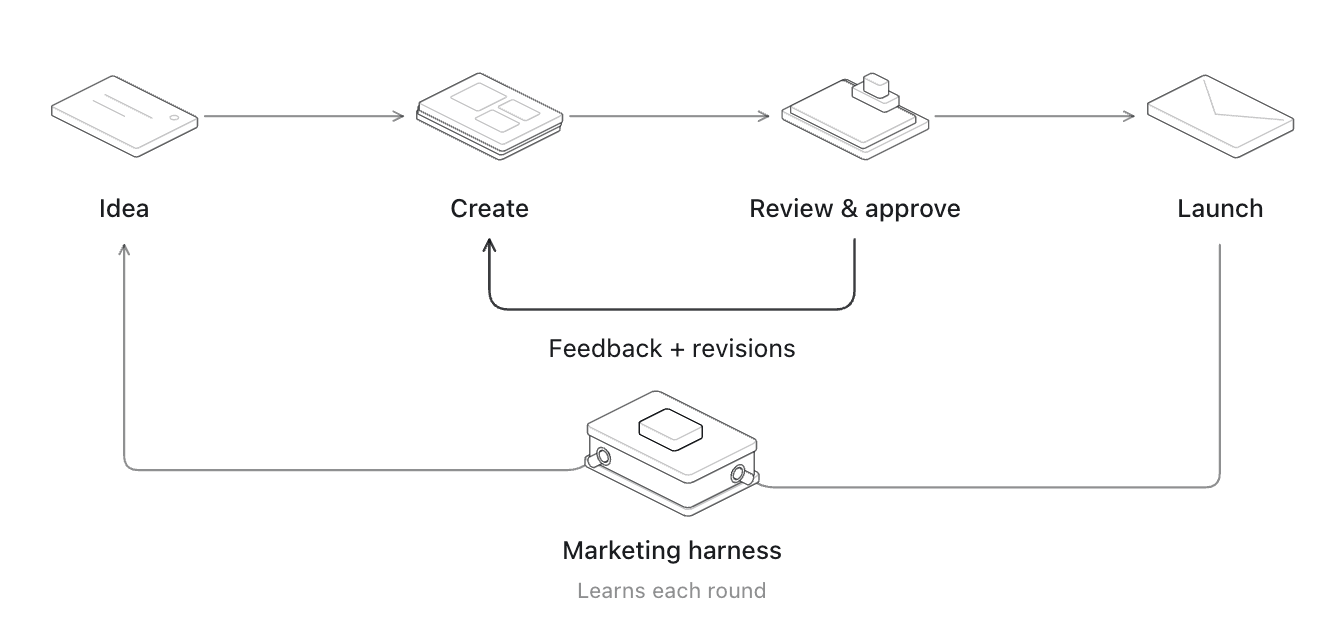
Let’s say that to launch a campaign today, it takes your team seven steps: campaign request, brief, copy, creative, content production, legal and compliance review, and launch.
Throwing away that whole process and giving a marketer a sleek UI to do the entire campaign end-to-end sounds exciting, but is really hard to do in practice. That process exists for a reason.
Does creative need to manually search for all the product images and hand design an email? No… But does creative need to review and revise before it goes out? Yes.
Each stakeholder brings specialized knowledge and taste to the equation.
So instead of giving you a totally new marketing process, you should be able to rely on agents to compress yours over time. A good harness needs to help your team get through the rework, revisions, and approval loops faster, not just through initial drafts faster. That’s what moves the needle on idea-to-launch time.
As an example, take this seven step process:
- Campaign request. Agent checks details and requests missing information.
- Brief. Agent drafts the brief; campaign owner reviews.
- Copy request. Agent drafts copy; copywriter reviews and revises.
- Creative request. Agent drafts using approved assets; designer reviews concepts.
- Production and localization. Agents build localized content; regional teams review.
- Legal review. Agent flags claims; legal teams review supporting terms.
- Launch. Agent prepares a launch checklist across Salesforce, Adobe, and Meta; marketing ops approves launch.
And importantly, not everyone should have to learn a new tool. The harness should work directly out of your existing systems like Workfront, Wrike, and Asana with the ability to leave bi-directional comments. And it can link out to a dedicated app for creative edits, visualizations, etc.
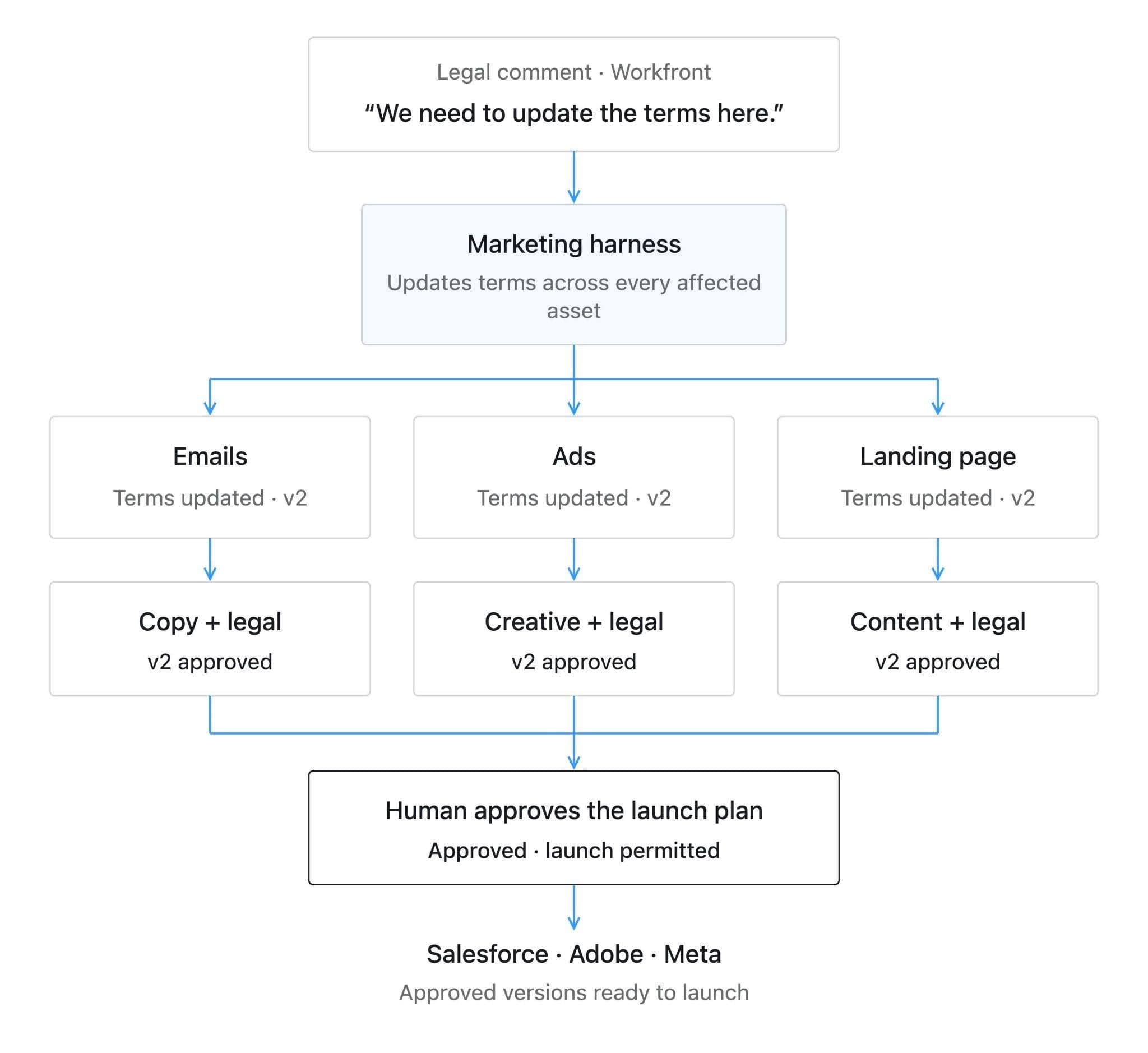
The harness should also coordinate revisions across steps, and apply them across all assets and comms. If legal gives feedback on the claim in the ad copy, the agent should update the affected emails, ads, and landing pages. It should route those changes back for approval and make clear which versions are ready.
One small legal correction causing a tsunami of tiny changes is exactly where we lose time today and where a harness can shine.
The harness must enforce approvals. If launch requires a person’s approval, the agent shouldn’t be able to execute until the launch plan is approved (more on that later).
The harness should also be knowledgeable and learn over time. It needs to have the context to actually do these jobs effectively and learn from the feedback of your team. That is what helps you not just do “faster marketing” but “better marketing” and to gradually get to the point where individual steps are almost entirely automated as agents learn the nuances.
2. The marketing harness needs to deeply understand your business, brand, and goals
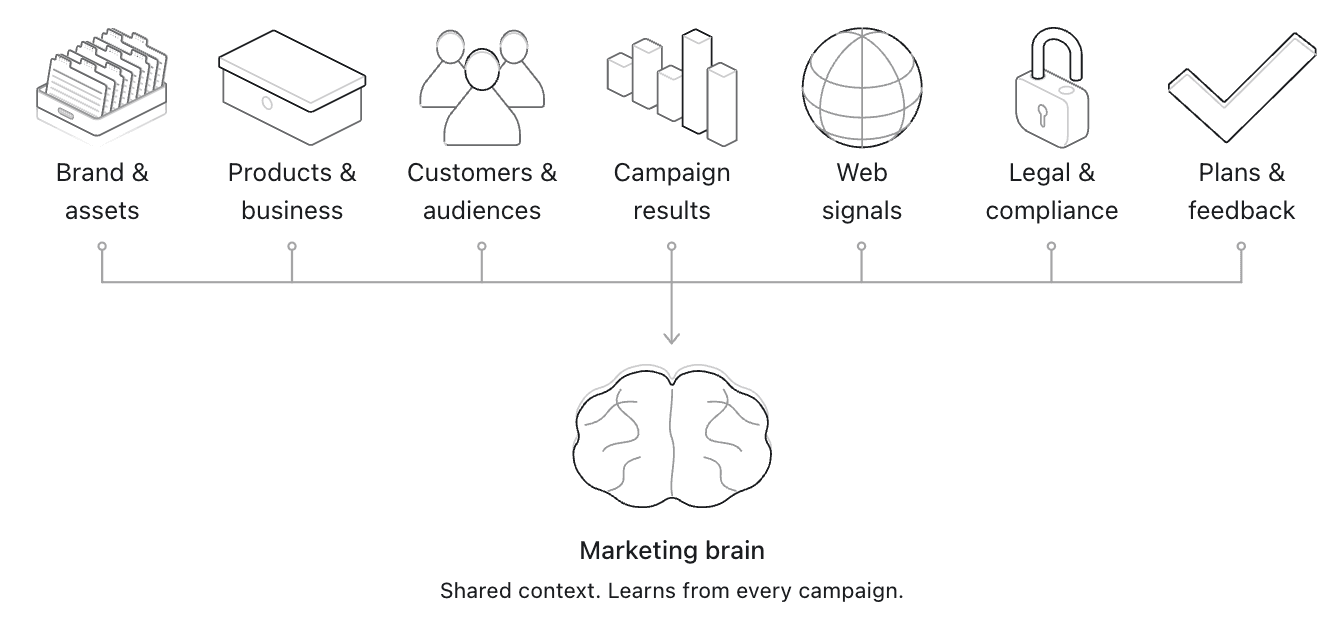
Marketing requires a lot of context. Something I always joke about with marketing leaders is that there's no such thing as “marketing data.” There's the full data of the business, and marketing needs access to it.
To build a campaign, you need to know what you sell, what customers actually buy, how your brand should look and sound, what worked, what flopped, and what happened the last time you tried something similar. An agent needs that context too. I call the shared knowledge agents draw on to make those decisions the marketing brain.
Building that brain requires connecting your context, understanding what it means, and learning from the work. Each takes deliberate support from the harness.
Your marketing brain needs to be an expert at your company’s brand
The top challenge I hear from marketing teams using AI for content production is that the output is off-brand. That’s because brand guidelines aren’t enough. A marketing harness needs to go beyond that:
First, learn what “on-brand” means from the work. Your agents should study past campaigns and keep learning from what brand, legal, and marketing reviewers approve, change, or reject. If a creative director rejects an image because it feels staged, the agent should remember why and apply that feedback next time. You shouldn’t have to teach it the same lesson on every campaign.
Second, use the assets your team has already approved. A designer doesn’t reinvent your colors every time they make an ad. An agent shouldn’t either. It should find the right assets, product photos, stock photography with the right usage rights, and components in your libraries and marketing systems (because they’re never neatly organized in a single DAM…), then assemble them into the creative. You should then be able to adjust them in review.
The marketing brain must be an expert at legal and compliance
The brain needs explicit guidelines on your legal and compliance rules. Which claims are approved, when are disclosures required, and how these rules vary by products and markets. One ad approved in one country probably needs different terms in another.
A good harness helps agents consistently apply these rules when generating content and remember each round of legal review. If legal corrects you once, the brain should remember it. So that over time, it learns the nuances of your process and gets it right the first time.
Your marketing brain needs to know what worked, what didn’t, and what to try next
The brain should study past campaigns closely enough to explain what worked, what failed, and what’s worth trying next. That’s not often something that is cleanly organized in a single source of truth. A good harness builds its brain from a variety of messy sources to start seeing around corners.
That starts with bringing together your campaigns, creative, and performance data from every channel. The hard part is making sense of it: connecting what people saw with how they responded, developing explanations for the results, and turning that analysis into ideas for the next campaign.
This can get quite sophisticated. For example, for analyzing video ads, the marketing brain should break each video into scenes and frames to examine the opening hook, product placement, pacing, and call to action. It should connect those elements to where viewers stopped watching, clicked, or converted, where that data is available.
The same depth should apply across the campaign. Who received the message? What offer did they see? Did the landing page deliver on the ad’s promise? How often were they contacted, and what did they buy afterward?
The more data the brain has, the more it can do
Brand guidelines, approved assets, product information, and legal requirements can support content production. But marketing is much more than that. You shouldn't have to connect everything on day one, but the marketing harness should support going beyond it.
For example:
- To improve visibility in AI search, you want to understand what people are asking on engines like Google and ChatGPT and current AI traffic and conversion rates. The marketing brain should know this.
- To personalize CRM campaigns and target your ads, you need to give the brain access to first-party customer data from your CDP or warehouse, along with your marketing calendar. That gives it context to recommend who to reach, which offers to feature, and what copy and creative will be relevant to each audience.
The harness should be composable with your existing systems. It should work with your CDP, connect directly to your warehouse, and have as much data and metadata as possible.
And the marketing brain should be shared. It should be able to pattern-match in ways you never could. For example, what people are searching for on ChatGPT should inform your next Meta ads. When each tool keeps its knowledge separate, teams have to transfer those insights themselves. A central brain can apply what it learns in one part of marketing to decisions across the rest.
3. The marketing harness needs to be able to work across all your tools
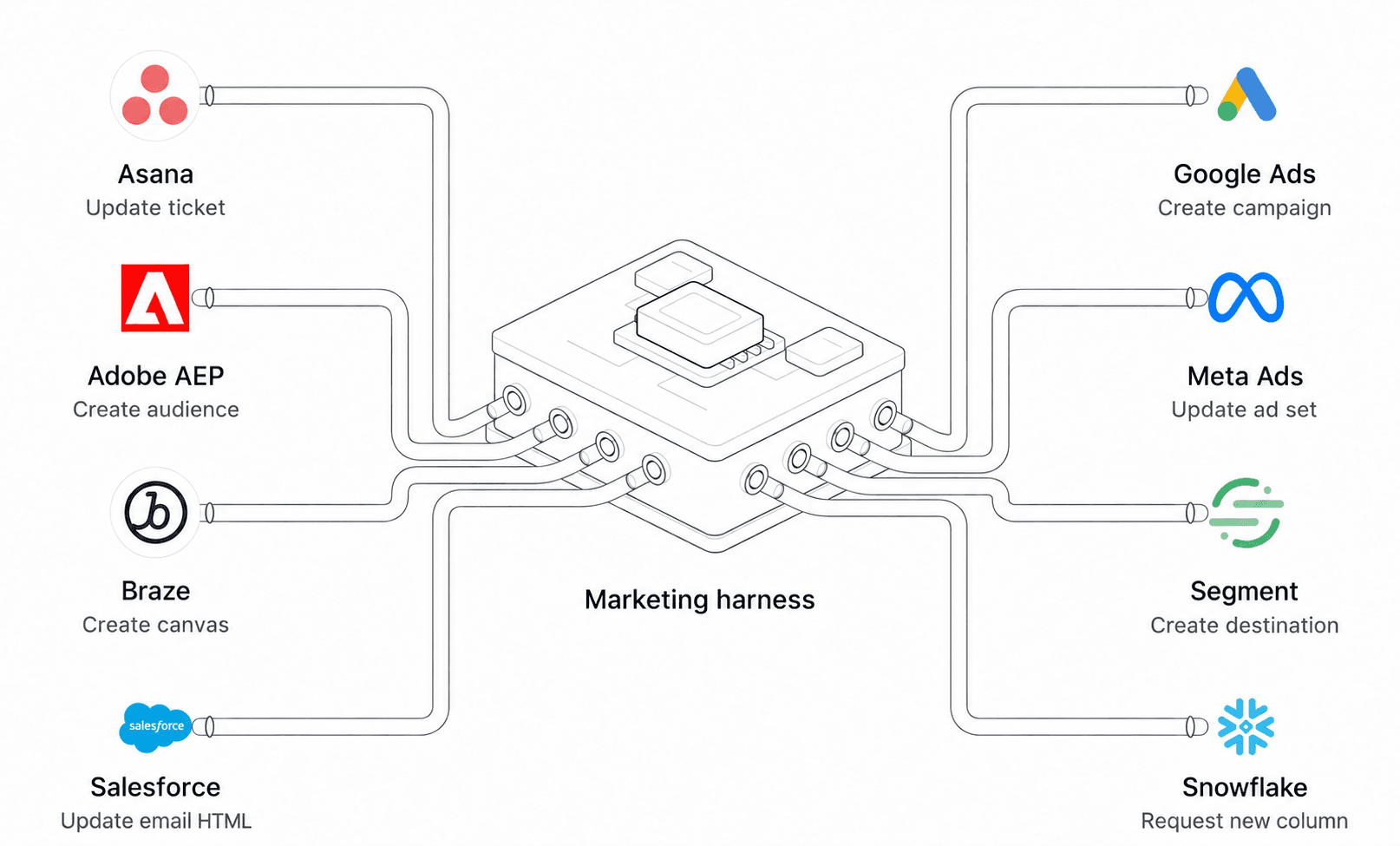
The question you should ask yourself is: why should I build my marketing brain inside a neutral layer instead of inside my largest vendor?
The marketing harness needs to actually carry out work in the tools where campaigns run. That means building audiences, configuring email journeys, and launching approved campaigns in the company’s existing systems, using its workflows and rules.
For a bank’s travel card campaign, an agent might take the approved audience rules, email content, and web updates and then actually go implement them in your CDP, ESP, and CMS or DXP. To do this, the harness needs robust knowledge of and integrations with the hundreds of marketing technology tools in the ecosystem, from Adobe to Salesforce to Braze.
This system needs to be deeply customizable. Enterprises have their own audience definitions, campaign templates, approval rules, and system configurations. The harness should provide the connections and controls while making it easy for teams to define agents for their own workflows.
Over time, your agents should manage live campaigns, like monitoring performance and adjusting your campaign budgets on the fly. For that to work, your agent needs a deep understanding of each platform. It can’t reliably compare Google Ads and Meta results if it doesn’t intimately understand definitions, attribution, and reporting periods.
The harness needs to support this depth of expertise as teams give agents more responsibility across marketing.
4. The marketing harness needs strong guardrails and swim lanes
If your agent can launch a campaign, it can also launch a bad campaign. To keep it from doing that, you need to give it clear boundaries.
The good news is that you’ve already defined these boundaries, and have people inside your org who already own them. Your design team has guidelines, your legal team has policies, and your martech team controls the tools. A good harness needs to be governed by a clear set of rules.
You can do this in 3 ways:
- Limit what an agent can do. Define what agents can access, edit, publish, and block actions that require direct approval.
- Verify they got the facts right. Doublecheck that the agents are making decisions grounded in real sources, not over hallucinations.
- Keep an audit log of their work. Record every step agents take, including what they accessed, changed, and published.
That’s how you give the harness and its agents the autonomy to work while keeping your team in control.
Looking ahead
If you’ve made it this far, thank you! I hope it was helpful.
AI adoption is still early, but it’s happening, and the impact is meaningful. We need to stop trying to brute-force it. I’ll be writing more on this topic.
At Hightouch, we’ve built an Agentic Marketing Platform and a forward-deployed team to help your team put it to work. The platform includes an enterprise marketing harness, available via MCP, plus specialized workflows for performance marketing, lifecycle marketing, AEO/SEO, and creative teams.
It starts from your existing, governed data model. You shouldn’t have to build and maintain a second version of your business just to use AI. Hightouch gives agents a shared layer across your marketing tools, while your data model stays the source of truth.
If you’re interested or want to discuss AI marketing transformation more broadly, grab time with our AI team here.