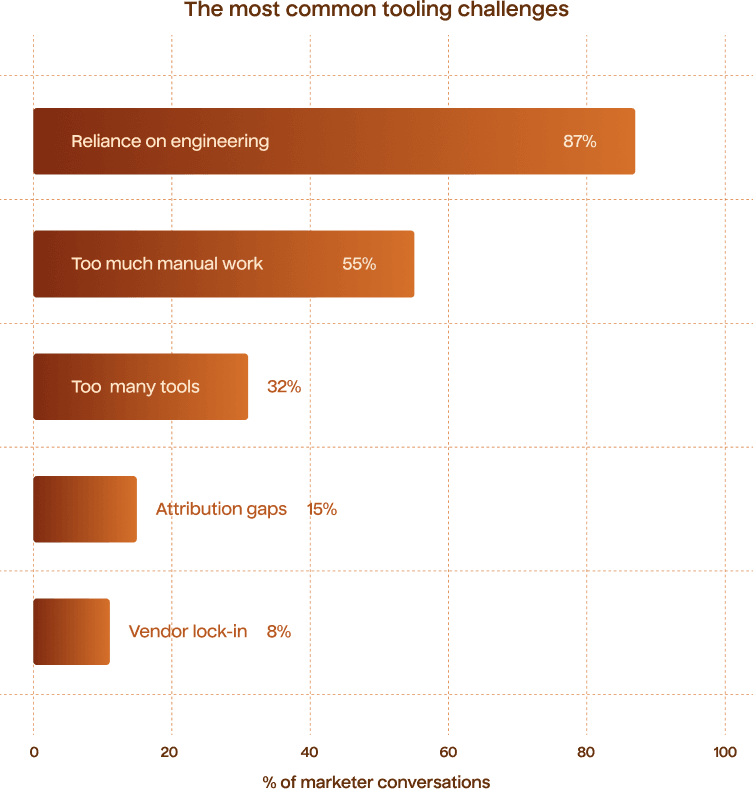
In a Hightouch analysis of 384 anonymized conversations with marketers, the most common tooling challenge was reliance on engineering teams. Below is the full breakdown, what these “tooling challenges” often signal underneath, and how to fix the root cause.
The most common tooling challenges (ranked)
- Reliance on engineering teams: 87%
- Too much manual work: 55%
- Too many tools: 32%
- Attribution gaps: 15%
- Vendor lock-in: 8%
What these “tooling challenges” likely represent in practice
The findings suggest that tooling is where many marketing problems become visible, even when tooling is not the underlying cause.
Many tools are designed to reduce effort and speed up execution. In practice, teams often report the opposite:
- Tools add steps instead of removing them.
- Work that should be self-serve becomes blocked.
- Marketers spend time moving data instead of running campaigns.
This creates a common reaction: replace the tool, or add another tool. The findings suggest a better first step is identifying the root cause that makes work feel slow, manual, or dependent on other teams.
The root cause: data access and data quality
In the report, marketers’ tool pain often traces back to data constraints. Hightouch found that 75% of the time, data is the underlying source of pain when marketers talk about tools. Common data-related issues include:
- Inaccessible data: marketing teams cannot reach the data they need, when they need it.
- Data doesn’t flow between tools: customer data is split across multiple systems and tools.
- Poor-quality data: data is inaccurate, incomplete, outdated, or inconsistent.
- Unclear “source of truth”: different tools contain conflicting versions of the customer.
When these problems exist, teams struggle to:
- Build accurate audiences and segments
- Launch campaigns without engineering help
- Personalize experiences reliably
- Measure performance consistently
- Trust attribution outputs across tools
In this context, “tooling challenges” often describe the visible symptoms of underlying data constraints.
Fix the constraints that make tools feel “broken”
When these constraints exist, teams struggle to execute without workarounds, even if they buy more software. Fixing the foundation is about making customer and marketing data connected, accessible, and reliable across the systems marketers depend on.
Why this matters more in an AI era
AI adoption in marketing often fails for the same reasons many data projects fail: poor data foundations. Teams struggle when data is incomplete, unreliable, hard to access, or controlled by a few technical owners. This creates ongoing dependency on engineering for basic progress.
AI is also changing. Many teams now want AI that can interpret business information, recommend decisions, and support or trigger actions, not only generate content. Those tasks require end-to-end business context, including customer behavior, campaign exposure, conversions, and constraints like budgets and eligibility rules.
If relevant data is fragmented across tools or difficult to query, AI can only operate on partial context. In that scenario, AI is limited to narrow tasks and cannot reliably support decisions or actions. A connected, accessible data foundation is what enables more useful, higher-leverage, and more autonomous AI workflows.
Where to learn more
Want to dive deeper? Download “Has martech failed marketers?” to see what is driving marketer frustration and the practical steps to fix it.
Report methodology
Hightouch analyzed trends from 384 fully anonymized conversations with marketers across B2B and B2C teams in the U.S. and EMEA, spanning industries including retail, media and entertainment, fintech, travel and hospitality, quick-service restaurants, healthcare, and B2B SaaS