For retailers that live and die by their margins, marketing efficiency is survival.
New customer acquisition keeps getting more expensive. Repeat purchase is where profit happens. And during the holiday season, when demand peaks, competition spikes, and buying cycles compress, the margin for error disappears.
Most retailers already invest in lifetime value (LTV) levers such as retention, cross-sell, and win-back programs, using tactics like loyalty initiatives, behaviorally triggered messages, personalized offers, and segmented lifecycle journeys. The strategy is sound, but execution is often constrained by data gaps, user identity fragmentation, and slow or complex activation paths. And by the time holiday planning rolls around, it’s often too late to fix them.
The retailers protecting holiday profits are the ones who move at the speed of their data – activating the right signal at the right moment, without the friction between data and execution that holds most teams back. Increasingly, those retailers are moving to Composable CDPs (Customer Data Platforms) that unify customer data for targeted, personalized marketing activation.
This post breaks down where retailers face costly LTV leaks, and how a Composable CDP unlocks the speed, precision, and personalization that make LTV-driven programs work harder.
Leak 1: Campaign velocity stalls while you wait for data
Holiday campaigns move fast. To keep up, marketers need direct access to all their customer data, from historical signals to offline purchases, loyalty attributes, brand affinities, and more.
But too often, even teams utilizing a CDP still operate with only a partial view of the customer. That’s because most CDPs were built around web and mobile events, like page views, product views, clicks, sign-ups, etc., and only capture a subset of customer data easily. Anything that’s historical, offline, business specific, or calculated – like lifetime value calculations, churn risk scores, in-store purchases, and loyalty information – requires time consuming data and engineering work to transform and map the data from the company’s data warehouse into the CDP’s rigid structure.
Because that process is so difficult, and because traditional CDPs charge for storage, most teams end up pruning attributes, shortening retention windows, and only loading what they think they’ll need.
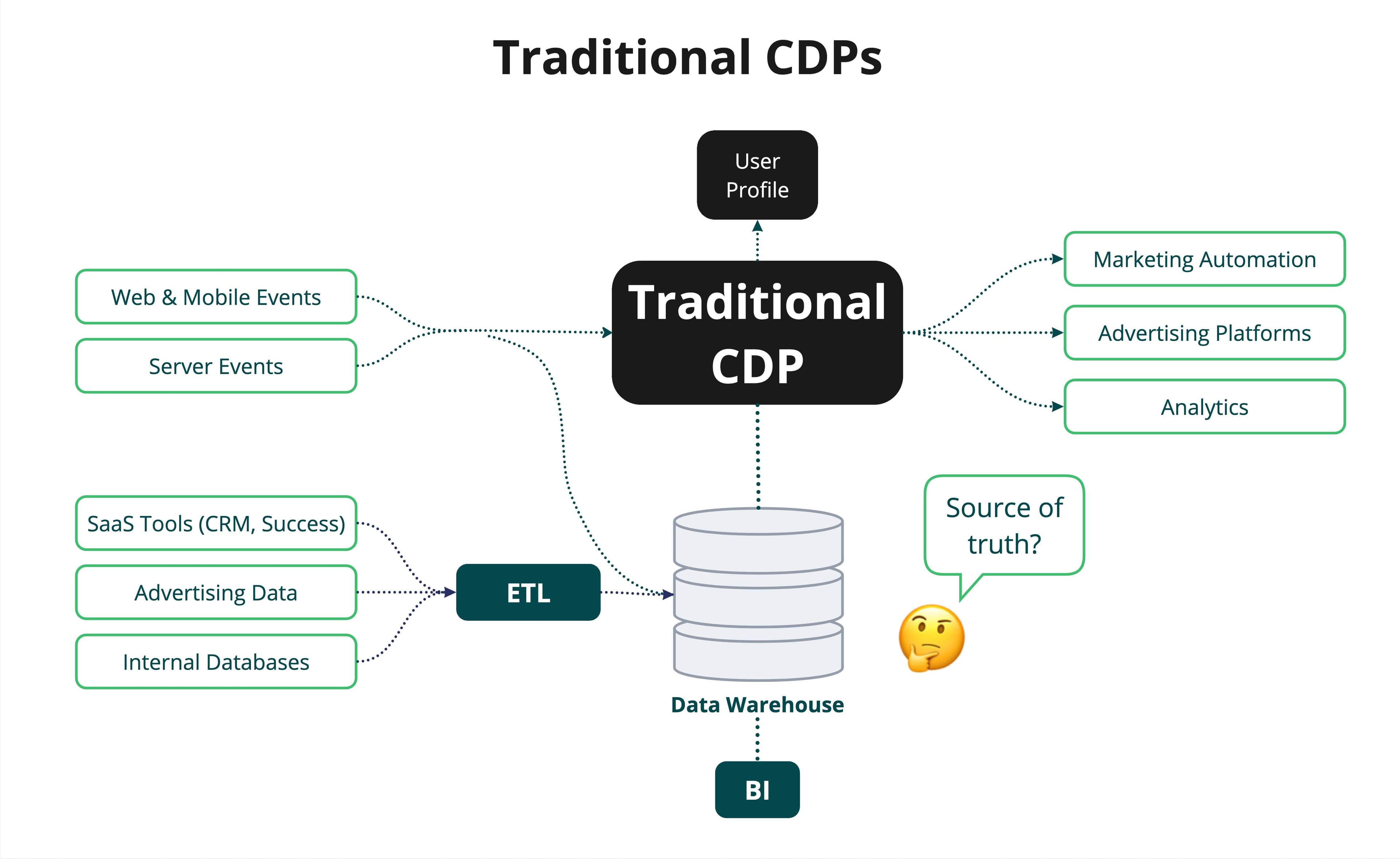
Web, mobile, and server events flow from the CDP to the warehouse, but only a fraction of your warehouse data reaches the CDP due to complexity and cost.
The composable fix:
A Composable CDP eliminates this problem entirely by plugging directly into the place your company data already lives: your data warehouse. Instead of copying and transforming partial data into a second system, it activates directly from the warehouse’s complete source of truth and removes the usual delays.
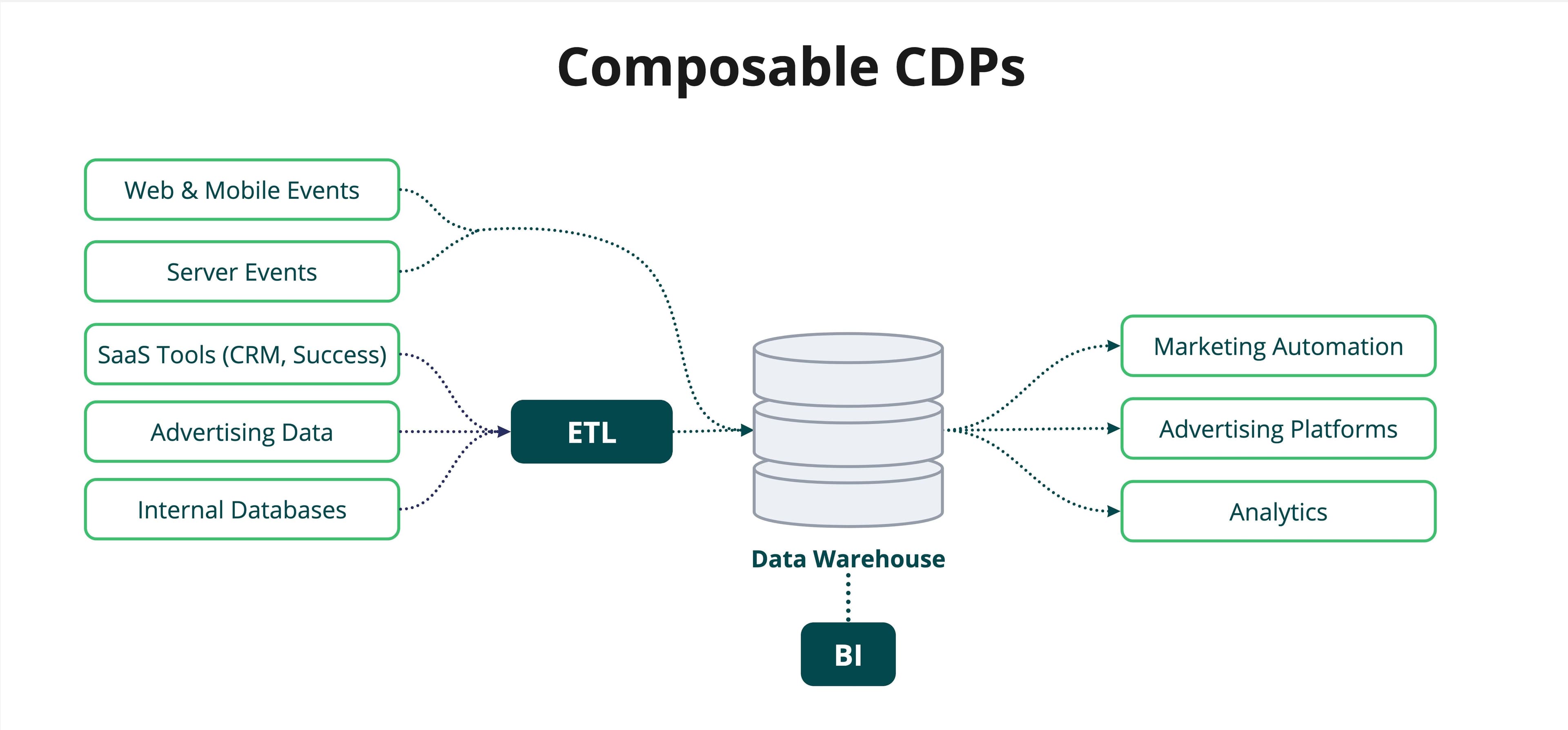
With a Composable CDP, marketers can access their complete customer data, build audiences, and activate them across marketing channels with ease.
This means marketers get easier access to 100% of their customer data, and audiences that once took weeks to build can now be created by marketers in minutes. No technical resources required. All historical behavior remains available for segmentation, and first-party, offline, and calculated signals become instantly targetable. Empowering marketers to act on the full picture of their customers without waiting on technical teams. In other words, marketing’s campaign roadmap is no longer gated by data availability, and marketing can ship campaigns on their schedule – even on tight holiday deadlines.
Real-world impact:
Say your business just shipped new loyalty tiers and you need to target those members in time for the holidays. With a traditional CDP, it’s often a data ticket and weeks of waiting before that new data is available in your system for campaigns. With a Composable CDP, you can incorporate those loyalty tiers into any holiday campaign segments right away.
Leak 2: Offline behavior and online identity aren’t unified
Shoppers move fluidly across online and offline channels, and it’s critical to tie these interactions back to a single customer to enable personalized experiences, accurate suppression, and meaningful measurement.
But too often, identity resolution tools don’t have a reliable way to access offline data from things like point-of-sale (POS) systems or loyalty programs. Most rely on strict deterministic identifiers like email, phone, or loyalty ID to connect offline touchpoints to online identity, and matching suffers when those identifiers aren’t present or are entered incorrectly.
The composable fix:
Composable CDPs ensure access to complete customer data by operating entirely from the company’s data warehouse. Some platforms, including Hightouch, then pair deterministic matching with probabilistic matching. Probabilistic methods use looser signals like name, address and fuzzy email matches to link transactions and profiles even when exact identifiers are incorrect or missing. For example, it can recognize that emily.lee@gmail.com and emilylee@hightouch.com with the same physical address are likely the same person. This unlocks far more addressable users and fills the gaps that cause offline or logged-out interactions in other systems to disappear.
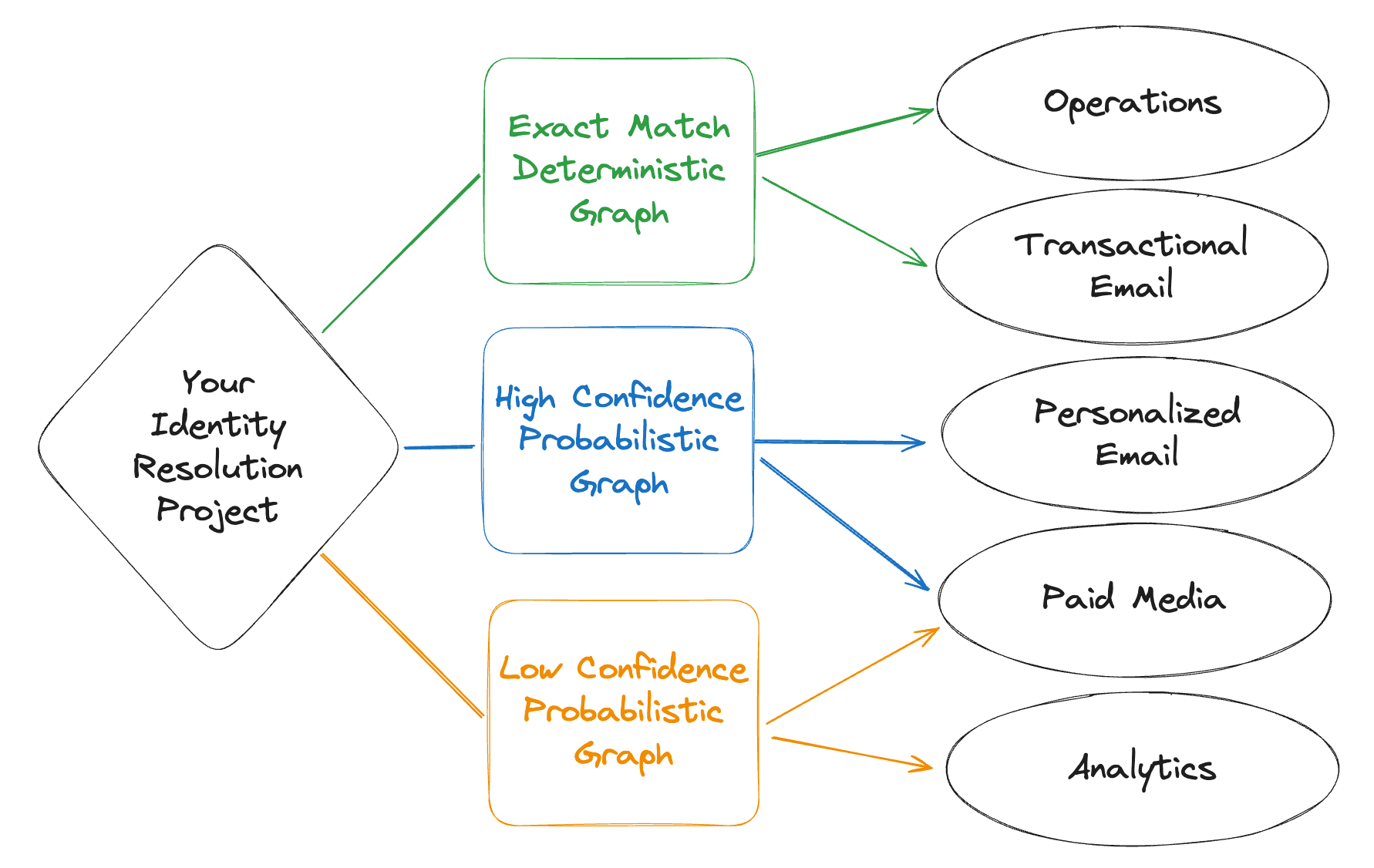
Different confidence levels of identity resolution are better suited for different use cases. Some matching is best served by deterministic methods, while other matches benefit from broader probabilistic matching.
Real-world impact:
A customer enters their email incorrectly while shopping in-store. Instead of losing that signal, a Composable CDP can still match that transaction to the correct profile using probabilistic methods, allowing you to use the purchase for targeted marketing and personalization.
Leak 3: It’s nearly impossible to coordinate omnichannel campaigns and tests
Coordinating campaigns and tests across marketing channels like email, paid social, SMS, direct mail, and in-app is anything but simple. Audience definitions, holdouts, activation, and reporting often live in different systems and are owned by different teams within marketing. Aligning them is slow and error-prone, and it’s hard to get a clean read on what’s actually driving lift, which is critical for making smart optimizations of your channel strategy.
The composable fix:
A Composable CDP is the command center for omnichannel campaigns and experimentation. Teams can manage audience definitions and test groups in one place, and then activate them across email, paid, onsite, push, and any other marketing channel, without rebuilding the logic inside each platform. With unified orchestration, A/B, multivariate, and holdout tests become dramatically easier to launch and manage.
And instead of stitching together platform-level reports – each with different definitions, attribution windows, and conversion visibility – marketers can evaluate performance holistically in their CDP. When every ad platform draws from the same data foundation and feeds outcomes back into the same system, the result is a true test-and-learn machine working above all of your channels with more velocity, more signal, and more growth.
Real-world impact:
To test whether layering ads on top of email lifts conversions, for example, you’d typically need to:
- Split customers into ‘email only’ vs. ‘email + ads’ groups
- Build and upload audiences to multiple platforms
- Ensure the right people land in each test group
- Then submit a request to your data team to help you pull the results
By the time the test is done, you’ve spent more time coordinating than learning. Or, you might be too busy to pull the results together at all.
With a Composable CDP, you simply define your audience, sync it to the right channels, and track the results from a single source of truth.
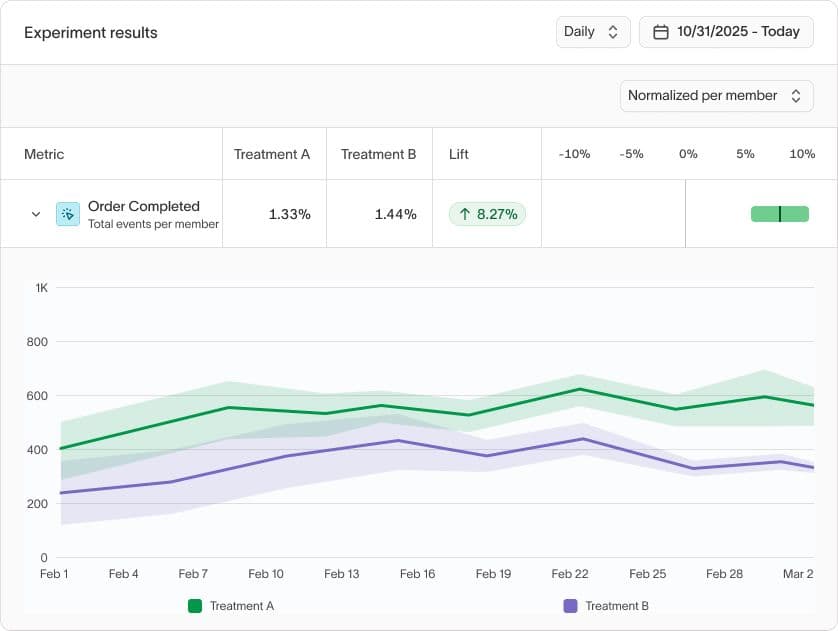
In this experiment example, customers in Treatment group B who received both email and ads generated a 4.41% lift in completed orders.
The bottom line
Getting more value from every customer isn’t always about adding more channels, more campaigns, or more tactics. It’s about building the data foundation that lets your team act with speed, precision, and confidence. When marketers have access to all their data, can unify identities across channels, and can test with ease, every lifecycle program becomes more effective, and every customer becomes more valuable.
And when retailers get this right, the results are dramatic:
-
PetSmart scaled personalization to 70M+ members with triple-digit engagement lift and 15–25% incremental sales.
-
Veronica Beard increased incremental email revenue by 20% with affinity-based segments.
-
Collectors increased email engagement by 125% and reduced campaign execution time from one month to a single day once activation ran directly from live data.
The retailers who protect profit by investing in this foundation aren’t just performing better during the holidays; they’re compounding revenue all year long.
If you found this helpful, you may also want to explore the other two posts in this series:
- How smart retailers protect holiday profit: Reducing waste in paid media
- How smart retailers protect holiday profit: Maximizing retail media margins
Together, they outline the full picture of where retailers lose (and gain) the most margin – and how a modern, Composable CDP approach helps you enter next holiday season with a foundation built to win.
If you’re ready to see what this could look like for your business, book a Hightouch demo. We’ll show you how leading retailers unify customer data, boost identity resolution, and activate multichannel campaigns in minutes, not weeks.