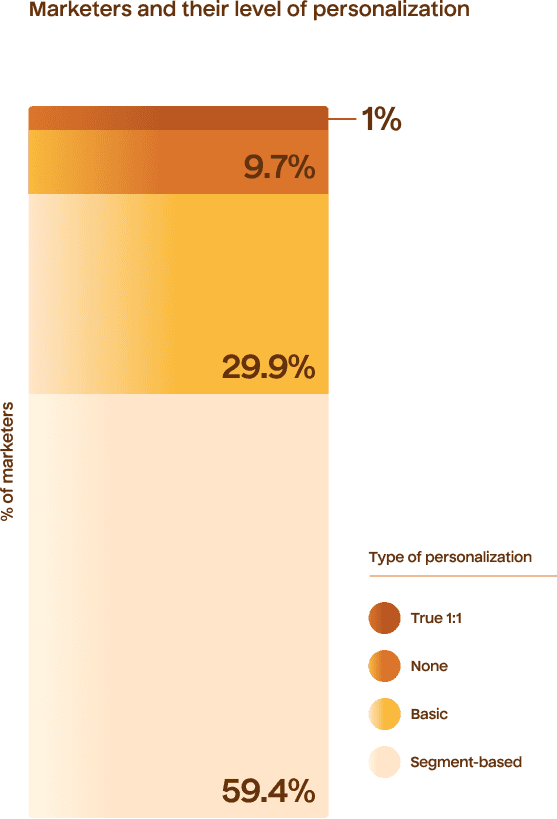
In a Hightouch analysis of 384 anonymized conversations with marketers, most teams reported they were still doing segment-based personalization (59.4%). Below is the breakdown of what ‘personalization’ means in this context, why teams get stuck at the segment level, and what it takes to move toward true 1:1 personalization.
How marketers personalize today (ranked)
- Segment-based personalization: 59.4%
- Basic personalization: 29.9%
- No personalization: 9.7%
- True 1:1 personalization: 1%
What “personalization” means in this context
This article uses “personalization” to describe tailoring marketing messages or experiences based on customer data. The levels referenced above typically imply:
- Basic personalization: Simple, rule-based changes using minimal attributes (for example, using a first name or company name).
- Segment-based personalization: Experiences differ by group (for example, “new users,” “high-intent visitors,” or “recent purchasers”).
- True 1:1 personalization: Experiences adapt to an individual customer using a richer, more current view of that person.
Personalization in marketing depends on customer data
Personalization relies on one critical input: customer data (data about their preferences, their attributes, and their behavior). When customer data is missing, you are limited to basic personalization. Basic personalization typically includes:
- Using a name in an email
- Referencing a broad segment (for example, “new customers”)
Common data problems include:
- Delays: Customer information arrives too late to be useful
- Manual uploads: Updates depend on people pushing files or lists
- Inaccurate data: Records contain errors or mismatched identities
When these problems exist, personalization can produce inconsistent messaging. Inconsistent messaging can:
- Send mixed signals to the customer
- Damage trust
- Harm the customer relationship
What “true 1:1 personalization” requires
“True 1:1 personalization” means tailoring content and timing to a specific person based on what you know about them and what they are doing now. To move toward 1:1 personalization, you need two capabilities:
- Context
- Action
Context means comprehensive, accessible customer data
Context is the ability to understand a customer using complete and up-to-date information. Context requires customer data that is:
- Comprehensive: It includes everything you know about the customer
- Easy to access: Teams and systems can use it without friction
- Current: It reflects recent changes, not outdated snapshots
Action means being able to use the data in customer experiences
Action is the ability to apply customer data to real marketing decisions, including what message or offer to send, in which channel, and when.
As teams look toward agentic AI to help move from insights to execution, this “action” layer becomes even more important. AI can recommend or trigger actions only if it can operate on trustworthy customer context; otherwise, it simply automates uncertainty at a higher speed.
Want to learn more?
Want to dive deeper? Download “Has martech failed marketers?” to uncover what’s really behind marketer frustration and how to fix it.
Report methodology
Hightouch analyzed trends from 384 fully anonymized conversations with marketers across B2B and B2C teams in the U.S. and EMEA. The conversations represented a diverse mix of industries, including retail, media and entertainment, fintech, travel and hospitality, quick service restaurants, healthcare, and B2B SaaS.