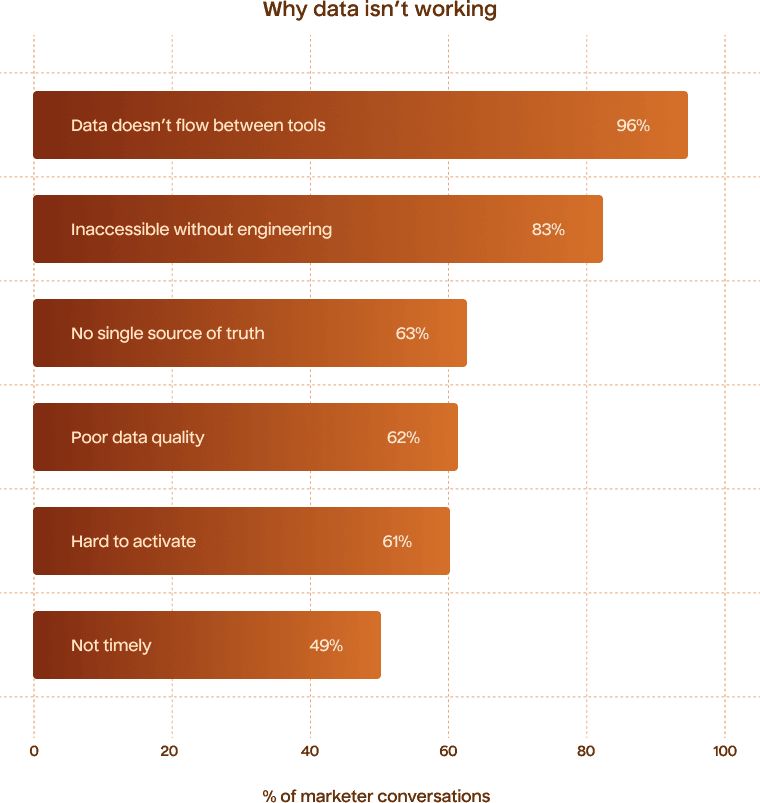
In a Hightouch analysis of 384 fully anonymized conversations with marketers, the most common reason data “isn’t working” was that it doesn’t flow between tools (96%). Below is the full breakdown, followed by why unreliable data undermines targeting, measurement, and decision-making, and a practical path to fix the foundation.
Why marketing data isn’t working (ranked)
- Doesn’t flow between tools: 96%
- Inaccessible without engineering support: 83%
- No single source of truth: 63%
- Poor data quality: 62%
- Hard to activate in marketing tools: 61%
- Not timely: 49%
Reliable data underpins for trustworthy decisions
Marketing relies on data to plan, execute, and measure. When that data is unreliable, it’s harder to trust results and act with confidence.
What this means in practice
Marketers have more tools than ever, but tools don’t solve data quality problems on their own. If the underlying data is inaccurate or inconsistent, those tools can amplify mistakes and create new problems.
Why it matters
Unreliable data makes it difficult to answer core marketing questions, including:
- Are we targeting the right customers?
- Which campaigns are actually performing best?
- Can we trust the results we’re seeing?
What breaks when the data is wrong
When the data is incorrect or incomplete:
- Targeting becomes less precise, because audiences may be based on incorrect attributes or outdated events.
- Performance measurement becomes less reliable, because conversions and attribution may not reflect what actually happened.
- Confidence in decision-making drops, because results may reflect data issues rather than real campaign impact.
A martech stack can work when data is centralized and usable across tools
A marketing technology stack doesn’t fail because there are too many tools, it fails when teams cannot reliably move data between them. Centralizing key customer data, then making it usable in downstream tools, reduces the day-to-day friction marketers feel and makes execution and measurement more consistent.
The core approach
The approach has two parts:
- Centralize customer data in one system of record
- Sync that trusted data into the tools where campaigns run
Step 1: Centralize data in a data warehouse
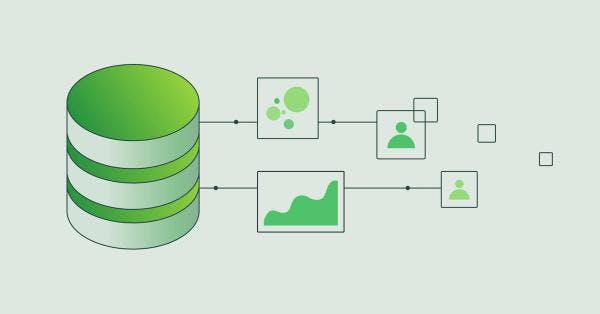
A data warehouse is a central system that stores data from many sources in one place. When teams standardize key customer fields and events in the warehouse, they can align on shared definitions and reduce inconsistencies across tools.
This helps because:
- Key customer data is defined consistently
- Teams use the same definitions for metrics and attributes
- Campaign tools can reference a shared dataset instead of conflicting records
Step 2: Add an activation layer on top of the warehouse
An activation layer connects the warehouse to the downstream tools where marketing work happens. It helps ensure the audiences and attributes used in those tools stay aligned with the source data over time.
An activation layer typically:
- Reads trusted data from the warehouse
- Syncs it into destinations like ad platforms, email tools, and CRMs
- Keeps those tools updated as warehouse data changes
What this enables for marketers, and why it matters for agentic AI
With centralized data and reliable activation, marketers can:
- Build audiences from consistent warehouse definitions
- Activate those audiences across channels without manual exports or one-off fixes
- Spend less time waiting on tickets for routine data access and updates
This foundation also matters as teams adopt agentic AI. Agents are only as useful as the context they can access and the actions they can take. When customer data is centralized and activation is reliable, it becomes easier for AI systems to operate with the same shared context marketers use, and to drive work forward in the tools where campaigns actually run.
Where to learn more?
Want to dive deeper? Download Has martech failed marketers? to understand what’s driving marketer frustration, and the practical steps to fix it.
Report methodology
Hightouch analyzed trends from 384 fully anonymized conversations with marketers across B2B and B2C teams in the U.S. and EMEA. These conversations spanned a wide range of industries, including retail, media and entertainment, fintech, travel and hospitality, quick-service restaurants, healthcare, and B2B SaaS.