About this series: The market has taken a lot on faith about LiveRamp's onboarding solution, from what it passes through to what it delivers. In this two-part series, we're testing those assumptions and unpacking what they actually mean for performance, privacy, and control.
The fundamental promise of data onboarding is simple: give an identity provider your first-party data, and its identity graph will make more of your customers recognizable to advertising platforms.
As one of data onboarding's pioneers, LiveRamp became the industry default. Marketers viewed its RampID identity spine as the established, privacy-conscious way to activate first-party data across paid media. But beneath that familiarity lies a nagging question: Does LiveRamp's high cost buy the best possible match rates?
LiveRamp's pending acquisition by Publicis sharpens that question, raising new concerns about the neutrality of one of adtech's most entrenched intermediaries. Before letting the fear of switching keep them locked in, marketers should scrutinize LiveRamp's onboarding solution and see if it really does deliver.
The pattern we couldn't ignore
At Hightouch, we've run many evaluations against LiveRamp.
More than half of Match Booster customers migrated from LiveRamp. Companies evaluating Match Booster bring their audiences to Hightouch and ask us to prove out the quality and reach of our data onboarding solution.
Quality is relatively easy to evaluate. Hightouch draws on the same core third-party identity partners as LiveRamp, so a match through either results in comparable data quality. We can prove this out easily through overlap analysis.
That leaves reach as the real test: how many customers does LiveRamp actually reach once the same first-party data lands on each ad platform?
Tested again and again, two findings kept surfacing that surprised us and our customers.
Finding 1: In most cases, LiveRamp drops first-party data during onboarding
In one test, a Fortune 500 company activated the same first-party audience two ways: send first-party data directly to their DSP, and through LiveRamp to the same DSP. Then they checked how many of the users overlapped between both audiences.
Since LiveRamp's onboarding is meant to enhance match rates, they expected every user they sent directly to also be reachable through LiveRamp, plus any new matches the LiveRamp identity graph adds. In other words, overlap should approach 100%.
Instead, they saw less than 50% overlap, meaning more than half of the users who matched through direct first-party activation were missing from the LiveRamp-onboarded audience after reaching the destination.
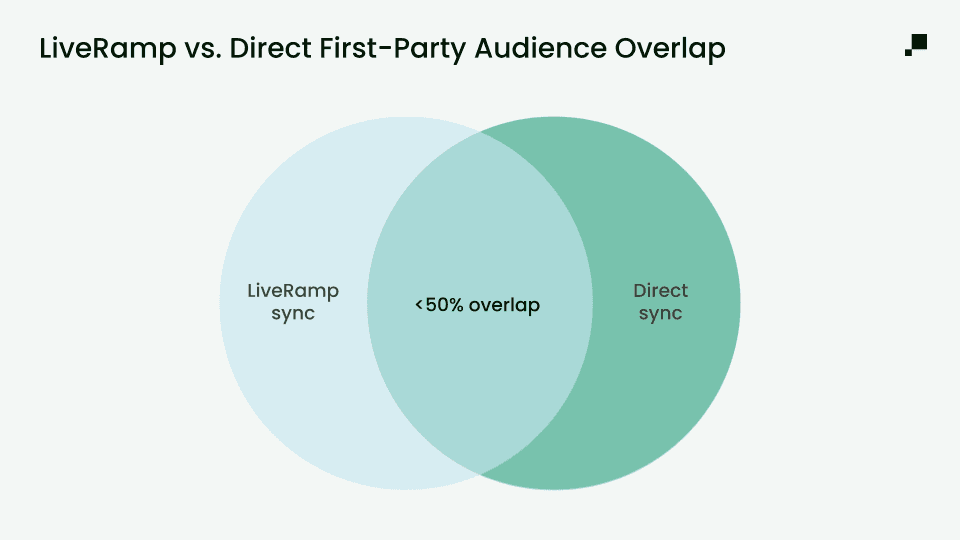
At Hightouch, we have observed this phenomenon consistently in tests. It points to one surprising possibility: LiveRamp often drops your first-party data.
Finding 2: In some cases, first-party data alone outperforms LiveRamp
This pattern continued to emerge in other forms, too.
In a separate test, a Fortune 500 global media and entertainment company activated the same audience directly using their first-party data, through LiveRamp, and through Hightouch's Match Booster.
What they discovered was surprising. Not only did Match Booster drive higher match rates on every channel compared to LiveRamp, but on some channels, first-party data alone outperformed LiveRamp.
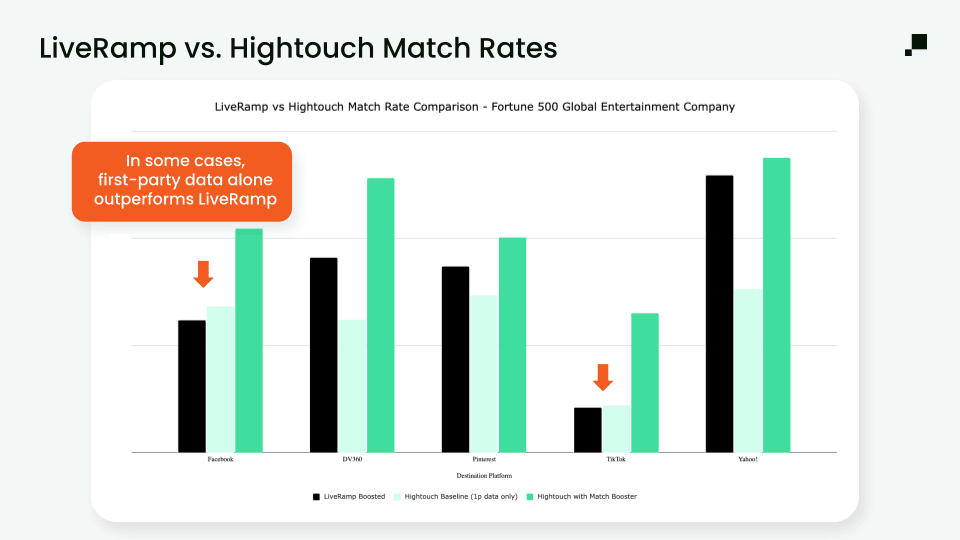
These results only make sense in light of finding 1. If LiveRamp is consistently dropping your first-party data, it explains why first-party audiences can outmatch LiveRamp. If the losses in first-party data outweigh the gains from LiveRamp's identity graph, the result is a smaller audience, not a larger one.
Two different findings revealed the same problem: the audience going into LiveRamp was producing smaller audiences than expected across ad platforms. So we dug into why.
How LiveRamp actually onboards your data
We all know the basic mechanics of how LiveRamp does data onboarding. They resolve your first-party identifiers against their identity graph, convert matched identities into RampIDs, then use those RampIDs to translate your audience into whatever identifiers each ad platform accepts. Every downstream match starts with LiveRamp's resolution of your original data.
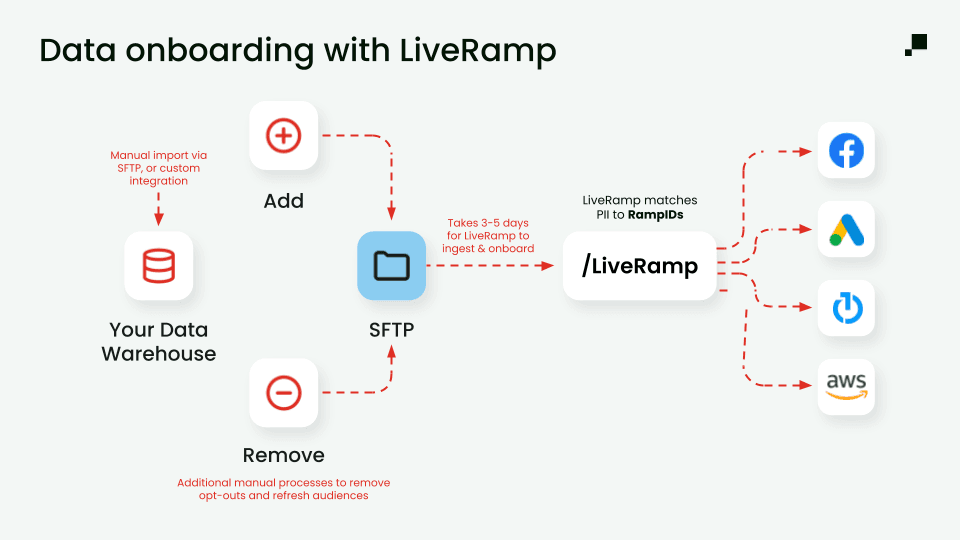
This approach yielded a working hypothesis. When activation relies on matching to RampIDs, LiveRamp's identity resolution acts as a filter before onboarding even begins. If a first-party identifier fails to match to a RampID, the audience record is dropped. The destination platform never gets the opportunity to match the audience member.
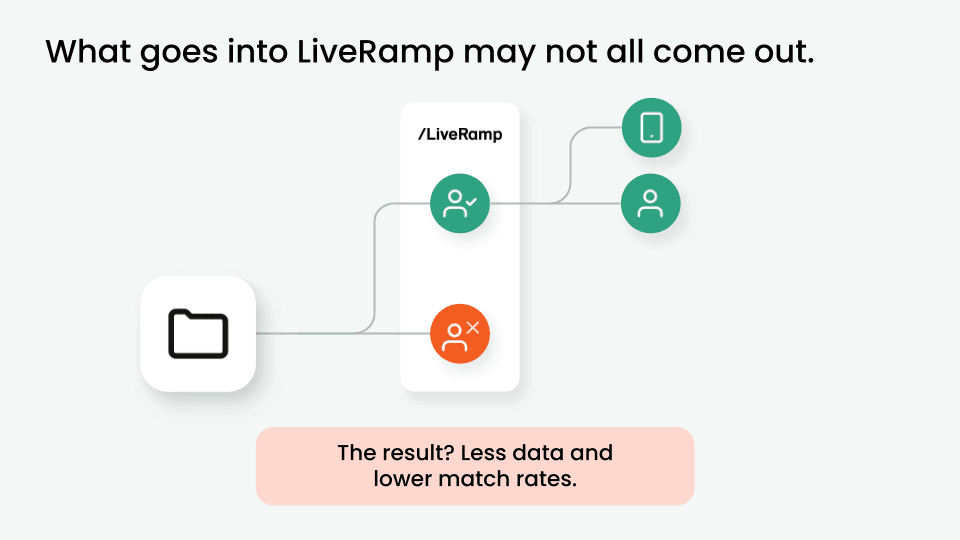
An email address that doesn't match to LiveRamp's graph may still be matchable directly on Meta, The Trade Desk, or Amazon, but only if it survives onboarding. When usable identity data is dropped, platforms receive fewer identifiers and lose the chance to match them.
The impact on media performance
This raises an important question. If companies pay LiveRamp to make more customers recognizable, what happens when onboarding fails to improve on, and sometimes underperforms, what first-party data achieves alone?
For marketers who fear that leaving LiveRamp means sacrificing performance, these results should change the calculation. Moving away from LiveRamp does not mean giving up reach. In many cases, making the move may actually improve performance if you find an alternative who makes full use of the customer data you already have.
“For brands with significant first-party data, this really isn’t just an identity problem—it’s a media performance issue. When onboarding drops signals that platforms could have matched, brands lose reach and waste media dollars before a campaign even begins.”

Rio Longacre
Partner and Managing Director of AdTech at Credera, Omnicom's Transformation Consultancy
No identifier left behind
Data onboarding itself isn't the problem. Applied correctly, third-party identifiers can meaningfully improve match rates.
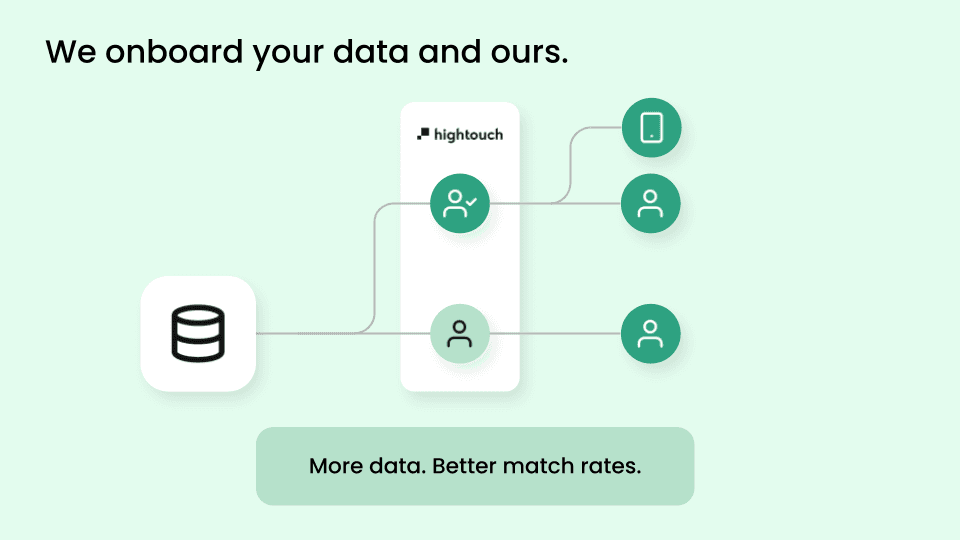
Effective data onboarding should preserve every first-party identifier a brand has, then layer on incremental third-party identifiers that create more chances for a match.
Hightouch's Match Booster puts that into practice. It keeps your first-party identifiers intact, then layers additional identifiers from Hightouch’s third-party identity graph on top before activation. If the graph can enhance a customer, great. If it can't, your original first-party identifiers are still delivered to the ad platform for a direct match.
“Hightouch helped pioneer the composable CDP by proving customer data doesn’t need to live in another packaged platform to be useful. Match Booster brings that principle to paid media: preserve the first-party signals you own, enrich where it adds value, and activate without losing data along the way.”
Rio Longacre
Partner and Managing Director of AdTech at Credera, Omnicom's Transformation Consultancy
Don't take our word for it
The best way to evaluate data onboarding is not to rely on a vendor’s claims, including ours. We recommend running a test to see what actually happens with your own audiences.
Send the same first-party audience to your most important ad platforms directly, and then through LiveRamp. Then, where the platform provides the appropriate tools, compare the resulting match rates and audience overlap. If a large percentage of the first-party audience doesn't show up in LiveRamp's audience, that tells you how much of your own data is being dropped (and how much potential reach you're losing).
When you're ready to take the test a step further, consider testing a product like Match Booster to see how much of an improvement you can get by combining your full first-party dataset with a modern data onboarding solution.
Hightouch runs these tests across major advertising platforms, allowing teams to evaluate match rates, activation speed, and operational effort using their own data. Ultimately, the data does the talking.
Ready to see the difference? Schedule a meeting to run a match rate test of your own.