Return-on-ad-spend (ROAS) is the north star for performance marketers. For years, improving it meant heavily orchestrating personalized experiences and making manual micro-adjustments to campaigns.
The model has changed. When performance marketers use signal engineering to feed the right audience guardrails and conversion events, the ad platforms can use AI to efficiently find the “right” people on their own. As a result, one of the biggest levers for performance marketing teams to focus on is creative velocity: the ability to quickly produce more on-brand creative for the algorithm to select and learn from.
Why is scaling creative velocity so important and so difficult?
Creative velocity comes down to three things: volume, variety, and freshness, each of which pose unique challenges for performance marketers today.
Volume: teams need more creative than the old process can support
Ad platforms need more creative than they did a few years ago. Only 6-7% of ad variants perform at scale, which means performance teams need enough assets in-market for the platform to test, compare, and learn from.
The problem is that most creative workflows were not designed for this pace. Today's workflow looks something like this:
- A marketer writes a brief.
- A designer or agency builds a handful of assets.
- The marketer uploads them.
- The team waits for performance to come in.
- The process starts again for the next campaign, product launch, audience, or seasonal push.
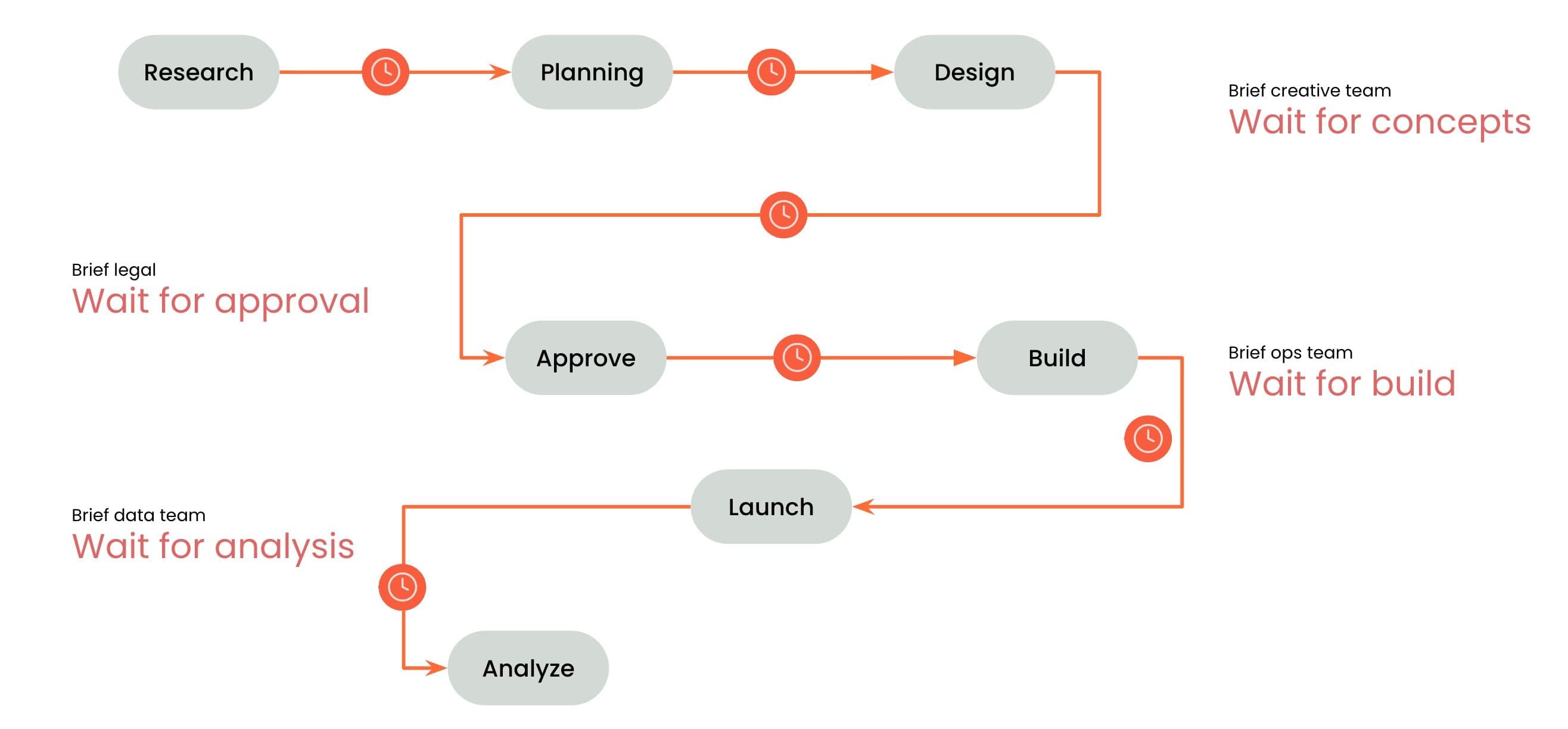
That can work when you need a handful of ads a month, but it fundamentally breaks when ad platforms need hundreds of assets.
Variety: creating more ads only helps when the ads are meaningfully different
Creating more assets does not automatically mean more winners. If the ads are just minor variations of the same idea, the platform does not have much new information to work with.
People buy the same product for different reasons. Take a running shoe. One buyer wants to run a faster 5K. Another wants something comfortable enough for long walks. Another cares about how it looks. Another is waiting for the right deal.
Good creative variety covers those different motivations. It also spans formats, hooks, offers, product angles, proof points, and visual approaches. The goal is not to create more versions of the same ad. The goal is to give the platform a broader map of reasons someone might buy.

This is where many teams get stuck. When the workflow can only produce a small set of polished assets per cycle, teams naturally prioritize the safest or most obvious ideas. That leaves potentially valuable angles unexplored.
You may have enough creative to launch, but not enough variety to learn what actually moves performance across different buyers.
Freshness: winning ads need a refresh loop
Even great ads have a shelf life.
People see the same creative repeatedly, and over time, ads start to lose effectiveness. After enough repeated exposure, even a winning ad will start to wear out.
When that happens, the answer is not to keep pushing the same asset. The better move is to replace it with something new that builds on what the winning ad taught you. That requires a constant refresh loop.

Most teams are still trying to manage fatigue through native ad platform alerts and dashboards. That might be workable with 20 live ads. It becomes unrealistic when a paid media program has hundreds of assets running at once.
At that scale, declining ads often stay active too long, leading to inefficient spend and dips in performance.
Agentic AI can solve the creative velocity challenges, but only if the quality is there
Agentic AI can significantly scale all three pillars for paid media teams. With agents, you can:
- Generate hundreds of diverse ads from a single prompt or brief
- Monitor every live ad for signs of fatigue and flag exactly which ones need refreshing
- Feed insights from competitor activity, first-party performance data, and broader trends into a prioritized queue of what to create next
But, there is a big catch: quality. Producing tons of low-quality ads doesn't move ROAS, and quality is exactly where most AI tools fall apart. Even the ad platforms themselves have struggled with this. Meta's own AI ad generation recently took a lot of heat for creating a blatantly incorrect ad for REI.
Some tools try to solve this by forcing everything through the same templates, with only minor variations allowed. That avoids obviously bad output, but it defeats the purpose: you lose the creative diversity that ad platforms demand.
Hightouch Ad Studio solves creative velocity without sacrificing quality
We built Ad Studio with creative velocity and quality in mind. The platform is built for the full performance marketing loop: measuring performance, ideating what to make next, generating creative, and launching to ad platforms. Performance data flows back into Hightouch, so every round of generation is stronger than the last.
With Ad Studio, you can improve all three pillars of creative velocity while maintaining high quality standards:
Volume: Generate as many ads as you need, starting from a data-backed insight in your customer data, a trend on TikTok, or an idea from your sales team.
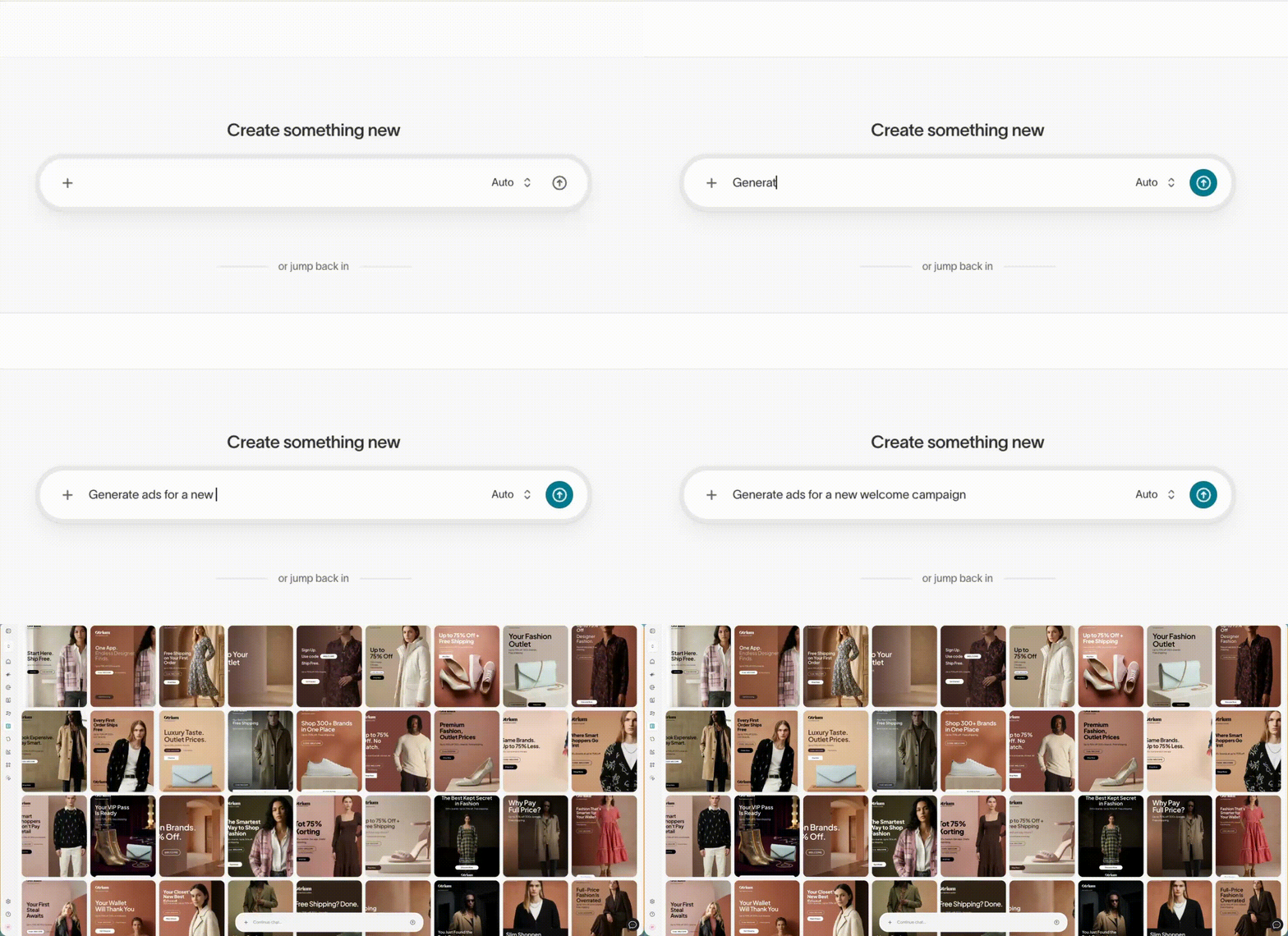
Variety: Instead of using templates that restrict creative diversity, your design team can create “Styles” for different brand directions–editorial vs. whimsical vs. aspirational, and so on. Users can generate high-quality, diverse ads across a range of looks that still adhere to your design guidelines.

Freshness: Ad Studio tracks each ad's performance curve, flags those that are fatiguing in an easy-to-use dashboard, and can create a fresh variation informed by what made the original work.

Composable context and embedded support ensure quality
When it comes to producing high-quality output, AI relies on context. Agents need as much information as possible to work well. We believe that composable context is the only approach that works for marketing because marketing context lives in so many different places.
Ad Studio can connect to your performance data in the data warehouse, your design system in Figma, and third-party sources, so every generated ad is built from your actual brand and data. Any other approach limits the context that agents can access because it takes time to upload every piece of data or creative inspiration. To ensure success, our forward-deployed creative team helps teams configure their context.
One of the benefits of this approach is the context becomes smarter over time and is useful beyond Ad Studio. As teams review creative, give feedback, approve ads, and learn what performs, Hightouch can turn those interactions into memory & learnings that other tools and agents can access through the MCP. So the value of composable context is not just that Ad Studio can pull from the right systems to create better ads, but that the learnings created in Hightouch can flow back into the rest of your AI stack.
Book a demo to learn more about Ad Studio today
Performance marketing has changed, and the most successful teams are leaning into agentic AI to meet the demands that ad platforms require.
Book a demo with our team to learn more about how Hightouch can help you scale creative velocity today.